
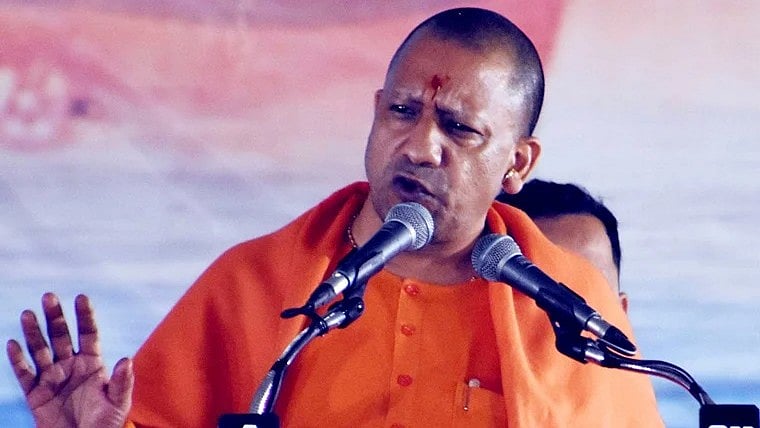
Ayodhya: “In Ayodhya, every particle exudes dignity, every lamp radiates compassion, and Lord Shri Ram dwells in every heart,” Chief Minister Yogi Adityanath said on Sunday during the coronation ceremony of Lord Ram at Ramkatha Park in Ayodhya Dham.
Recalling the origins of Diwali, the Chief Minister said that thousands of years ago, when the world was engulfed in darkness, Ayodhya illuminated itself with lamps to welcome its Lord, its God, its ideal, and its faith. “That divine celebration later became Diwali—the eternal symbol of Sanatan Dharma,” he noted.
CM Yogi added that to preserve this sacred tradition, the Deepotsav began in 2017 with the lighting of 1.71 lakh lamps. “Today, in its ninth edition, Ayodhya Dham shines with over 26 lakh lamps, while across Uttar Pradesh, a record 1 crore 51 lakh diyas illuminate the night—an expression of devotion, pride, and faith,” he said.
Before his address, the Chief Minister honored revered saints including Mahant Nritya Gopal Das Ji Maharaj, President of the Shri Ram Janmabhoomi Trust; Jagadguru Ramanujacharya Dr. Raghavacharya Ji Maharaj; Jagadguru Vasudevacharya Ji Vidya Bhaskar Ji Maharaj; Jagadguru Ramanujacharya Shri Dharacharya Ji Maharaj; Mahant Vishesh Prabanna Ji Maharaj; Mahant Suresh Das Ji Maharaj; Jagadguru Shri Ram Dinesh Acharya Ji Maharaj; Mahant Avdhesh Das Ji Maharaj; Mahant Devendra Prasadacharya Ji Maharaj; Mahant Rajkumar Das Ji Maharaj; Mahant Dharmdas Ji Maharaj; Dr. Ramvilas Vedanti Ji Maharaj; former MP Mahant Anantacharya Ji Maharaj; Mahant Ramanand Das Ji Maharaj; and Mahant Dr. Bharatdas Ji Maharaj, presenting them with garlands, robes, and mementos.

Addressing devotees at Ayodhya Dham, Chief Minister Yogi Adityanath said the countless lamps lit during Deepotsav are not mere symbols of festivity but reflections of the unwavering resolve of every Indian. “These lamps signify the victory of faith over five centuries of struggle and darkness, reminding us of the sacrifices, humiliation, and endurance of our ancestors,” he said.
The Chief Minister noted that once, the divine presence of Lord Shri Ram resided in a modest tent, but today, as Deepotsav marks its ninth year, he sits in his resplendent, eternal abode. “Every lamp tells the story that truth may be challenged, but it can never be defeated. Truth always prevails—just as Sanatan Dharma has endured through centuries. Ayodhya, the fulcrum of that struggle, now stands as the living symbol of that triumph, crowned by the grand and divine temple of Lord Shri Ram,” he said.
CM Yogi also reminded the gathering of the historical disregard shown by some political parties during the Ram Janmabhoomi movement. “In this very Ayodhya, there was a time when Lord Ram was called a myth in court. Those who once questioned His existence now seek to align themselves with faith,” he remarked, urging people to remember how India’s eternal beliefs were once disrespected.
Chief Minister Yogi Adityanath said that there was a time when some questioned the very existence of Lord Ram, even as they bowed before the graves of invaders, leaving no chance to demean the nation’s faith. “During the Ram Temple movement, they used every legal tool to obstruct the temple’s construction. But today, we can proudly say—they fired bullets, and we are lighting lamps in Ayodhya. They locked the temple, but with the blessings of saints, we have built a magnificent abode for Lord Shri Ram. This is the victory of devotion and the fulfilment of the resolve of Ram bhakts,” he said.
The Chief Minister added that those who once erased Ayodhya’s identity by renaming it Faizabad are the same forces that sought to suppress its spiritual legacy. “We have restored Ayodhya’s true identity, transforming it once again into Ayodhya Dham. This Deepotsav is living proof that no politics can imprison faith,” he declared.
CM Yogi further said that such elements continue to pursue a colonial policy of divide and rule to spread caste-based hatred and division. “For centuries, foreign invaders tried to desecrate India’s sacred soil. They broke temples, mocked symbols of faith, and wounded the nation’s spirit. Yet, faith never faltered—it remained steadfast, unbroken, and eternal,” he affirmed.
The Chief Minister noted that Ayodhya today stands not only as a center of faith but also as a major global tourism destination. “Some people are still trying to recreate the conditions of subjugation,” he warned. “But this new India, united as Ek Bharat, Shreshtha Bharat, is both developing and preserving its civilizational heritage.”
He emphasized that Ayodhya is being developed on multiple themes, as a capable, clean, healthy, cultural, modern, and emotional city. “Today, Ayodhya reflects the faith of the entire nation and the world. Devotees from every corner of India, from Kashmir to Kanyakumari, Kohima to Kutch, arrive here with reverence. Wherever Sanatan Dharma exists, devotees are coming to Ayodhya with pride to witness this global spiritual capital,” he said.
He added that some people, for political gain, had once created an identity crisis for Ayodhya. “But that crisis is over. Ayodhya today is both a sacred center of faith and a prominent global tourist destination,” he said.
Recalling the transformation, the Chief Minister said that Ayodhya was once neglected, chaotic, and unclean when only a few thousand devotees visited annually. “Today, between six and ten crore devotees visit Ayodhya Dham every year,” he noted. “This Ayodhya has been developed in accordance with the vision of Prime Minister Narendra Modi to make it the global spiritual capital and the faith capital of India.”
He reflected that when India gained independence in 1947, every citizen hoped that freedom would mean liberation from all forms of slavery, political, cultural, and spiritual, and the revival of our ancient values. “Yet Ayodhya continued to be neglected,” he said. “In 1949, when devotees sought to enshrine Ram Lalla in His rightful temple, an order was issued to remove the idol. But devotees stood firm, declaring that no power on earth could displace Lord Ram from His birthplace. Their unwavering resolve remained: ‘Ram Lalla hum aayenge, mandir wahin banayenge.’”
He said that from 1950 to 1986, the temple remained locked, an attempt to imprison Lord Ram in his own home. “The perseverance of Sanatan Dharma has defeated those who worked to confine faith within locks,” the Chief Minister said. “Despite every attempt to suppress it, our faith continued its struggle, relentless, fearless, and undeterred. Ultimately, truth triumphed, and justice paved the way for the establishment of Dharma in Ayodhya.”
Today, as Lord Ram Lalla sits enthroned in His divine and magnificent temple, every follower of Sanatan Dharma, across India and the world, feels an overwhelming sense of pride and joy. It is a moment of fulfilment, as the centuries-old resolve of our ancestors has finally been realised.
Chief Minister Yogi Adityanath said that Prime Minister Narendra Modi has etched an unparalleled chapter in history, becoming the first Prime Minister to visit Ayodhya and lay the foundation stone of the Shri Ram Janmabhoomi Temple. He is also the first to visit every sacred site associated with Lord Ram across the country. On January 22, 2024, he bestowed the highest honor upon the Sanatan faith by presiding over the Pran Pratishtha of Lord Shri Ram in Ayodhya. This moment, the Chief Minister said, symbolizes the culmination of a sacred journey and the steadfast realization of principles deeply rooted in India’s civilizational ethos.
CM Yogi added that the essence of Ram Rajya lies in the ideal, “Nahi daridra kohu dukhi na deena, nahi koi abodh na lakshan heena” Inspired by this vision, the double-engine government is ensuring that the benefits of development reach every needy person. Every poor family now has a toilet, a roof over their head, a cooking gas connection under Ujjwala Yojana, and ₹5 lakh health insurance under Ayushman Bharat. During the COVID-19 pandemic, free rations were provided to 80 crore citizens.
Today, unemployed youth are being empowered with jobs, farmers are receiving irrigation facilities, quality seeds, and assured markets for their produce. Through his call for Swadeshi, Prime Minister Modi has restored dignity to Indian artisans and workers, aligning every citizen with the vision of a self-reliant, developed India. “This,” CM Yogi said, “is the true manifestation of Ram Rajya, where poverty, sorrow, and ignorance have no place, and where divine, material, and social development move hand in hand. This is the new India, the new Uttar Pradesh, where the ideals of Lord Ram are becoming reality.”
The Chief Minister said that Uttar Pradesh has today emerged as a model of law, order, and security. Before 2017, festivals often brought tension and fear, but after adopting the ideals of Lord Ram, the state now celebrates every festival with harmony and joy. “Today, Uttar Pradesh is free from hooliganism and mafia rule,” he said. “According to NCRB data, the state now ranks among those with the lowest crime rates in the country. The rule of law prevails, the poor are respected, farmers are prospering, women are safe, and the youth have opportunities. Every village has electricity, and every heart is filled with pride and new hope.”
He said Ayodhya today stands as a symbol of both spiritual grandeur and modern development, where devotion and progress walk hand in hand. Statues of three revered South Indian saints—Tyagaraja, Purandara Das, and Maha Swami Arunachal Kavi, who dedicated their lives to Lord Ram between the 13th and 18th centuries—have been installed near Brihaspati Kund. Earlier, a grand memorial to legendary singer Lata Mangeshkar, whose voice immortalized the hymns of Lord Ram, was inaugurated at Ramghat Square, now a prominent pilgrimage and photo destination.

Around the Shri Ram Janmabhoomi complex, statues of Jagadguru Shankaracharya, Jagadguru Ramanujacharya, Jagadguru Ramanandacharya, and Jagadguru Nimbarkacharya have been installed, honoring the great acharyas of Sanatan Dharma. “In Ayodhya,” CM Yogi said, “the memories of Nishad Raj, Mata Ahalya, and Mata Shabari continue to inspire us. We also remember Jatayu, the first martyr of the Ramayana era, and the humble squirrel whose devotion to the Ram Setu teaches that every effort—big or small—is sacred when done in service of Dharma.”
He added that even within the Ram Janmabhoomi complex, a statue of the squirrel has been installed to symbolize that in building a divine nation, every hand, every heart, and every act of devotion has meaning.

