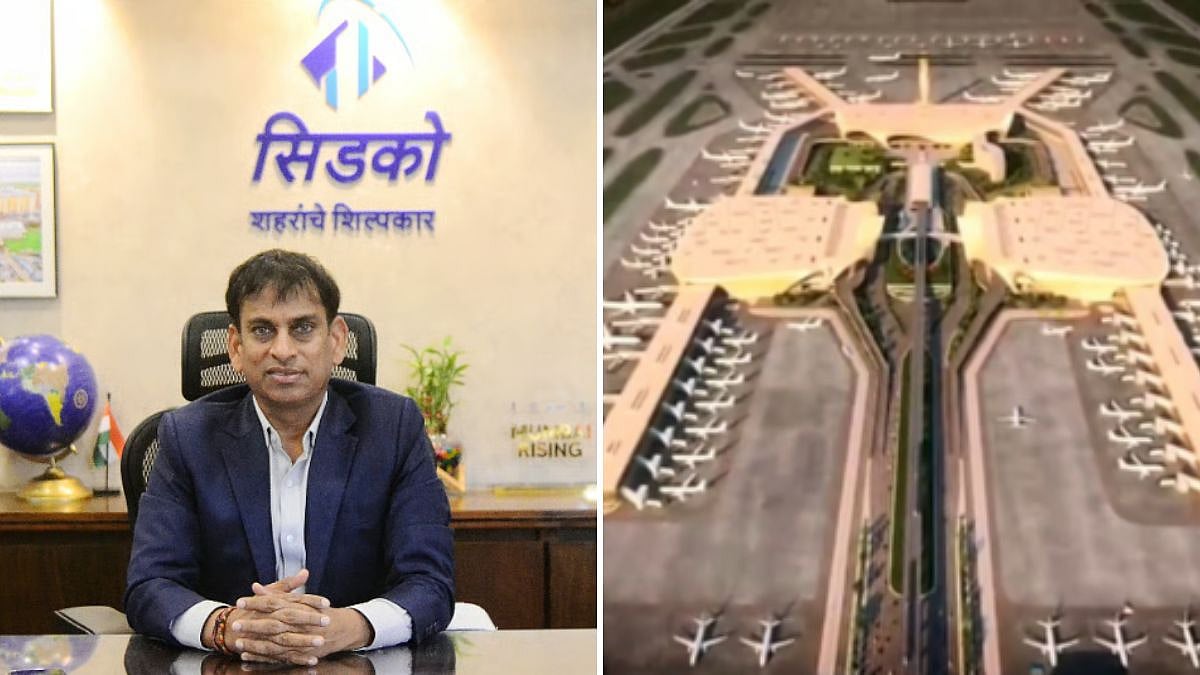
Navi Mumbai, Dec 23: As the ambitious Navi Mumbai International Airport (NMIA) prepares to commence operations from December 25, The Free Press Journal had an exclusive interaction with City and Industrial Development Corporation (CIDCO) Managing Director and Vice Chairman Vijay Singhal.
Conceived in 1997, NMIA’s journey has spanned nearly three decades, overcoming multiple challenges before reaching a historic milestone with its inauguration on October 8. The airport has been developed under a public-private partnership (PPP) between CIDCO and Adani Airport Holdings Ltd (AAHL), with equity stakes of 26 per cent and 74 per cent respectively.
As the nodal agency and project facilitator, CIDCO was responsible for planning, land acquisition, rehabilitation and pre-development works under the state government, while AAHL oversees the airport’s development and operations.
Photo Credits: Farooq Sayed
How does it feel to have the airport finally operational during your tenure?
It is truly a dream come true for all of us. This achievement reflects three decades of collective teamwork, with the biggest contribution coming from the Project Affected People (PAPs), who gave their land to CIDCO for this landmark project. On the very first day, the airport will witness air traffic movement of 30 flights.
How significant is this moment for Maharashtra?
The commencement of operations at Navi Mumbai International Airport marks the culmination of a long-cherished dream. It reflects CIDCO’s sustained commitment to world-class infrastructure development. This airport symbolises futuristic planning, inclusive growth and global connectivity, and is a proud achievement for every citizen who believed in and supported this vision over the years.
What makes NMIA CIDCO’s most ambitious project till date?
NMIA is CIDCO’s most ambitious project because it represents decades of meticulous planning, extensive inter-agency coordination and engineering excellence. From concept to commissioning, it has been envisioned as a world-class greenfield airport. The scale, complexity, sustainability focus and long-term impact make it unparalleled in CIDCO’s journey.

With NMIA, Mumbai becomes the only metropolitan city in the country to have two international airports, placing it in the league of cities such as London, New York, Tokyo and Moscow. Notably, operations are beginning within two months of inauguration after completing security sweeps and other mandatory procedures.
How will the commencement of NMIA operations benefit the Mumbai Metropolitan Region?
The operationalisation of NMIA will significantly ease congestion at Mumbai’s existing airport and establish a robust multi-airport system for the Mumbai Metropolitan Region. It will improve passenger experience, enhance operational efficiency and cater to the region’s growing aviation demand.
How will NMIA impact the lives of Navi Mumbai residents and people from surrounding regions?
For residents of Navi Mumbai, NMIA brings unparalleled convenience, reduced travel time and enhanced global connectivity. People from Pune, Thane, Panvel, Raigad and the Konkan region will benefit from faster and more efficient access to domestic and international air travel. Beyond mobility, the airport is expected to generate employment, boost tourism and attract large-scale investments across the region.

How will connectivity to NMIA be managed?
Seamless multimodal connectivity has been a cornerstone of NMIA’s planning. The airport is well connected through expressways, arterial roads, suburban rail, metro corridors and upcoming mass transit systems.
Strategic links such as the Mumbai Trans Harbour Link, national highways and dedicated airport approach roads will ensure excellent last-mile connectivity, making NMIA one of the most accessible airports in the country. Google Maps of the routes currently accessible have been updated.
Looking ahead, the Ulwe Coastal Road—70 per cent complete—will reduce travel time from the Eastern Express Highway to just 25 minutes. Targhar and Gavhan railway stations, along with the Nerul Jetty, have also been made operational ahead of NMIA’s launch.
Metro Line 8, also known as the Golden Line, is in the pipeline, pending final approval, and will connect both Mumbai and Navi Mumbai airports. This line will interlink with Metro Lines 2, 7B, 12, 4, 1 and the Aqua Line. Additionally, a water taxi service from Targhar connecting Colaba, Radio Club and Mandwa is planned.

How do you see NMIA shaping India’s aviation future?
With its state-of-the-art facilities, sustainability-driven design and future-ready capacity, Navi Mumbai International Airport is set to redefine India’s aviation landscape. It will emerge as a new gateway to the nation and serve as a benchmark for modern aviation infrastructure, reflecting India’s aspirations on the global stage. This airport is truly a New Year gift to the nation.
What are CIDCO’s plans for 2026?
The Navi Mumbai Airport Influence Notified Area (NAINA) will be our next major focus, along with the development of areas surrounding NMIA, including Aerocity, Medicity, Educity, Sports City, Corporate Park and an Integrated Logistics Park. Most importantly, our goal is to strengthen public trust and reinforce the belief that every CIDCO project will be completed successfully—just like NMIA.
Air traffic movement at NMIA on December 25
Total Air Traffic Movements (ATMs): 30
Arrivals: 15
Departures: 15

Airline-wise operations:
IndiGo: 9 arrivals and 9 departures
Air India Express: 2 arrivals and 2 departures
Akasa Air: 2 arrivals and 2 departures
Star Air: 2 arrivals and 2 departures
First arrival: IndiGo flight 6E460 from Bengaluru at 0800 hrs
First departure: IndiGo flight 6E882 to Hyderabad at 0840 hrs
Last arrival: IndiGo flight 6E2055 from Goa (MOPA) at 1850 hrs
Last departure: IndiGo flight 6E461 to Bengaluru at 1945 hrs
Chronology of Key Approvals and Milestones of Navi Mumbai International Airport (NMIA)
November 1997: Ministry of Civil Aviation (MoCA), Government of India, constituted a committee to examine sites for a second airport for Mumbai.
September 2000: CIDCO / Government of Maharashtra (GoM) revised the proposal to a two-runway international airport and submitted a feasibility report to MoCA.

November 2000: Airports Authority of India (AAI) sub-committee examined the Navi Mumbai site, found it technically and operationally feasible, and recommended a detailed Techno-Economic Feasibility Study (TEFS).
September 2001: CIDCO submitted TEFS to AAI; after clarifications, AAI recommended a simulation study to assess interoperability of Mumbai and Navi Mumbai airports in shared airspace.
August 2006: International Civil Aviation Organization (ICAO) conducted the simulation study jointly sponsored by CIDCO, GoM and AAI, confirming feasibility of simultaneous operations.
February 2007: CIDCO submitted the Project Feasibility and Business Plan Report to MoCA.
July 2007: Union Cabinet granted in-principle approval for development of a greenfield international airport at Navi Mumbai; MoCA constituted a Steering Committee for project implementation.

March 2008: CIDCO appointed a consortium led by Louis Berger Group (USA) as Prime Consultant for airport development.
July 2008: GoM approved development of NMIA on a PPP basis and designated CIDCO as the nodal agency.
May 2009: Ministry of Environment and Forests (MoEF) amended CRZ Notification, permitting the airport in CRZ areas with safeguards.
October 2010: Ministry of Defence granted defence clearance to the NMIA project.
November 2010: Environmental and CRZ clearances accorded by MoEF.
April 2017: Pre-development works commenced on the core airport area.
October 2017: State Cabinet approved MIAL as the selected bidder; Letter of Award issued.
January 2018: Concession Agreement signed.

February 2018: Land development works awarded by CIDCO and novated to the concessionaire.
July 2021: Cabinet approved change in ownership of NMIAL following acquisition of MIAL shares by the Adani Group.
August 2021: EPC contractor Larsen & Toubro commenced construction work at the NMIA site.
March 2022: Financial closure achieved by the concessionaire.
October 2024: Indian Air Force C-295 aircraft carried out the inaugural landing at NMIA.
December 2024: IndiGo operated the first commercial aircraft landing at NMIA.
Also Watch:

October 2025: Navi Mumbai International Airport inaugurated by the Prime Minister of India.
To get details on exclusive and budget-friendly property deals in Mumbai & surrounding regions, do visit: https://budgetproperties.in/

