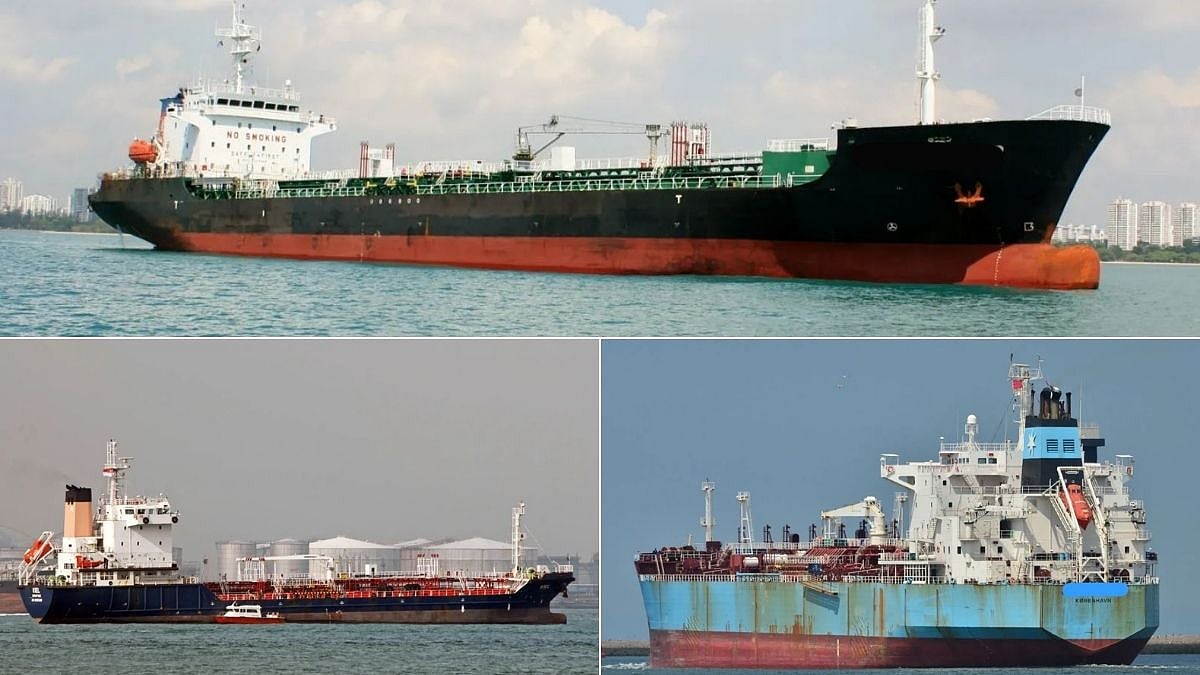
Mumbai, Feb 10: A 90-member team comprising officers from the Indian Coast Guard (ICG), Intelligence Bureau, and other agencies is interrogating 55 individuals aboard three vessels for their alleged involvement in oil smuggling. Most of those being questioned are Indian nationals, with one Sri Lankan among them.
The ICG intercepted and detained three sanctioned oil tankers in the Arabian Sea on February 5. The vessels, reportedly part of an Iran-linked “shadow fleet,” were located about 100 nautical miles west of Mumbai while allegedly engaged in the illicit transfer of oil cargo within India’s maritime jurisdiction. Following the operation, the tankers were moved under heavy escort and anchored approximately 25 nautical miles offshore, as the crew’s suspected involvement in the crime and the ongoing investigation prevented their entry into Mumbai port, an ICG official told FPJ on Tuesday.
Authorities said the tankers are on international sanctions lists and are suspected to be part of a network transporting Iranian crude to global markets. The detained vessels have been identified as Asphalt Star, Stellar Ruby, and Al Jafzia (formerly Chiltern), all listed under U.S. sanctions. According to consultancy reports, the tankers’ details are:
● Al Jafzia (IMO 9171498; ex-Chiltern) – broadcasting a Nicaraguan flag, previously false-flagged in Guyana
● Asphalt Star (IMO 9463528) – falsely broadcasting a Malian flag, formerly false-flagged in Aruba
● Stellar Ruby (IMO 9555199) – flagged in Iran
Officials said the vessels are part of a notorious “dark fleet” known for frequently changing names, identities, and registrations to evade global maritime law enforcement. Initial investigations suggest the syndicate employed mid-sea, ship-to-ship transfers in international waters to move large volumes of crude from conflict-ridden regions in Iran, avoiding customs duties and regulatory oversight in coastal states like India.
A joint multi-agency task force, comprising the Coast Guard, Naval Intelligence, Intelligence Bureau (IB), Department of Revenue Intelligence (DRI), and Customs authorities, has been formed to probe the vessels’ operations. The team is examining cargo, ownership records, and operational networks with the aim of dismantling the smuggling syndicate and ensuring compliance with both national and international maritime laws. Officials said the movement of these sanctioned tankers has been under surveillance since the second week of December, when they departed from the UAE.
According to the officials the ship tracking system showed that en route to the UAE the ships halted for a day in Pakistan maritime zone before moving to Indian territory and possibly supplied crude oil to a smuggling syndicate in Pakistan. AIS data (Automatic Identification System – the ship tracking system) provided by Pole Star Global reveals that these three vessels were navigating in a highly complex and coordinated manner. The ships frequently met at different locations and then separated, forming a network that connected Iranian oil transfer regions to ports on India’s west coast.
The main transfer areas are Basrah (Iraq) and Khor Fakkan (United Arab Emirates). The vessels were transporting oil from these regions to ports in India.
In the Iranian oil trade, AIS signal manipulation—known as “spoofing”—is often used. This means the ships disguise their actual location and activities, making it appear as if they are on ordinary commercial voyages, while in reality they are involved in Iran-linked illicit or sanctioned oil transactions.
Also Watch:
Thus, these vessel movements form a hidden network that facilitates the transport of oil from Iran to other countries’ ports, while outwardly appearing to be normal commercial activity.
To get details on exclusive and budget-friendly property deals in Mumbai & surrounding regions, do visit: https://budgetproperties.in/

