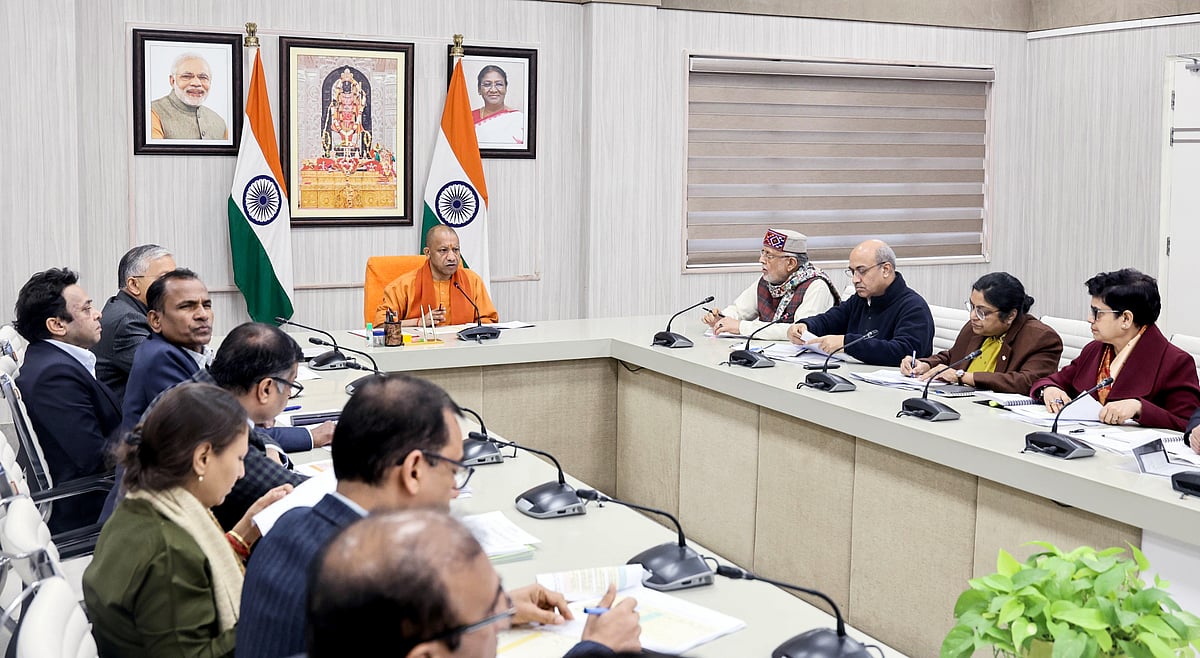
Lucknow: Poverty eradication in Uttar Pradesh has moved beyond policy intent to measurable action. Under the leadership of Chief Minister Yogi Adityanath, the state’s Zero Poverty Mission has emerged as a results-driven governance model, combining administrative resolve, technology-enabled delivery and rigorous ground-level verification. The mission is anchored in a clear objective: ensuring that every eligible family is brought within the ambit of government welfare schemes.
The comprehensive exercise conducted in two phases demonstrates that the Yogi government is focusing not on numerical targets alone, but on eligibility, transparency and measurable outcomes. Residents of Gosaiganj in Lucknow — Ramsagar, Urmila and Ramu — stand as living examples of this initiative. Under the mission, they have been provided with housing, drinking water, roads, electricity, ration and other essential facilities.
Under the Zero Poverty Mission, deprived families of Ramsagar, Urmila and Ramu in Gosaiyaganj, Lucknow, are being provided with basic amenities including housing, water supply, roads, electricity and food security. Similarly, across the state, marginalized households are being identified and connected to various government schemes.
Beneficiaries consistently express appreciation for the initiative, stating that the Zero Poverty Mission goes beyond financial assistance. It represents a comprehensive approach encompassing food security, healthcare, housing, education, water, energy and livelihood opportunities. This campaign marks a decisive step toward positioning Uttar Pradesh as a national model of inclusive development and social security.
In the first phase of the Zero Poverty Mission, the state set a target of achieving 100 percent Direct Benefit Transfer (DBT) coverage for eligible families under eight major welfare schemes. District-level reports indicate that benefits under the ration scheme have reached 97 percent of eligible households, a significant achievement in ensuring food security.
Coverage under the Destitute Women Pension Scheme has reached 87 percent, while 62 percent of eligible beneficiaries have been covered under the Disability Pension Scheme. Additionally, 63 percent of eligible families have been provided health security under the PM/CM Jan Arogya Scheme.
Verification of eligibility criteria, identification of duplicate entries and data cleansing are being carried out at a rapid pace for the Old Age Pension Scheme, BOCW Labour Card, PM Kisan Samman Nidhi, and PM/CM Housing Schemes. The government has made it clear that every deserving beneficiary must be included under welfare schemes under all circumstances.
The second phase, launched on October 15, 2025, focuses on door-to-door verification across 16 welfare schemes and is scheduled for completion by January 15' 2026. This phase emphasizes inclusion under essential services such as PM Ujjwala Yojana, sanitation assistance, Jal Jeevan Mission and electricity connections.
Based on findings from the survey, large numbers of women are being prepared to be linked with Self-Help Groups under the Livelihood Mission. In the education sector, the process to bring nearly 11,000 children back into the formal education system through re-enrolment has already begun.
The Yogi government has established the Chief Minister Helpline 1076 as a strong tool for reviewing welfare schemes. Analysis of grievances and suggestions received through the helpline is being used to ensure that policies align with ground realities and that no eligible family is left behin

