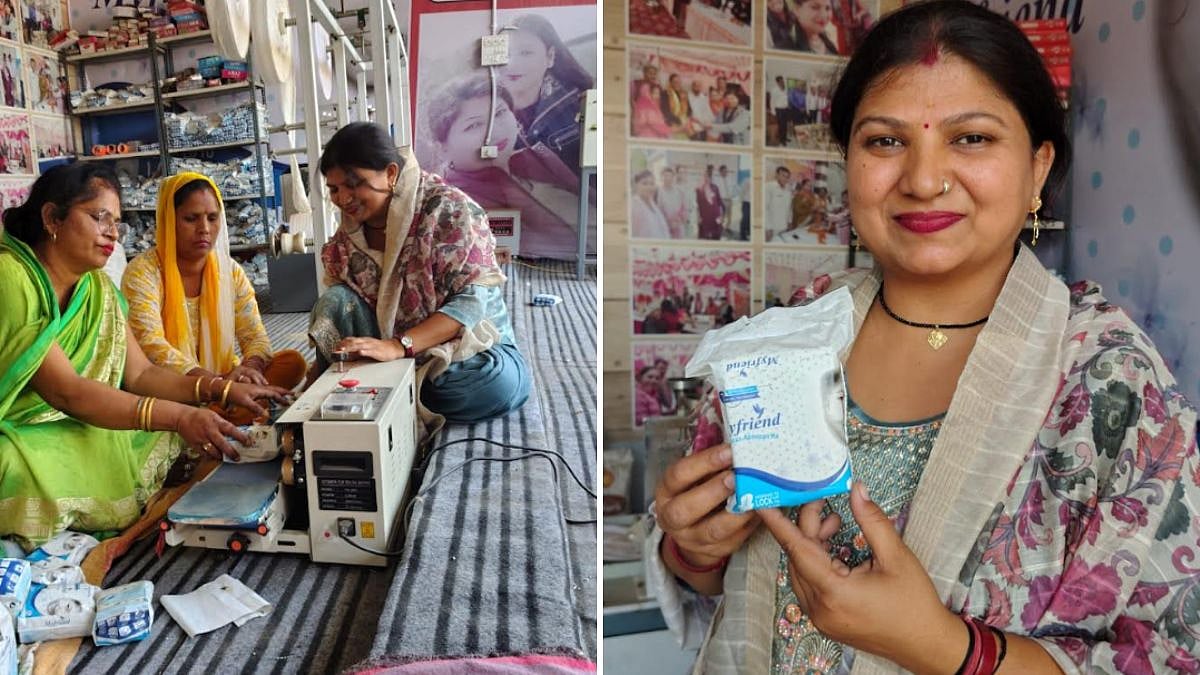
Haridwar: The women who work inside the small sanitary pad unit in Kurdi village still hesitate before saying the word. Some smile and lower their voices. Others glance toward the door first. The habit is old and deeply set — the reflex of a community that has spent generations treating a basic biological function as something between a secret and a shame.
Nitin Saini, known as Neetu, does not hesitate. She is thirty-eight years old, runs the unit out of a rented room in Haridwar district, and says the word the way you say any other word: plainly, without apology, because it is the correct word for the thing she is describing.
"Why should women feel ashamed about something their bodies naturally go through?" she asked, checking packets moving through a semi-automatic machine while two employees worked beside her.
It has taken her years to say that aloud. It has taken her everything she had.
The Child Bride
The year was 2010. Neetu's family had moved to Haridwar from Kairana in western Uttar Pradesh, displaced by communal tensions and the fear that follows when local gang networks begin to set the terms of daily life. She arrived in her husband's household already carrying what that world had given her: married at fifteen, educated until Class 9, and fluent in the grammar of what women in her position were expected to do.
Cook. Clean. Raise children. Stay within limits.
By seventeen she was a mother. Soon there were three children. Her education was a closed chapter — not discussed, not regretted aloud, simply done with.
"I was told women do not need too much education," she said. "Whenever I asked for money for my studies, or for better schooling for my children, the answer was that government schools were enough. Especially for girls."
But the desire did not close with the chapter. Every morning she watched children walk past her door carrying school bags. She watched them the way you watch something that was yours and then wasn't.
"I used to feel bad," she said. "Thinking that my studies ended before I could even complete school."
When she decided to appear for her Class 10 examination as a private candidate, the resistance at home sharpened quickly. Her husband said he would not spend money on it. If she wanted to study, she could manage it herself. And the examination centre, he insisted, should be far from the village. He did not want people to know.
To fill the examination forms, Neetu travelled nearly 40 kilometres to Hadipur alone, where a relative helped her complete the paperwork. Her husband did not accompany her. On the nights between those journeys, after dinner was cooked and her children were asleep, she studied under a dim bulb.

"There were moments when I thought of giving up," she said. "Sometimes I would wonder if everybody around me was right and I was doing something wrong."
In 2017, she passed her matriculation. In 2025, she completed a postgraduate degree in Sociology from Hemvati Nandan Bahuguna Garhwal University.
Between those years, she built something.
Struggle begins
In 2018, Neetu joined Disha, a grassroots organisation working with women's self-help groups — first as a member, then as a Community Resource Person. She travelled from village to village, meeting women whose lives resembled hers closely enough to be mirrors. Most had left school early. Few handled money themselves. Most needed permission to step outside their homes.
For a time she worked with a microfinance company and earned nearly Rs 22,000 a month. The money was real but the work troubled her.
"The pressure on poor women to repay loans was enormous," she said. "I realised money alone cannot change women's lives if they still have no dignity or decision-making power."
She left.
The turning point came during an exposure visit to a sanitary pad manufacturing unit in Dakrani village in Himachal Pradesh. The women there were not shy about what the products were for. They spoke about menstruation the way they spoke about farming or rainfall — as a fact that shaped their lives and needed managing. But they complained that the pads were poor quality. That they leaked during long hours of farm work. That they were not made for women who moved.
Neetu came home to Kurdi and could not stop thinking about that conversation.
In rural Uttarakhand and the districts of Uttar Pradesh she knew well, menstruation was still managed in silence. Women dried reused cloth secretly, behind closed doors. Girls missed school during their periods because they had no reliable protection and nowhere to speak about it. Buying sanitary pads from a male shopkeeper felt humiliating enough that many simply did not.

"Even saying the word was uncomfortable," said Sunita Devi, an ASHA worker from the area. "Women used old cloth for years because they felt shy discussing periods. Infections were common, but very few sought treatment."
When Neetu told people in the village she wanted to manufacture sanitary pads, they laughed.
"People asked if there was no other business left," she recalled. "Even women giggled during meetings whenever I discussed menstrual hygiene."
Her own children felt embarrassed. "My daughter and sons would ask, why are you doing this work? People are talking about us. Cannot you do something else?" She smiled when she said it — the smile of someone for whom that question has become, in hindsight, almost charming.
She had already crossed too many doors to turn back from one more.
Using a loan arranged through the NGO network, she travelled alone to Delhi to source raw materials. For a woman who had once needed to travel 40 kms in secret to fill an examination form, navigating the crowded wholesale markets of a strange city was the same kind of crossing — the same refusal to accept that the world on the other side of a door was not hers.
She named her brand `My Friend’.
She chose that name because she knew what it meant to not have one.
The business
The business is not large. It has never competed with the major sanitary pad brands on price or distribution. Sales are modest. Profits are limited. But the unit now employs three women from Kurdi, each earning around Rs 7,000 a month — enough, in a village economy, to mean the difference between asking and deciding.
"Earlier I had to ask my husband even for small expenses," said Pooja, one of the employees. "Now I can contribute to my children's education myself."
Rekha, another local woman, buys the pads for herself. "The quality is good and we can speak directly to her if there is any problem," she said. "Earlier we bought whatever the shopkeeper gave us."
Under the Prime Minister's Employment Generation Programme, Neetu secured support for a semi-automatic machine worth Rs 6 lakh. Women from self-help groups across the district — some travelling from as far as Saharanpur — now visit the unit for training. What they learn there is not only how to operate a machine or handle packaging. They learn the vocabulary. They sit together and say the words that, before they arrived, they lowered their voices to avoid.
Alka Singh had never worked outside her home before the unit opened. "Earlier we depended on others for everything," she said. "Now at least we know we can earn with our own skills." She said it while folding packets, without looking up, the way you say something that has quietly become true.
Sunita Devi has watched the change from her position as an ASHA worker, visiting homes across the area. "Girls are becoming more aware," she said. "Many who were previously using unsafe methods have shifted. But the biggest change is that mothers and daughters are talking more openly."

While menstrual hygiene awareness has improved in Uttarakhand over the past decade, challenges persist in rural areas. According to the National Family Health Survey (NFHS-5), around 62 per cent of young women aged 15-24 in rural Uttarakhand use hygienic menstrual protection, slightly above the national average of 58 per cent. However, access remains uneven due to inconsistent product availability, affordability and the growing challenge of disposing plastic menstrual waste in the fragile Himalayan ecosystem.
To improve access, the state government supplies sanitary napkins to adolescent girls aged 10 to 19 through Accredited Social Health Activists (ASHAs) at a highly subsidised price of Rs 6 per pack. District administrations have also introduced sanitary pad vending machines and incinerators in girls' schools, particularly in remote districts such as Chamoli, to encourage menstrual hygiene and reduce absenteeism during periods. More recently, Uttarkashi district directed the installation of vending machines and incinerators in women's toilets at government offices and public places, while instructing departments to ensure the machines remain functional and adequately stocked with sanitary pads.
Yet, health workers say affordability is only one part of the challenge. "The government-supplied sanitary pads are useful, but many adolescent girls complain that they leak during heavy menstrual flow," said an ASHA worker involved in menstrual health awareness in the area. "Many are now looking for safer and better-quality alternatives, but cost remains a major concern." It is this gap between availability and usability that entrepreneurs like Neetu are trying to bridge by manufacturing affordable sanitary pads locally while also encouraging women to speak openly about menstrual health.
Neetu is now an elected ward member in the Gram Panchayat. She has a postgraduate degree. She runs a business that employs women and trains more. Outside the unit, packets of `My Friend’ are stacked against a wall, waiting to be distributed to nearby villages.
None of this is what the village expected from her.
She was asked what she considers her greatest achievement. Not the degree, not the panchayat seat, not the machine — she gestured toward something smaller and harder to measure.
"The biggest satisfaction," she said, "is that my daughter never had to ask permission to study."
