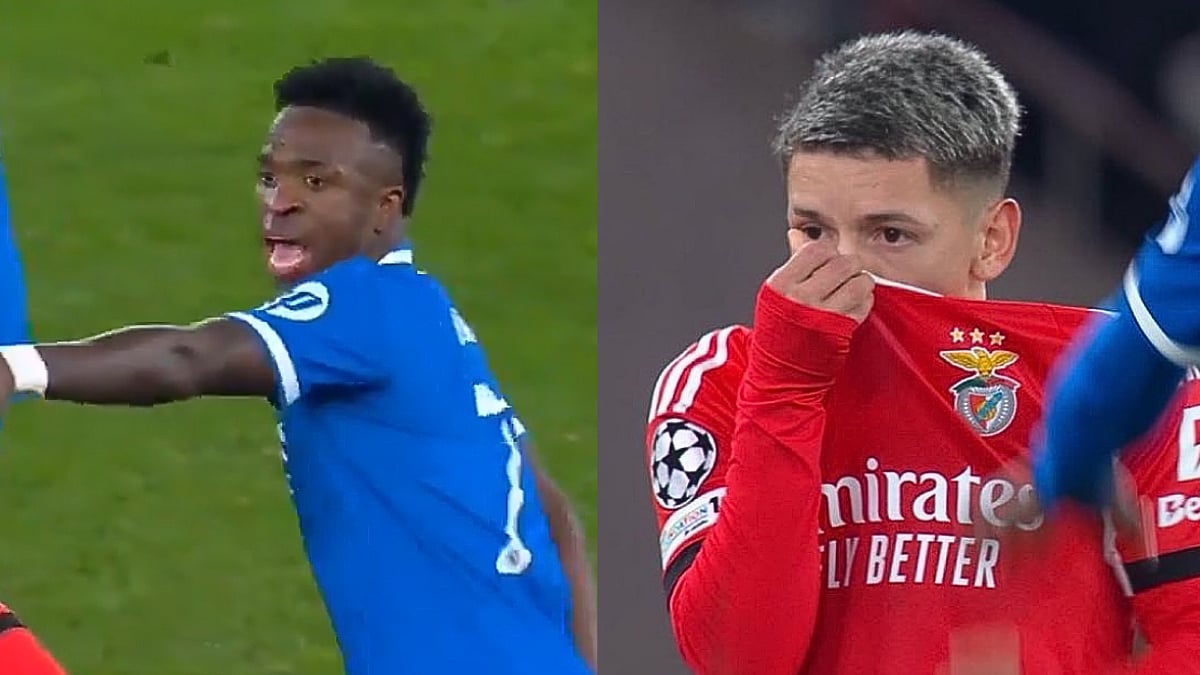
In a highly charged UEFA Champions League first-leg playoff clash on Tuesday at the Estadio da Luz in Lisbon, the match between Real Madrid and Benfica was temporarily stopped after Real Madrid’s Brazilian forward Vinicius Junior accused a Benfica opponent of racially insulting him. The interruption came shortly after Vinicius had scored the game’s only goal in a 1-0 win for the Spanish club.
The Brazilian winger had given Real Madrid the lead in the second half with a superb curling strike into the top corner. Moments later, he was confronted by Benfica’s Argentine attacker Gianluca Prestianni, who approached Vinicius while covering his mouth with his shirt. Vinicius then ran to talk to French referee Francois Letexier, who immediately stopped the game and activated FIFA’s anti-racism protocol, a signal made by crossing his arms above his head, leading to a stoppage of roughly 10 to 11 minutes.
According to television footage and reports, Vinicius told the referee that Prestianni had called him a “monkey,” a racist slur that has deep historical and cultural weight in sport and society. While there was no clear audio evidence to confirm exactly what Prestianni said, he had his shirt covering his mouth, several Real Madrid players close by supported Vinicius’ claim, saying they heard something “very ugly.”
During the stoppage, Vinicius appeared visibly upset and sat on the Real Madrid bench; some teammates even considered leaving the field in protest, according to reports. Kylian Mbappe and midfielder Aurelien Tchouameni were among those who spoke with him during the pause.
The aftermath post incident
After the restart, the incident continued to overshadow the match. Benfica fans jeered Vinicius whenever he touched the ball for the remainder of the game and even threw bottles and other objects onto the pitch in the final minutes, which the referee addressed via stadium announcements.
The fixture ultimately finished 1-0 to Real Madrid, who will take that slim advantage back to Spain for the second leg. But the incident has reignited a broader conversation about racism in football and the effectiveness of protocols aimed at protecting players from abuse on and off the pitch.

