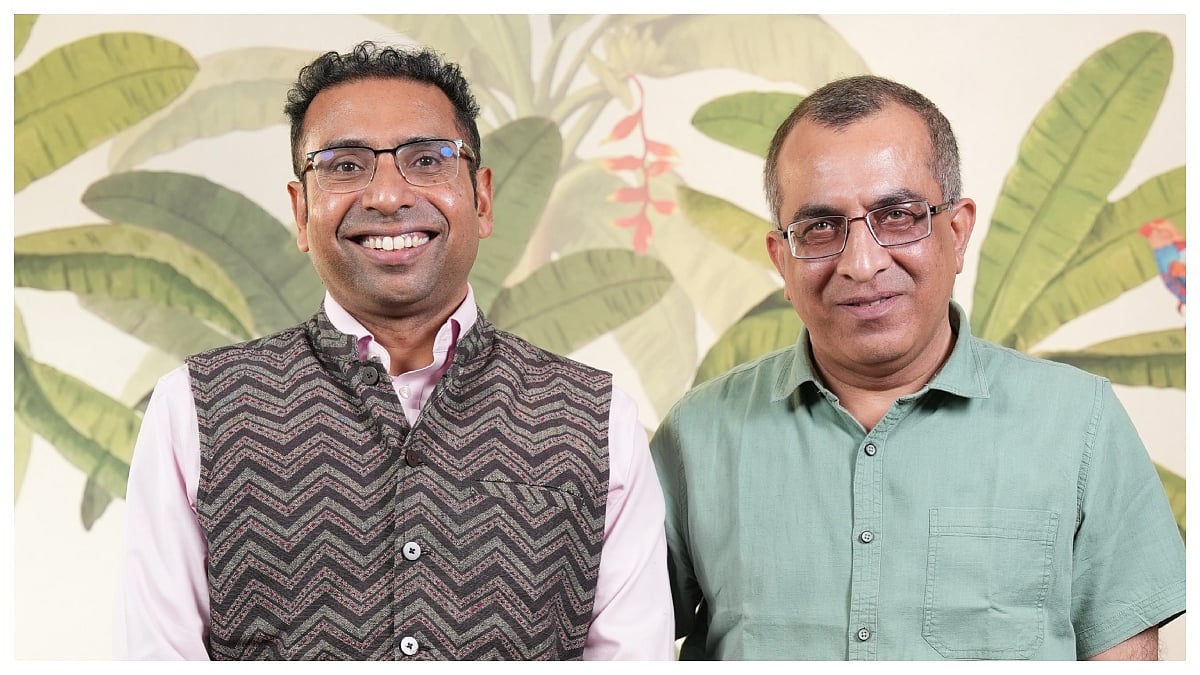
In a detailed conversation, he spoke to Law about India’s evolving economic structure, pressures on the middle class, the impact of artificial intelligence on employment, and his long-term investment philosophy. Throughout the discussion, Mukherjea emphasised that his observations were based on long-term data trends rather than short-term market movements or sentiment.
The Rising Household Debt and Indian Democracy
Mukherjea highlighted that India’s household debt (excluding home loans) has surged to 34–35% of GDP, the highest in India’s history. One in 10 households, Mukherjea notes, is now officially under debt trap, spending over 40% of income servicing EMIs. It’s a fragile equilibrium: as long as salaries arrive on time, everything is “fine.” The moment they don’t, the spreadsheet collapses.
And hovering above all this is India’s taxation system. Mukerjea told Law, “India’s democracy is quite captivating” - out of 95 crore voters, only about 4 crore pay income tax. As a result, a relatively small segment of salaried citizens bear a disproportionate share of direct taxation to fund government expenditure.

Middle-Class Pressures: “Taxed, Underpaid and Unemployed”
Mukherjea shed light on the Indian middle class and the widening gap between rising living costs, stagnant real wage growth, and slowing white-collar job creation.
Speaking to Law, Mukherjea said that while headline inflation figures remain moderate, the middle-class’ inflation is heavily driven by healthcare, education, insurance, and transportation, which runs closer to 10% annually, effectively doubling the cost of living every seven years. In contrast, he noted that nominal salary growth for many white-collar professionals has averaged 4-6%, which does not keep pace with these expenses.
Citing data from Naukri.com’s JobSpeak index, Mukherjea pointed out that white-collar job growth expanded at 11–12% annually between 2010 and 2020, but has remained flat over the past three years. He added that this slowdown is occurring even as approximately 8 million graduates enter the Indian workforce every year, intensifying competition for limited opportunities.

External Risks and Trade Concerns
During the conversation, Mukherjea also flagged geopolitical risks, particularly around global trade. He referred to proposed tariffs of up to 50% under a potential Trump administration, noting that export-oriented clusters, such as textiles in Coimbatore, carpets in eastern Uttar Pradesh, and jewellery manufacturing in Gujarat, could be significantly affected if such tariffs are not renegotiated. He said prolonged trade disruptions could have implications for employment across these regions.
Affluent Households and Savings Stress
Mukherjea also referenced findings from a 2025 research study conducted with Dun & `Bradstreet, which examined households earning more than ₹20 lakh annually. According to the study, one in 10 affluent households was found to be in financial distress, while 14% reported having no financial savings. He attributed this to high post-tax inflation, elevated urban living costs, and significant EMI obligations, which reduce the surplus available for savings and investments even at higher income levels.

Coffee Can Investing and Long-Term Thinking
Borrowed from Robert Kirby’s idea, the strategy involves buying 15-20 exceptional companies, those with consistent revenue growth and return on capital above 15%, and then doing the hardest thing in investing: nothing. For a decade or more. Mukherjea compares it to building a castle. Revenue growth determines the height; return on capital is the moat. Without a moat, competitors walk in. With it, compounding does the heavy lifting while investors get on with their lives.
His data suggests such companies have an 80–90% probability of beating the index over ten years, for instance, Asian Paints compounding 22,000 times since its IPO is not an exception, it’s the blueprint. His Coffee Can philosophy extends to life. Mukherjea writes on flights, resists overuse of social media, and embraces what he calls the Rahul Dravid approach - steady, unflashy, relentlessly effective over time. Like Dravid’s career, Coffee Can stocks may look dull day-to-day, but zoom out and the greatness is obvious.
Artificial Intelligence and Job Transitions
Speaking on artificial intelligence, Mukherjea cited a report by NITI Aayog, NASSCOM, and BCG. He said that IT services, customer support, call centres - the very sectors that created India’s white-collar boom - will be the first to see roles disappear. By 2031, 20–25% of these jobs could vanish. He noted that this poses a challenge given India’s demographic profile and continued addition of new graduates to the workforce.
The second phase, according to Mukherjea, involves complementarity, where new forms of employment emerge alongside AI systems. Speaking to Law, he suggested that India could play a significant role in data cleaning, labelling, and bot training, effectively becoming a large-scale training hub for global AI models. He added that much of this work is likely to be gig-based, resembling platform-driven employment models.

In Mukherjea’s India, the middle class is not lazy, stupid or reckless. It is simply running on a treadmill set by inflation, debt, taxation and technological disruption. His advice is not to sprint harder, but to step off the machine entirely, by owning assets that compound quietly while the noise carries on.
In an economy obsessed with speed, Mukherjea’s biggest provocation may be this: the future belongs not to the fastest runner, but to the most patient gardener.

