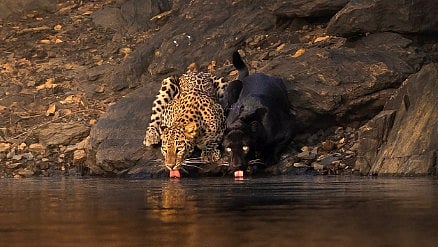
A remarkable wildlife encounter from Karnataka’s Bhadra Tiger Reserve has captured nationwide attention, after a black panther and a spotted leopard were photographed calmly drinking water together. The breathtaking image has flooded social media, offering a rare window into the hidden world of India’s forests and leaving wildlife enthusiasts in awe.
Captured in the tranquil backwaters of the reserve, the frame shows the two majestic big cats standing side by side, their reflections shimmering across the still water, a moment so striking it appears almost cinematic.
The photographer behind the viral moment
The rare sighting was documented by wildlife photographer Arvind Karthik, who shared the images on his Instagram handle. Accompanied by a private guide inside Bhadra Tiger Reserve, Karthik managed to capture a scene that even seasoned wildlife researchers rarely witness.
Within hours of being posted online, the photograph spread rapidly across platforms, drawing admiration from conservationists, nature lovers, and photographers alike.
How rare is this wildlife encounter?
Seeing two adult leopards peacefully sharing space at a water source is extremely uncommon. Leopards are solitary predators and typically avoid prolonged contact with others of their kind unless during mating or when a mother is raising cubs.
The presence of a melanistic leopard, commonly known as a black panther-alongside a regular leopard makes the sighting even more extraordinary. Such moments are seldom recorded in the wild, making this encounter truly exceptional.
Why is one leopard black?
Contrary to popular belief, a black panther is not a separate species. It is a melanistic form of the Indian leopard (Panthera pardus). This dark coloration is caused by a genetic condition called melanism, which leads to excess production of melanin, the pigment responsible for darker skin and fur tones.
Interestingly, under certain lighting conditions, the leopard’s classic rosette patterns remain faintly visible beneath the black coat. Researchers believe melanism provides better camouflage in dense forests, especially in shadow-rich habitats like the Western Ghats.
Social media reacts to the magical encounter
Soon after being shared, the image dominated wildlife pages and news feeds, with users describing it as “mesmerising,” “majestic,” and “a symbol of India’s wild beauty.” Many called it a reminder of how much natural wonder still thrives within the country’s protected forests.
The photograph has not only gone viral but has also reignited public interest in wildlife conservation and forest protection.

