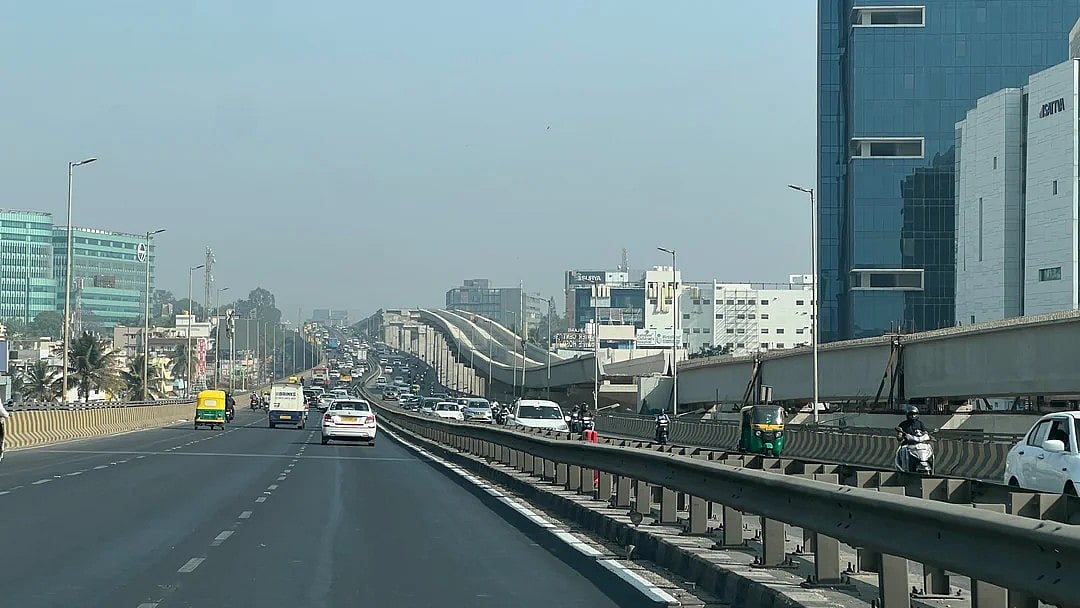
A section of Bengaluru’s Namma Metro has unexpectedly captured public attention after images of a sharply sloping track went viral online. The photographs, widely shared across social media platforms, show a dramatic incline and descent on an under-construction elevated stretch, prompting users to compare it to a roller coaster.
The unusual angle of the track quickly earned playful nicknames, with many dubbing it Bengaluru’s newest “amusement ride.” The visuals, first spotted on Reddit, show the metro line descending steeply before merging toward ground level, running parallel to a busy roadway.
Mixed reactions
Social media users responded with a mix of curiosity, amusement, and debate. While some found the steep gradient visually startling and entertaining, others highlighted that such slopes are common in urban rail systems and are part of standard engineering design.
Several users speculated that the stretch might belong to the upcoming Blue Line corridor, which will connect central Bengaluru to Kempegowda International Airport. In particular, many pointed to the Hebbal–Yelahanka section, where significant elevation changes are necessary due to road intersections, flyovers, and land constraints.

Engineering reality behind the viral visual
Metro rail projects frequently involve complex elevation shifts to accommodate existing infrastructure, water bodies, highways, and land limitations. Despite appearing steep in photographs, these gradients are designed within permissible safety limits and undergo extensive structural and operational testing before passenger services begin.
Officials have not yet confirmed the exact location of the viral stretch but have reiterated that all metro corridors are built in accordance with strict safety and engineering guidelines.

Metro expansion and smarter mobility initiatives
The viral moment comes amid rapid expansion of Bengaluru’s metro network. The Bengaluru Metro Rail Corporation Limited (BMRCL) is actively working to extend connectivity across key corridors, aiming to reduce congestion and improve urban mobility.
In a recent commuter-friendly move, BMRCL partnered with SUN Mobility to introduce electric vehicle battery-swapping stations at select metro hubs. This initiative is expected to significantly enhance last-mile connectivity and encourage eco-friendly transport solutions across the city.

