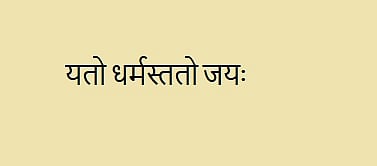
‘Yato dharma stato jaya’ means where the dharma, or the righteousness, exists, there shall be the victory. In other words, it is a huge relief and an assuring phrase that urges us to lead a righteous life so that we shall be victorious. It is a well-repeated phrase, and the guided actions of the Bhagavan are behind those who follow dharma; this is the assurance.
There may be a few clarifications required for the seekers on the words used here. They may ask what dharma is. Is dharma the moral thing to do? Or is dharma according to the “code of conduct” defined for definite segments? Is dharma kala-bound, meaning specific to times? Is dharma place-bound, meaning for different regions it is different? Such questions need to be asked in the beginning of one’s life’s journey. Ideally, this shall set the path better for one and for those who share and conduct a joint venture of life with the person.
Dharma has absolutes, and it has relatives to clarify. When we say the fundamentals or tenets of living, like “satyam vada” or “dharmam chara”, the applicability is for most of the circumstances. Satyam, or the truth, has to be uttered always. But how do we justify the asatyam spoken on certain occasions? There may be an exception given to such. For example, for saving the life of a cow, if any anrutam or untruth is spoken, it may be fine, is what elders clarify. From the modern utilitarian perspective of ethical conduct too, we evaluate whether more people are deriving better benefit out of an action or not. If yes, then we adopt this as an option, which is the summary. This is more from relative grounds. On the absolute plane, an untruth is an untruth whether it saves one or a hundred lives. One can’t utter it. Similarly, dharma acharana has no exemptions. Truthfully answered.
Thus, the saying of ‘yato dharmastato jaya’ means, when we adhere to the principles of dharma, we shall eventually be victorious. The collective compromises shall result only in diluting the life code and making all lose. If all adhere to the dharma, the transaction costs reduce and processes become simple.
Dr. S. Ainavolu is a Mumbai-based teacher of Management and Tradition.

