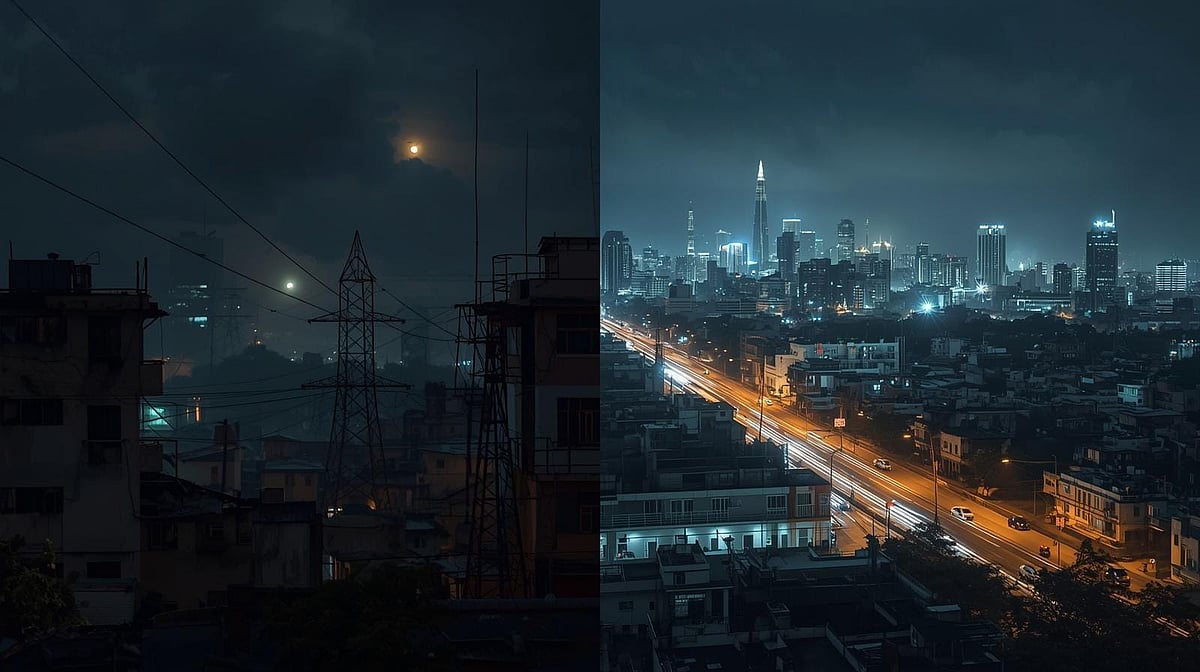
Pune: Ever since the summer of 2026 began, Punekars have faced problems with inconsistent electricity supply. With residents of the district being patient initially, when the problem continued, discussions took to social media.
The discussions on social media have prompted Puneites to compare their condition to the nearest big city to them -- Mumbai, the capital of Maharashtra. Netizens have observed that compared to Pune, Mumbai has fewer problems when it comes to electricity supply.
Punekars often complain about sudden power cuts. In many areas, outages last for hours. In some cases, they even stretch beyond a day. On the other hand, Mumbai is known for its stable electricity supply. Power cuts are rare and usually short.

Movies are, in fact, famous for quoting that ‘Mumbai mein kabhi light nahi jaati', which means Mumbai never has electricity problems. However, for Punekars, electricity outages occur a few times a week, a weekly Thursday maintenance day and problems in infrastructure have become a norm.
For example, on Saturday and Sunday, the Bhosari area in the Pimpri-Chinchwad city of the Pune district faced over 16 hours of power disruption within 24 hours. Bhosari is a mix of industrial and residential zones, which caused major inconvenience for both residents and businesses.
Power Disruption Problems in Pune:
- May 2025: A heavy rainstorm flooded feeder stations in areas like Kondhwa, cutting power to around 38,000 consumers. Supply was mostly restored by the next morning.

- July 2025: A fault in a 220 kV underground cable at Hinjawadi caused a major outage affecting over 52,000 consumers. This included IT firms and residents. Homes got power back by early the next day, but industries faced rotational supply for over 30 hours.
- February 2026: An 80 MVA transformer failure at the Bhosari substation disrupted power in Pimpri-Chinchwad. Some areas remained without electricity for about five hours before restoration began.
- Overall Trend: Power outages in Pune are mainly caused by extreme weather and equipment failures. Authorities usually restore supply within 12–18 hours. However, industrial and IT areas may face longer disruptions with a staggered power supply.
Here are the six main reasons why Pune faces more frequent power outages compared to Mumbai:
1) Pune Has A Bigger And More Complex Network
Pune’s power supply is handled by the Maharashtra State Electricity Distribution Company Limited (MSEDCL). This company supplies electricity across Maharashtra. It covers cities, towns and villages. Because of this, the network is very large and spread out. Managing such a system is not easy.
Mumbai is different. It is a single, compact city. Its power network is smaller and more focused. This makes it easier to monitor and fix problems quickly. Experts say that with Mumbai, the focus areas are fewer compared to Pune. Also, Pune has diverse demands compared to the financial capital of India.
2) Mumbai Has Multiple Power Suppliers
Mumbai has more than one electricity provider, including Brihanmumbai Electricity Supply and Transport Undertaking (BEST), Tata Power and Adani Electricity. All of them operate in different parts of the city. If one line fails, supply can be shifted from another source. This reduces the impact of faults.
Pune depends mainly on one system under MSEDCL, and due to this, when a major fault happens, there is limited backup. This is why large areas can go without power at the same time. However, MSEDCL is making efforts to make the electricity supply smooth in its areas.
3) Mumbai Has Strong Backup Systems
According to officials, Mumbai uses a special system called “islanding”. This system helps keep power running even if one part of the grid fails. Electricity can be diverted quickly from other sources. It helps keep electricity running even when there is a major fault. In simple words, the city’s power network can “separate” itself from the larger grid and still continue to supply electricity.
Normally, cities depend on a larger state or national grid. If a big fault happens in that grid, many areas can lose power. But in Mumbai, the system is designed differently. If there is a problem outside the city, Mumbai can isolate its network and run on its own power sources for some time.
Pune does not have such a strong backup system. When a major cable or transformer fails, restoring the supply takes more time. This leads to longer outages. This is why, when a problem happens with electricity in Pune, it gets noticed by people.
4) Pune Is Growing Very Fast
MSEDCL officials said that Pune is expanding quickly. Every now and then, new housing societies, IT parks and industrial areas come up every year. This has increased the demand for electricity. The electricity demand is increasing every day, while the infrastructure to support it is not being developed at the same pace.
Officials admitted that in many places, infrastructure has not kept pace with this growth. As a result, the system gets overloaded. This increases the chances of faults and power cuts.
Compared to Pune, Mumbai’s growth is slower now. Its infrastructure is already well developed, and the demand has been stable for a while. With stable demands, the supply remains stable.
5) Pune Has Mixed Demand From Industry & Homes
While both Mumbai and Pune are major economic engines for Maharashtra, their electrical infrastructure, urban planning, and consumption patterns are worlds apart. Pune’s power grid is under immense strain because it is not just a residential city; it is a massive, sprawling industrial and IT powerhouse.
Pune’s metro region has a dense mix of industries, IT parks, and residential areas. It puts heavy and fluctuating pressure on the power systems. High energy demand from factories and data centres puts substations.
Mumbai’s demand is driven primarily by commercial towers (offices, retail) and residential complexes. While its consumption is massive, it is incredibly linear.

6) Weather and Ground Conditions Affect Pune More
Heavy rain often creates problems in Pune as water enters feeder boxes and damages equipment. In some areas, poles and lines are still exposed. This makes the system more vulnerable. According to an MSEDCL official, although Pune city has underground cable infrastructure, the other parts of the district lack it. This is one of the major ones.
Because Mumbai was built vertically and compactly, its transmission is almost entirely underground. It is protected from the weather, falling trees, and public infrastructure digging -- factors that frequently disrupt Pune’s fringes, especially the newly developed areas and rural zones.
Despite Mumbai having harsher rains, they are rarely the reason for electricity disruptions in the city of dreams.
MSEDCL’s Efforts
Pune’s power cuts are not caused by a single issue. They are the result of rapid urban growth, rising electricity demand, and the complexity of managing a large and mixed-use network. Unlike Mumbai, which benefits from better planning, multiple power suppliers, and stronger backup systems, Pune’s infrastructure is under constant pressure. However, the MSEDCL says efforts are ongoing to improve the situation.
Speaking to The Free Press Journal, Vikas Puri, Public Relations Officer of MSEDCL’s Pune Zone, said that electricity demand has increased significantly. He added that rising temperatures and technical faults are also contributing to disruptions. “We try to resolve issues immediately, but in some cases, we have to locate underground distribution points and carry out repairs, which takes time,” he said.
MSEDCL has urged citizens to use official channels to report complaints. Consumers can call toll-free numbers 1912 and 1800 212 3435, which are linked to the official system. These details are printed on electricity bills and are also available on the mobile app and website. Complaints can also be raised through social media and WhatsApp, which helps reduce response time.
Puri also said that regular maintenance is another key part of the system. MSEDCL carries out scheduled maintenance, usually on Thursdays, in a staggered manner. Officials say this is necessary to prevent bigger breakdowns. Prior notifications are issued through advertisements and messages to inform residents about planned outages.
MSEDCL has also appealed to citizens to ensure proper maintenance of their internal electrical systems. Neglect at the consumer level can sometimes lead to larger disruptions in the surrounding area.

