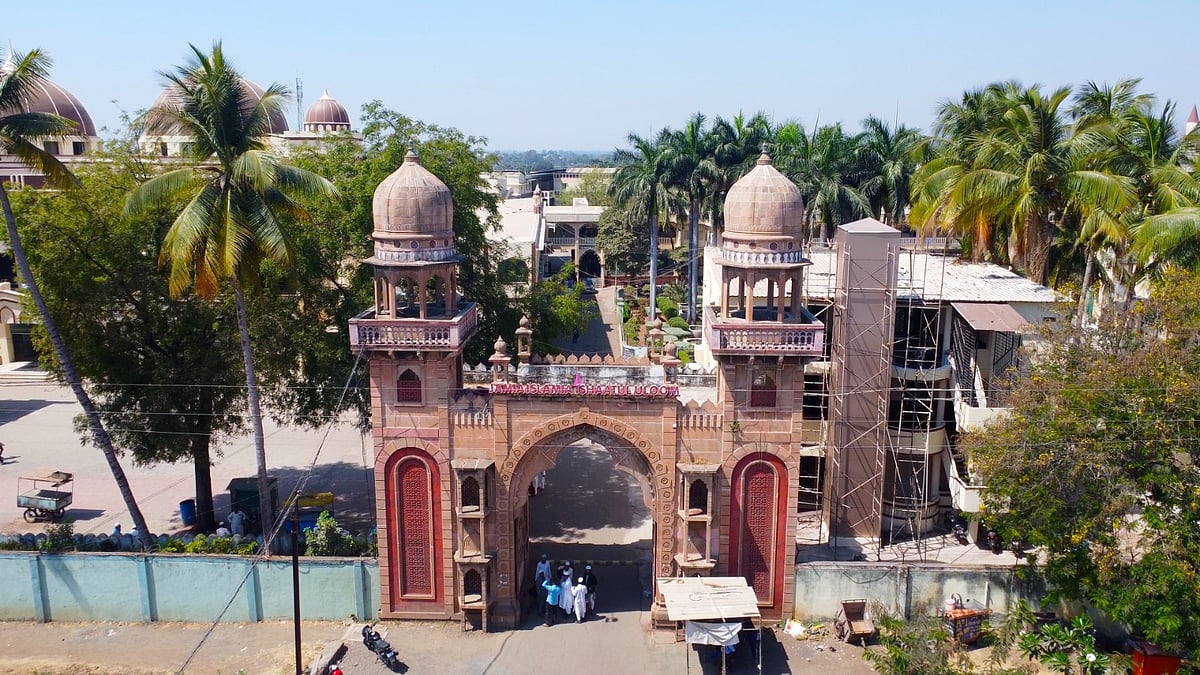
Mumbai: The Enforcement Directorate (ED) has expanded its financial investigation into the Jamia Islamia Ishaatul Uloom (JIIU) trust in Nandurbar, following evidence suggesting that funds from foreign contributions, government-linked grants,and domestic donations were allegedly diverted to undisclosed and off-book institutions across multiple states, officials familiar with the probe said.
The agency, already examining the trust for hawala-linked movements and the unlawful sheltering of two Yemeni nationals, is now tracing the financial trail to determine if foreign contributions intended for specific charitable or educational programs were instead channeled into undisclosed operational expenses or unregistered bodies outside the trust’s declared structure.
Between 2014–15 and 2023–24, the JIIU trust reportedly received nearly Rs406 crore in foreign donations, ED investigators said. The contributions originated from Kuwait, Botswana, the UK, Mauritius, Switzerland, Seychelles, and Panama. In addition to these overseas inflows, the trust is believed to have received substantial amounts from domestic NGOs, religious organisations, philanthropic trusts, and individual donors.
Scrutiny of bank records and financial statements revealed a consistent pattern, in which funds were deposited into the trust’s primary accounts and subsequently siphoned into smaller affiliated setups and unregistered institutions.These included several madrasas, maktabs, welfare centres, and educational bodies located in Maharashtra, Gujarat, and some parts of northern India. Investigators said these transfers appeared to bypass mandatory disclosures under the Foreign Contribution (Regulation) Act (FCRA), including utilisation certificates, audited accounts, and beneficiary declarations.
Officials familiar with the probe said, on condition of anonymity, that an examination of material seized during the December 1 search operations has thrown up thousands of transaction trails and several unidentified bank accounts that are now under close scrutiny. Investigators are also assessing the trust’s liability structure, payment architecture and inter-institutional fund flows, amid indications that the financial network may have been deliberately layered to obscure the end-use of funds.
According to officials, the agency is also probing the possible use of mule accounts and escrow-linked channels that may have served as secondary conduits to route or mask inflows. These accounts, they said, are now the focus of a “deep-dive scrutiny” to establish the ultimate beneficiaries.
Sources said the JIIU trust operated as an umbrella organisation for several Jamiat Ulema-e-Hind (JUH)-linked maktabs, madrasas, and mosques across rural and semi-urban regions, many following the Deoband school of thought and drawing their curriculum from Darul Uloom Deoband. Investigators noted that numerous institutions lacked the capacity to mobilise foreign donations independently, due to their small scale, limited infrastructure, or absence of FCRA registration. The financial probe agency suspects that the trust allegedly diverted what they termed “silent funding” or undeclared foreign-funded inflows to sustain these bodies, even though they were not eligible to receive overseas contributions. This structure, investigators said, enabled the trust to centralise foreign receipts while decentralising their deployment in a way that weakened transparency and masked end-use accountability.

Officials further stated that the trust routed funds to a network of religious and social bodies involved in relief and community rehabilitation, but is suspected to have diverted a portion to entities providing legal support to individuals facing prosecution in communal or security-related cases. Investigators noted that some of these organisations have historically provided legal aid for accused persons in terror-linked or riot-related cases, indirectly supporting criminal acts. While the ED has not yet determined whether such expenditures violate FCRA norms, officials said the utilisation patterns and financial trails “require detailed scrutiny.”
During the investigation, the financial probe agency found that the trust’s charitable framework was allegedly used to justify transfers that did not comply with statutory norms. Investigators said it remains unclear whether the beneficiary institutions actually received the funds, or whether the entries existed only on paper, with the possibility that a portion of the money was siphoned into personal accounts of trust functionaries. Several institutions were found to have received repeated allocations for identical or overlapping purposes, raising further questions about the actual utilisation of the funds.
The Ministry of Home Affairs had earlier cancelled JIIU’s FCRA registration on July 15, 2024, after concluding that the trust had channelled foreign contributions to non-FCRA-registered NGOs in violation of Section 7of the act. Officials said multiple recipient entities were unauthorised yet received routed transfers, suggesting a deliberate scheme to evade audits, regulatory oversight, and traceability norms.
JIIU institutions reportedly received government and university-linked funding. For instance: a JIIU institute was granted Rs60.10 lakh by North Maharashtra University (now KBCNMU), while the Jamia Private Industrial Training Institute in Akkalkuwa obtained a performance-based grant under the STRIVE project, which is a World Bank-supported Central Government scheme. Additionally, a Jamia-affiliated college was listed in the NMU annual report as a beneficiary of the Department of Science and Technology’s (DST) FIST Level II programme, which provides major funding for research and infrastructure.

While these entries confirm that government-linked incentives flowed to institutions under the trust, officials said no public record currently identifies a central research grant awarded directly to the JIIU trust itself. Seized documents referring to “national research incentives for organisational self-funding” are now being examined to determine whether the sanctioned funds, irrespective of the source, were utilised for their intended purpose, with investigators flagging potential irregularities in fund utilisation.
The financial probe agency also flagged the As-Salam Unani Hospital and Medical College,an institution associated with the trust, which allegedly submitted fake patient data to government agencies to secure grants and recognition. Officials said this raises suspicion that, while institutions successfully obtained government funding, some of these funds may have been acquired through fraudulent means.
Collectively, these findings indicate that the JIIU group accessed substantial funding through multiple channels, including university, state vocational, central research, and health-sector grants, while raising concerns over alleged misuse or irregularities in the utilisation of certain government funds.
To get details on exclusive and budget-friendly property deals in Mumbai & surrounding regions, do visit: https://budgetproperties.in/

