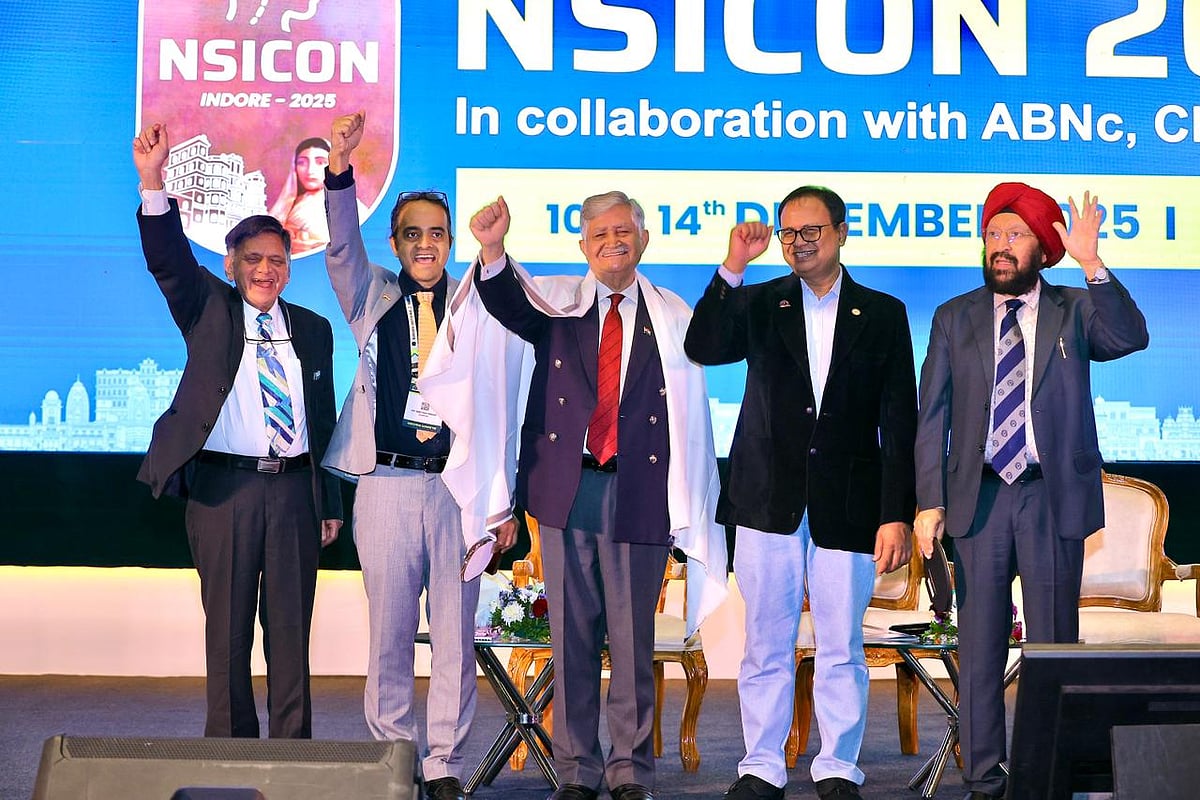
Indore (Madhya Pradesh): The fourth day of NSICON 2025, the annual conference of the Neurological Society of India, witnessed in-depth discussions on more than 200 research papers, centred around this year’s theme, "Overcoming Challenges in Brain and Spine Care." The day stood out for its strong message that, whether it is medical science or national security, staying technologically ahead is the key to success.
To inspire neurologists and neurosurgeons, former Army Chief General VP Malik, was invited as special guest. Sharing experiences from Kargil conflict, General Malik spoke about the indomitable courage and winning spirit of Indian soldiers. He emphasised that even in the absence of resources, it is determination and resolve that lead to victory, a spirit that ultimately led India to success in Kargil.
Reflecting on the past, General Malik noted that during the Kargil era, India depended heavily on foreign nations for advanced weapons and technology, whereas today the country has achieved remarkable self-reliance in the defence sector.

Referring to Operation Vijay, he highlighted that despite thousands of injured soldiers being hospitalised, fatalities were limited to just 10–15, underscoring the efficiency and dedication of military medical services. He further added that in later operations, including Operation Sindoor, extensive use of advanced technology played a decisive role in achieving success, reinforcing the need to continuously adopt new technologies in all fields.
Organising chairman Dr Vasant Dakwale stated that General Malik’s address deeply motivated doctors to adopt a soldier-like spirit—never surrendering to challenges and embracing evolving technology. He emphasised that neurosurgery is not merely a technical skill, but a balanced integration of science, experience, and compassion, with patient dignity and quality of life at its core.
Renowned US-based neurosurgeon Dr Kenan Arnautovic, while delivering the Jacob Chandy Oration, stressed that timely surgery remains the most effective treatment for many serious brain disorders and should never be delayed.

