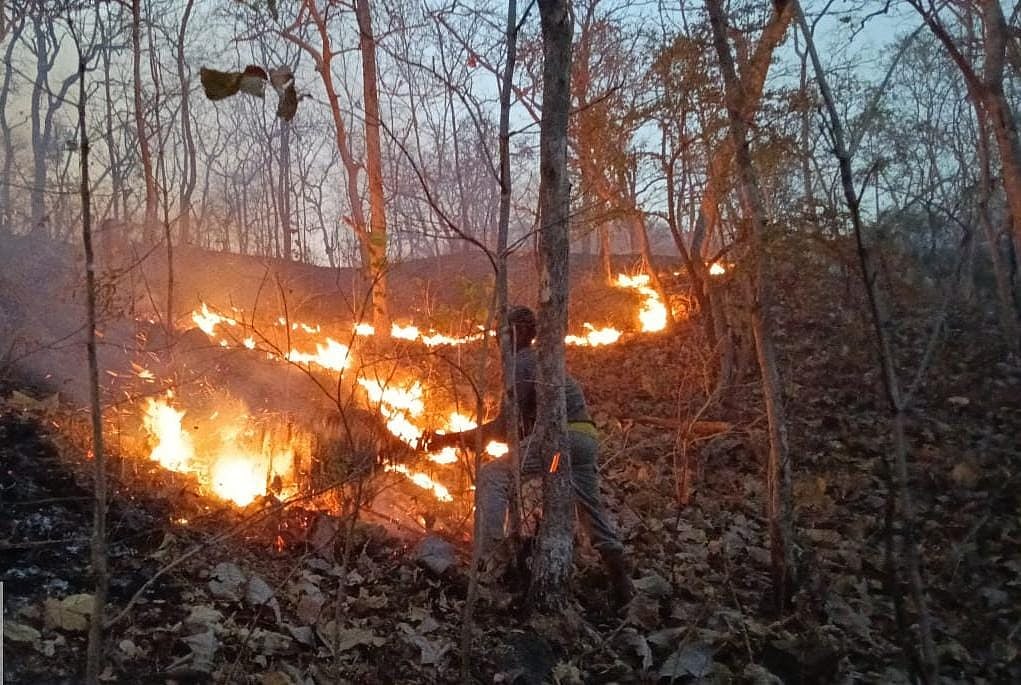
Indore (Madhya Pradesh): Forest fires in Madhya Pradesh have become a growing concern. Between 2022 and 2025, fire points across the state surged by 30%, sparking alarm about the increasing frequency and intensity of forest fires.
In Indore and Dewas, the number of fire points rose sharply in recent years, suggesting a troubling trend. However, despite this rise in detections, actual forest damage has remained surprisingly low.
So, why do the fire point numbers keep climbing, but the damage stays limited?
The answer lies in advanced satellite technology and a proactive fire management approach.




The rise in fire points can largely be attributed to the improved capabilities of modern satellite systems. While older satellites like MODIS missed smaller fires, the SNPP-VIIRS system now detects even brief, minor fires that would have gone unnoticed before. This means more fires are being recorded, but not necessarily more damage is occurring.
Pradeep Mishra, DFO Indore, explained, “The increase in fire points is a direct result of better detection technology. We're picking up small fires that may only affect dry grass or leaf litter. But the critical thing is that these fires are quickly controlled, which limits the spread and reduces their impact.”
Mishra also noted that satellite imagery consistently shows no significant increase in large burn scars in Indore and Dewas, even as fire point numbers have surged.
Early detection and rapid response
Effective fire management comes down to early detection and rapid response. “We’ve developed systems to detect fires at the earliest stages, often within hours,” Mishra said. “By responding quickly, we stop small fires from turning into major wildfires.”
Data-driven fire management: A game changer
The introduction of the eForestFire model in 2019-2020 has been instrumental in fire prevention efforts. Using historical data, the model helps authorities identify fire-prone zones well in advance, allowing them to set up fire lines and deploy resources before the fire season begins.
“Instead of waiting for fires to start, we now predict where they are most likely to occur,” Mishra explained. “This proactive approach has been crucial in minimising fire damage.”

Human activity, not just climate, plays a role in fires
While climate factors contribute to forest fires, human activities are often the primary cause. Mishra highlighted, “Things like mahua flower collection, tendu leaf harvesting, and agricultural clearing can easily spark small fires. These, if not controlled early, can quickly grow into larger fires.”
In response, fire management strategies in Indore and Dewas focus on intervening early to prevent these fires from spreading.