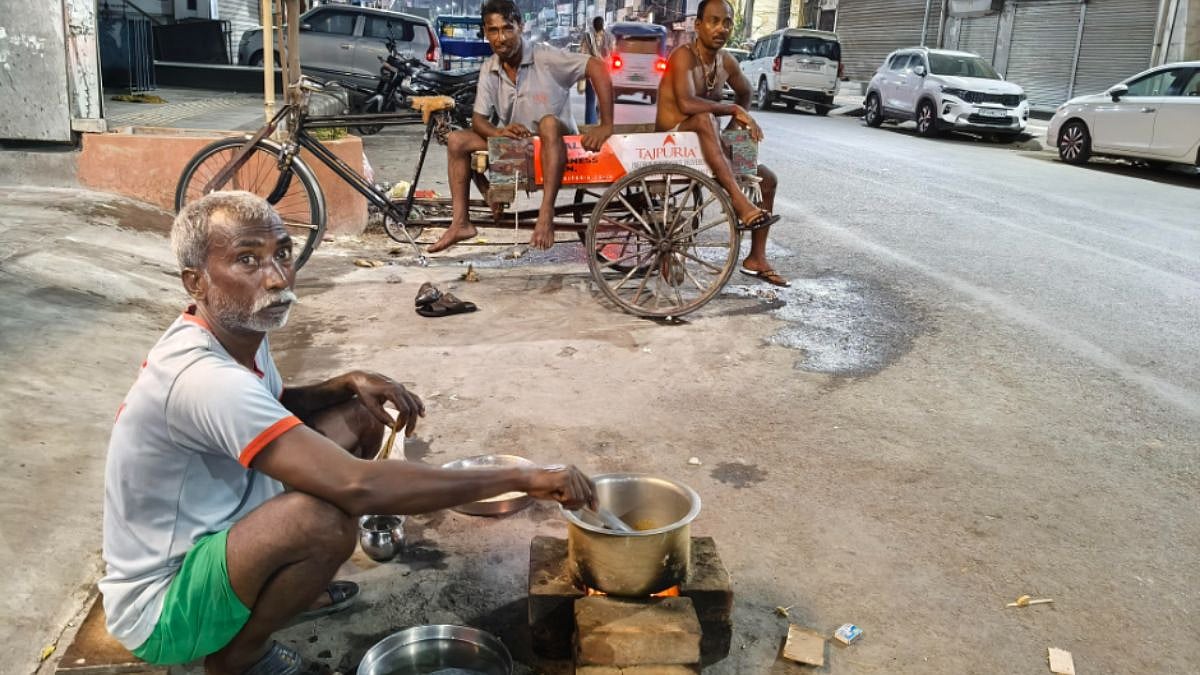
Lucknow: At 2 pm every day, 62-year-old cycle rickshaw puller Ramesh Yadav pulls over under a neem tree in Lucknow’s government residential colony in Indira Nagar. With 43 Degree Celsius this is the time when earning a livelihood turns into a physical hazard. His forehead is beaded with heavy sweat; his eyes are bloodshot. The metal seat of his vehicle has become too hot to sit on. Sweat drips from his forehead as he fans himself with an old newspaper.
"The seat burns like a tawa – it scalds through my clothes. I stop working for two or three hours every afternoon now," he says, his voice flat with exhaustion. "If I continue driving, I start feeling dizzy and my vision blurs."
For Yadav, the heat is no longer a seasonal inconvenience; it is a direct tax on his daily bread. Returning home offers no respite. His family of four shares a single ceiling fan under a corrugated tin roof that acts as a thermal conductor. When the city’s strained power grid fails—an occurrence Yadav maps by the hour—the fan goes dead. Even when it spins, it merely re-circulates the trapped, suffocating air.
Yet, as the sun dips below the horizon and the day’s economic paralysis lifts, a secondary, more deceptive crisis begins. For millions of informal workers, the sunset does not bring relief. It marks the onset of night-time heat stress—the frontline of a deepening climate inequality.
The Permanent Microclimate
At midnight, when affluent neighborhoods retreat indoor, into the comfort of air-conditioners, 38-year-old Rajesh Nishad unfolds a thin cotton sheet on the concrete pavement outside Lucknow's Charbagh railway station. A migrant laborer from Sant Kabir Nagar who works as menial labourer, Nishad's bedroom is the open street.
"The concrete doesn't cool down," Nishad says, touching the dark pavement beneath him. "At midnight, the ground still radiates heat like a stove. The air is dead. You sleep for twenty minutes, wake up drenched in sweat, and wait for the breeze that never comes."
On the worst nights, Nishad walks to a public utility tap, drenching his entire upper body in water just to force a brief drop in his skin temperature. "The days are punishing, but the nights are a different kind of torture," he whispers. "During the day, you can at least seek out the shade of a wall or a tree. At night, there is absolutely nowhere to hide."
What Nishad experiences on the asphalt is a documented meteorological phenomenon known as the Urban Heat Island effect, amplified by night-time warming.
"People are historically conditioned to judge heatwaves solely by daytime peak temperatures," explains Lucknow-based climate scientist Dr. Shachindra Sharma. "But the real danger to human survival is occurring after dark. Rapid, unregulated urbanization and the widespread replacement of green cover with dense concrete have transformed our cities into giant heat traps."
According to Dr. Sharma, concrete structures and asphalt roads absorb massive thermal energy during the day and release it at an excruciatingly slow rate after sunset.
"When high ambient humidity couples with elevated night temperatures, the human body enters a state of perpetual thermal debt," Dr. Sharma adds. "The core body temperature cannot drop. The heart is forced to pump faster to cool the skin, denying organs the critical window of cellular recovery they need from daytime stress. This isn't just discomfort; it is cumulative internal organ attrition."
Aarti Khosla, founder and director of Climate Trends said besides the day temperature, humidity levels also stayed consistently above 75 per cent during nighttime hours, worsening discomfort and reducing the body’s ability to cool itself naturally.

Quantifying the Silent Trauma
The physical suffering written into the lives of Yadav and Nishad is no longer a localized anomaly. It has scaled into a national macrocosm.
Data from a new, landmark nationwide study conducted by the Yale Program on Climate Change Communication and CVoter reveals that the abstract science of global warming has firmly breached the private thresholds of India’s working class. The survey, which interviewed 5,427 representative adults between December 2025 and February 2026, discovered an unprecedented shift in public consciousness.
An overwhelming 84 percent of Indian citizens report that they have now personally experienced the acute impacts of global warming, representing a massive thirty-four percentage-point spike from baseline data recorded in 2011. Furthermore, 88 percent express deep anxiety over changing climate patterns, with more than half categorizing themselves as very worried, while 77 percent explicitly fear that severe heatwaves are actively destroying the health and economic viability of their local communities.
The most sobering data point lies in how citizens are coping, as 28 percent of respondents state they have either already relocated or are actively considering seasonal migration due to extreme weather disruptions, such as recurring droughts and unrelenting heatwaves.
"The numbers reflect a harsh ground reality," says Yashwant Deshmukh, founder of CVoter International and co-author of the study. "Climate change is no longer a distant threat discussed in glass buildings. The Indian public is living through it, feeling it in their pockets, and fundamentally reorganizing their daily survival around it."
Across regional belts, this structural reorganization is quiet but profound. Construction laborers now start their shifts at 4:30 AM to beat the noon sun. Open-air vegetable vendors are entirely abandoning afternoon markets, risking spoiled produce. Delivery riders gather in packs beneath the shadows of highway flyovers, waiting out the peak ultraviolet hours.
The Inequality of Cooling
The crisis has laid bare a stark domestic divide: climate inequality.
The Yale-CVoter survey brings hard metrics to this disparity. While severe heat hits every demographic, only 15 percent of Indian households possess an air-conditioning unit, and a mere 27 percent own an air cooler. Compounding this structural gap, two out of three respondents report routine, daily electricity disruptions.
For the affluent, extreme heat manifests as a luxury tax—an inflated monthly electricity bill. For the bottom tier of the economy, it means systemic sleep deprivation, a 40 percent drop in daily wage-earning capacity, and chronic heat-induced illnesses.
The disparity is visible on Lucknow’s Latouche Road at midnight. While speed-regulated vehicles zip past with closed windows—their air-conditioning compressors expelling bursts of artificial heat onto the streets—Nishad sits on his sheet, watching them go.
"The rich finish their work, step into their air-conditioned rooms, and sleep like children," Nishad says, his gaze fixed on the passing headlights. "We sit out here on the dust. When a car speeds past, the temporary gust of wind it leaves behind is the only cool air we get for the night."
The Accountability Vacuum
This escalating human crisis raises a critical question regarding where the policy firewall actually stands.
The state of Uttar Pradesh has mandated City Heat Action Plans across its major municipal corporations, including Lucknow. On paper, these blueprints are designed to safeguard vulnerable outdoor workers through targeted micro-interventions, such as establishing public cooling centers, extending water distribution kiosks, and restructuring labor hours during orange and red alerts.
Yet, the ground-level execution reveals a severe implementation vacuum. There are no mobile hydration units or shaded rest stations accessible to rickshaw drivers along Lucknow's major transport corridors. Government claims labouers in construction sites should not be allowed to work between 12 noon and 4 pm, but this order is hardly followed.
Paradoxically, the public consensus for structural change is overwhelming. The Yale study notes that 86 percent of Indians actively back the government’s net-zero carbon emission targets, and more than 82 percent favor aggressively replacing coal with solar and wind infrastructure. Clean energy has ceased to be an elite, environmentalist talking point; it has matured into a mainstream public demand for survival.
Long-Term Attrition
As twilight approaches, the ambient temperature softens slightly. Ramesh Yadav mounts his e-rickshaw once more, desperate to salvage his lost afternoon earnings from the evening commuter rush. A few kilometers away, Rajesh Nishad folds his sweat-stained cotton sheet, preparing his body for another night of physical endurance on the pavement.
Global scientific bodies have labeled this planetary trajectory climate change. But on the streets of Lucknow, the working class uses a far simpler vocabulary.
For them, it is the season that refuses to end—growing longer, burning hotter, and slowly running out of spaces where a human being can safely survive.

