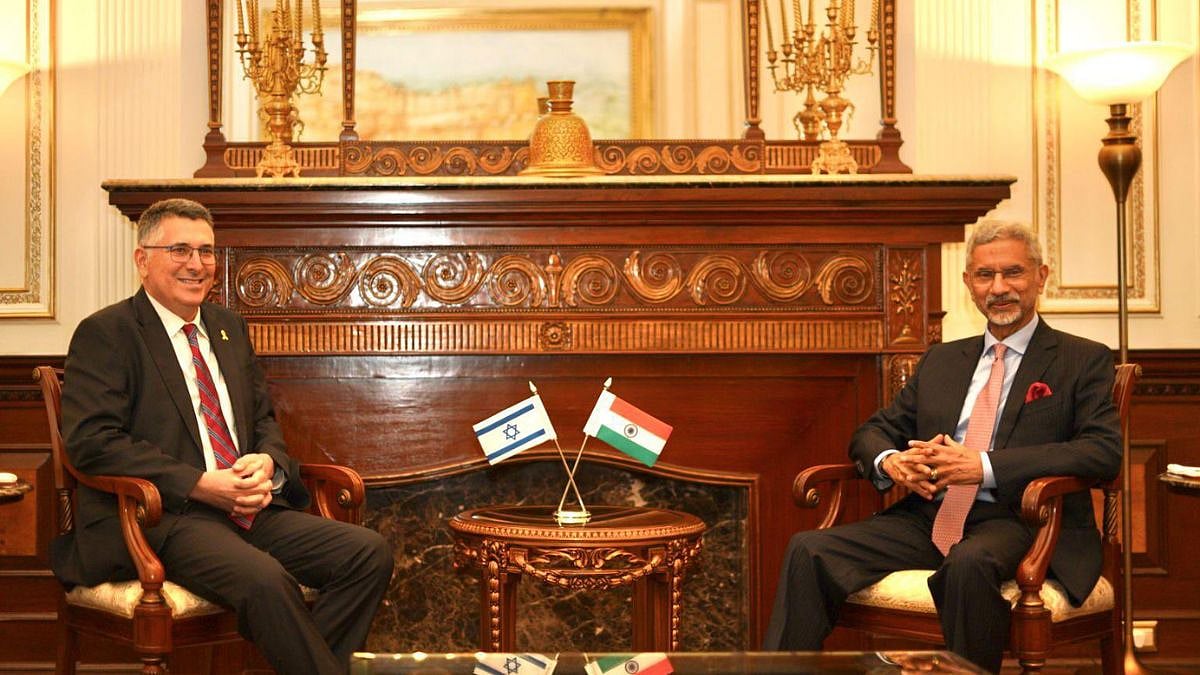
New Delhi: Gideon Sa’ar could not hide his love and admiration for India. The Israeli foreign minister, who is on his maiden visit to the country - two months after Israeli finance minister Bezalel Smotrich’s visit - described India as a “global superpower” in an interview to a television channel. He added that an MoU on defence between the two countries was in the works. Recalling the Hamas terror attacks, Sa’ar said in the interview.
“We will not forget the fact that Prime Minister Narendra Modi was the first world leader to call Prime Minister Netanyahu on that awful day. India stood by us, and we will remember that.”

The Israeli foreign minister had a packed day in Delhi. Arriving late on Monday night, he had a morning meeting with External Affairs Minister Dr S Jaishankar, followed by a meeting with NSA Ajit Doval. Observers pointed out the Israeli foreign minister’s visit was even more in the public domain than Smotrich’s had been. MEA sources state that Prime Minister Netanyahu may also be visiting India next perhaps by the year-end.
Though the Israeli finance minister met with his counterpart Nirmala Sitharaman where they inked the new Bilateral Investment Agreement (BIA) between India and Israel and met Commerce and Industry Minister Piyush Goyal, Gujarat Chief Minister Bhupendra Patel and Maharashtra Chief Minister Devendra Fadnavis, his visit did not dominate media headlines the way Sa’ar’s has done. Diplomats said the conclusion one could draw was that New Delhi was feeling less need to play down its relationship with Israel especially now that a ceasefire had been reached.
Former Indian ambassador Talmiz Ahmad stated that New Delhi had reached the conclusion after looking to the Arab nations, many of whom themselves were working with the Israelis “India has concluded there would be no significant Muslim or Arab backlash should it deal with Israel and therefore sees no need to be discreet about the relationship.” Whether this assessment is correct or not, what is true is that New Delhi and Tel Aviv believe that they have much in common, and therefore there is a greater need for them to work together.
In his opening remarks to the Israeli foreign minister, External Affairs Minister S. Jaishankar said India and Israel have a strategic partnership, and in India’s case that term has a real meaning. “We have stood together in testing times and we have created a relationship with a very high degree of trust and reliability. Our two nations face a challenge from terrorists. It is essential that we work towards ensuring a global approach of zero tolerance towards terrorism in all its forms and manifestations.”
Jaishankar went on to invite Israel to the AI Impact Summit being hosted by India next year and hinted that talks to implement the India-Middle East-Europe Economic Corridor (IMEC) long dubbed as “dead” after the Hamas attacks could be back on the anvil. “Given our strategic cooperation, an exchange of perspectives on regional and global issues also holds great value. There are some plurilateral initiatives in which we both have a strong interest. I look forward to that aspect of our deliberations as well.”
India’s warmth towards Israel has prompted some questions. Is New Delhi shifting its traditional stance on the Palestine issue? Khinvraj Jangid, Professor and Director, Centre for Israel Studies at OP Jinbal Global University and Comper Fellow at The Elizabeth and Tony Comper Center for the Study of Antisemitism, University of Haifa, Israel, believes that India has not veered from its traditional stance at all. “Jaishankar put it very well at the Berlin security summit. He said there that on terrorism, India is with Israel, and on the two-state solution, India is with the Palestinians,” he said.

“For a very long time, India thought keeping a distance from Israel would help Palestine. But that was a false notion. It was always the case from the time of the fifties that India's distance from Israel had to do with Arab pressure. And now that the Arab pressure is not there, there is no reason for India to keep a distance from Israel.”
Asked about how Israel and Israelis viewed the India relationship, Jangid said that Israel had always viewed India with fondness, pointing out that the first Israeli prime minister David Ben-Gurion had a picture of Mahatma Gandhi in his bedroom. However, the Cold War and India’s focus on the Palestine cause prevented the relationship from developing. “Once the Cold War ended, India didn’t really shy away from having a close strategic relationship with Israel. A lot of people reduce it to the arms, but there is a lot more to this relationship with very close people-to-people ties,” Jangid said.

“The other issue is that the Americans made it clear to Israel that you can’t sell defence materials to China, as a result of which Israel started distancing itself from China,” he said. “So given Israel's obligations to the Americans, outside of the Western world and outside of the Arab world, India is the most important partner for them.” The question then arises does India gain anything by a Netanyahu visit should it happen? Jangid believes India should assess the situation carefully before committing.
“Netanyahu will want to come to show to his people that he can travel and he still has good friends all over the world. For his domestic audience, that trip will look like a bright spot given the international warrant that is put against him. However, India is already working with Israel on various issues. So it may not get anything out of such a trip in tangible terms.”

