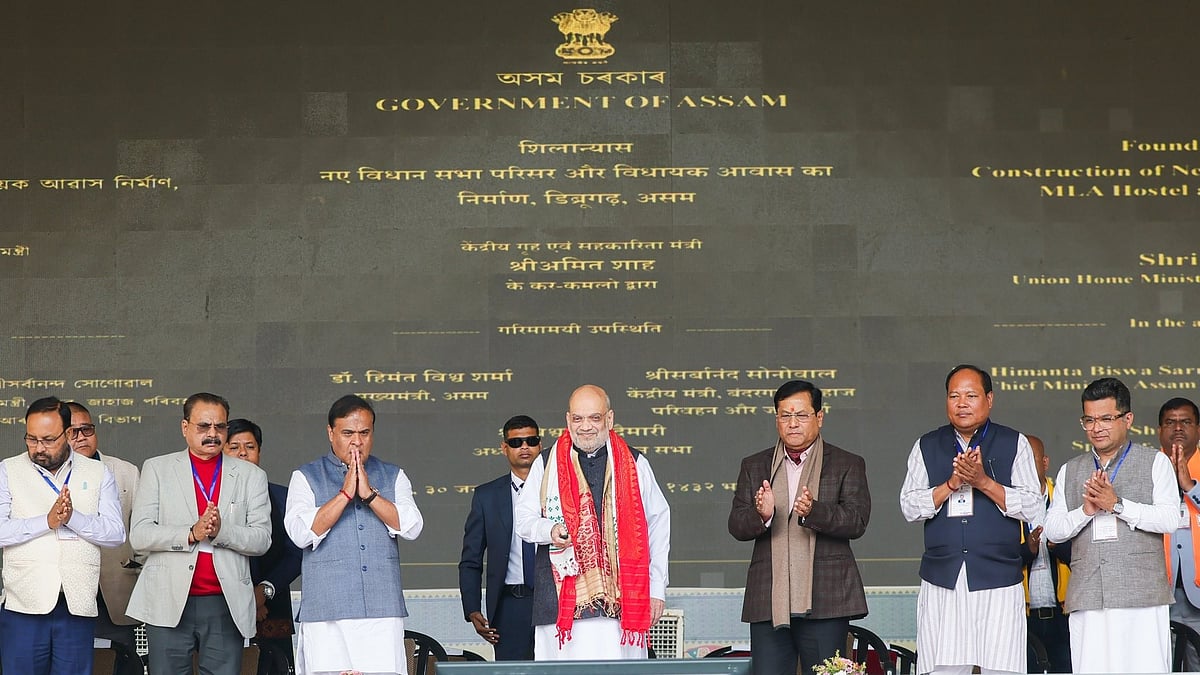
Guwahati: In a milestone moment for Assam’s journey towards decentralised governance and balanced regional development, Union Home Minister Amit Shah on Friday laid the foundation stone of the state’s second Legislative Assembly complex in Dibrugarh, formally setting the stage for the city’s emergence as Assam’s second capital.
Calling it a historic step towards inclusive governance, Shah also laid the foundation stones and inaugurated a series of key projects spanning legislative infrastructure, sports, wildlife conservation and flood mitigation. These included the Assembly complex and MLA hostels, the Institute of Wildlife Health and Research at Dinjan, and the expansion of Khanikar Stadium, alongside the launch of a major wetland restoration initiative across the state.
The new Legislative Assembly complex and residential facilities for MLAs will be built on 57 bighas of land at an estimated cost of ₹284 crore and are expected to be completed within 30 months. The complex will include a modern Assembly building, an 800-seat two-storey auditorium, police barracks and other essential infrastructure.
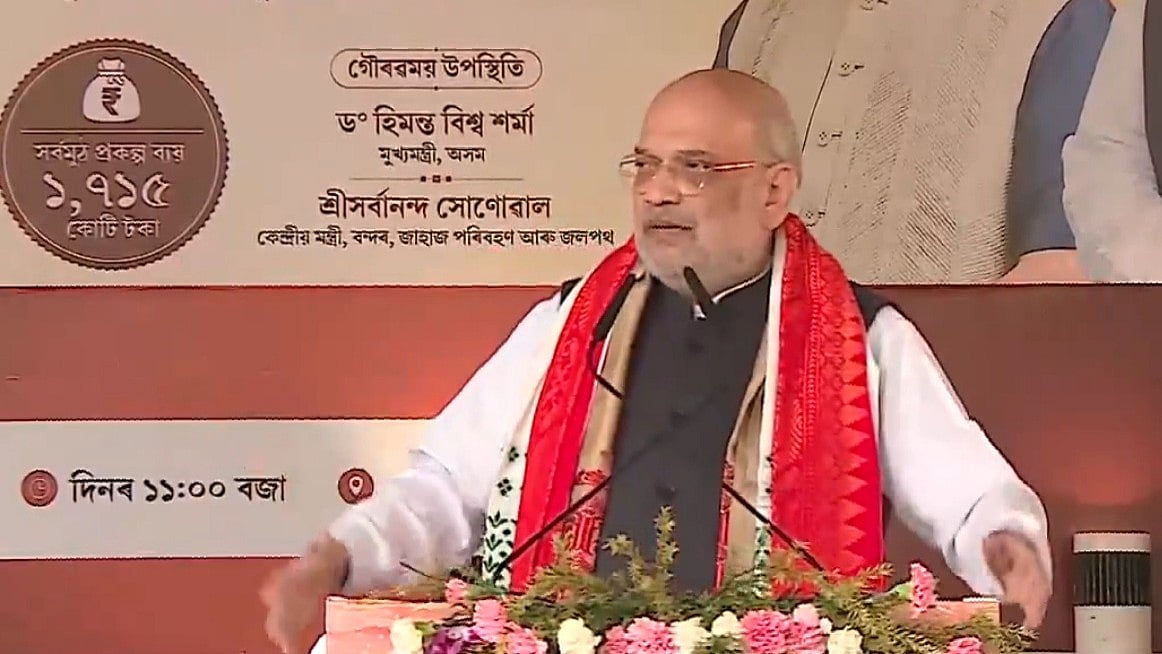
Addressing a large gathering, Shah recalled that Chief Minister Himanta Biswa Sarma had announced in 2025 the decision to make Dibrugarh Assam’s second capital. “Earlier, many such announcements remained only on paper. Today, the foundation has been laid. From now on, the people of Dibrugarh will also be residents of the capital of Assam,” he said, stressing that the move reflects the government’s commitment to inclusive development across regions, communities and tribes.
Highlighting Assam’s vulnerability to floods, Shah said the Centre has adopted a scientific approach to flood mitigation through wetland restoration. Based on surveys conducted by the Space Applications Centre, the Ministry of Home Affairs has invested ₹692 crore in the first phase to develop 15 major wetlands. He said the initiative would help protect around 7.5 lakh people from floods, irrigate nearly 77,000 hectares of farmland, recharge groundwater and support fisheries, animal husbandry, tourism and water sports.
A major boost to wildlife conservation also took shape with the foundation stone of the Institute of Wildlife Health and Research at Dinjan. Spread over more than 117 bighas and built at a cost of ₹292 crore, the institute will serve as a premier centre for wildlife disease surveillance, research, diagnosis and skill development for Assam and the entire Northeast. Shah urged the state to ensure facilities for birds as well, and said the institute could emerge as a globally significant research centre, including in genetic disease studies.
Sports infrastructure received equal emphasis with the inauguration of Phase I of the Khanikar multi-disciplinary sports complex, built at a cost of ₹238 crore on 106 bighas. Equipped with an indoor stadium, swimming pool, football ground, tennis and basketball courts, hostels and coaches’ accommodation, the facility aims to nurture sporting talent in Upper Assam. Simultaneously, the foundation stone for Phase II was laid, with an investment of ₹209 crore to expand seating capacity from 25,000 to 35,000.
Shah said peace and development have replaced decades of conflict in Assam under the Modi government, noting that more than 10,000 youths across the Northeast have laid down arms following over 20 peace agreements. “There was a time of curfews and gunfire. Today, the music of Bhupen Hazarika echoes across the world,” he said, adding that the conferment of the Bharat Ratna on Bhupen Hazarika and Gopinath Bordoloi symbolised a new era of recognition for Assam’s icons.
He also spoke about infrastructure growth, trade opportunities for Assam tea following India’s free trade agreement with the European Union, land rights for tea garden workers, and efforts to curb infiltration and protect Assam’s demographic balance.
Paying tribute to Mahatma Gandhi on his death anniversary, Shah said Bapu awakened the nation and led India to Swaraj through peace and moral strength.
Also Watch:
In his address, Chief Minister Himanta Biswa Sarma described the day as historic for Dibrugarh and Upper Assam, saying the region has played a decisive role in shaping the present government. He termed the second Assembly complex outside Guwahati as an unimaginable idea in the past, now turned into reality. Sarma also highlighted major projects in Upper Assam, including bridges, medical colleges, industrial investments, road corridors and flood mitigation initiatives.
He announced that application forms for land pattas for tea garden workers would be distributed from February 10 and reiterated that over 1.5 lakh government jobs have been provided transparently under the present government.
Union Minister Sarbananda Sonowal, Union Minister of State Pabitra Margherita, Assembly Speaker Biswajit Daimary, Deputy Speaker Dr Numal Momin, several state ministers, legislators and senior officials were among those present at the programme, marking what many described as the beginning of a new chapter in Assam’s political and developmental history.

