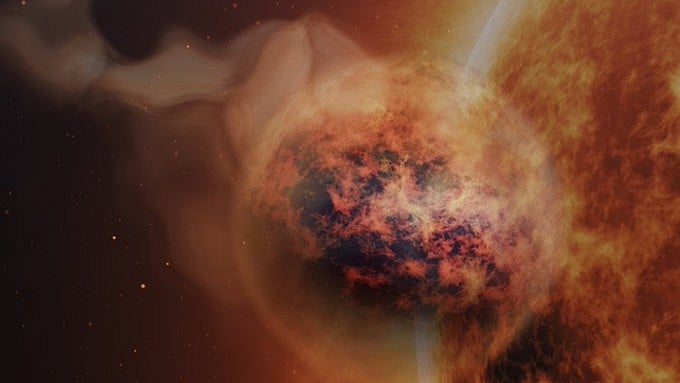
In its latest discovery, NASA's James Webb Space Telescope has discovered a planet where specks of sand fall as rain, according to the Guardian. Though the planet's water and cloud cycles are similar to Earth's, its clouds are formed of sand, and the clouds are made of silicate. This newly found planet is called Wasp-107b and is a Jupiter-sized exoplanet located 200 light years from Earth in Virgo's constellation. Wasp-107b is also known as the 'cotton floss' since it is substantially less dense than other giant gas planets. Despite being around the size of Jupiter, the planet is much lighter, with roughly the same mass as Neptune.
While in conversation with New Scientist, Prof Leen Decin of the Catholic Institute (KU) Leuven and the first author of the research, said, "In fact, the density of this airy planet is one of the lowest we've ever seen. That allows us to go very deeply into the planet's atmosphere."
Wasp-107b atmosphere was studied using JWST's MIRI
European astronomer's team used JWST's Mid-Infrared Instrument (MIRI) to study the planet's atmosphere composition. Water vapour, sulphur dioxide, and silicate sand clouds were discovered in the exoplanet's dynamic atmosphere. The research was published in the journal Nature. Previously, astronomers discovered clouds on exoplanets, but for the first time, their chemical composition has been examined by astronomers.
Wasp-107b atmosphere similar to Earth's water cycle
The planet's atmosphere works similarly to Earth's water cycle, except with sand instead of water. Silicate vapour creates minute grains of sand when it rises from the hotter, lower regions of the atmosphere and cools. These sand clouds eventually get dense enough to fall back down into the planet's lower layers of atmosphere.
Experts believe the Wasp-107b finding is a significant milestone
According to Mr Decin, "The finding of clouds of sand, water, and sulfur dioxide on this fluffy exoplanet by JWST's MIRI instrument is certainly a significant milestone. These latest findings have shed new light on our own Solar System and have reshaped our knowledge of planetary formation and evolution."
Dr Joanna Barstow, a planetary scientist at Open University working on separate JWST measurements of the same planet, said, "It's an excellent target as it's fluffy. It's one of the fluffiest planets out there, and when we look at their atmosphere, we can see these enormous signals. We've been making forecasts for the past decade, but nothing has prepared us for what we're seeing, both what we're learning and the data quality. It's been thrilling."

