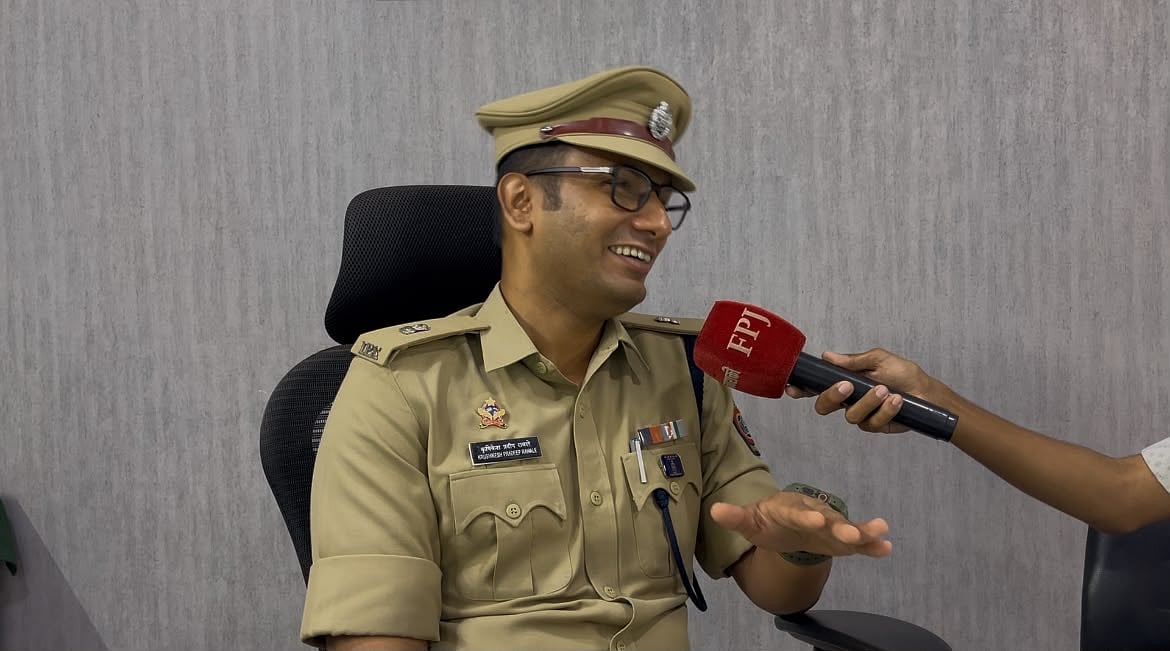
Pune: For a police officer, the day rarely ends when the city goes to sleep. Long hours, back-to-back protests, VIP movements and festival bandobast leave little room for rest or family time. But when DCP Zone 1 Krushikesh Rawale of Pune Police finally gets a break, his idea of unwinding is far removed from the chaos of Pune’s streets -- a quiet riverside, a few hours of sleep and his phone switched off.
With Zone 1 witnessing a series of protests in recent weeks, Rawale also speaks about the need for designated protest sites, the disruption caused by demonstrations on busy roads, and why people must be able to voice their concerns without affecting the daily lives of others.
In an exclusive interview with The Free Press Journal, he discusses the pressures of policing, leadership, protest management and finding peace behind the uniform.
Q. What does Police Commemoration Day mean to you personally as a police officer?
A. I see this day as an occasion to pay homage and respect to police personnel who have lost their lives while serving the nation, the state and every citizen. It is a day of immense respect for them. It is emotional, but there is also happiness in being able to pay our respects to those who made the ultimate sacrifice.

Q. Zone 1 has witnessed several high-pressure situations, from festivals to protests. How challenging has it been to manage everything simultaneously?
A. The situation has not been limited to Ganeshotsav. Since May, there have been student protests, Wari, Nag Panchami, demonstrations related to DJs and sound pollution, protests involving Vidyanand Bapat, Dahi Handi, Ganeshotsav and, subsequently, the MPSC protests. One event would be approaching its conclusion while preparations for another were already underway.
We rely on guidance from senior officers, Standard Operating Procedures (SOPs) and the support of Pune City Police personnel. Everything is planned meticulously. Even while making arrangements for Dahi Handi, we plan for Ganeshotsav. During Ganeshotsav, we manage crowds, prevent crime, identify chain-snatchers and pickpockets, and ensure the safety of devotees and VIPs.
We wait for events to conclude, after which we can expect some free time. However, the past few weeks have been difficult because of back-to-back bandobast duties. Responsibilities are delegated to officers, who are held accountable for their duties. This coordination helps us manage multiple situations simultaneously.

Q. What have been the biggest challenges for you and your team during this period?
A. The biggest challenge has been erratic working hours. Our duties sometimes continued until 3am, 4am or even 5am, despite having started around 10am or 11am. For the past two to three months, our professional and personal lives have been completely disrupted. There were no Saturdays or Sundays in the usual sense.
We had to explain to our families that this phase would pass and that we would spend time with them once things settled down. This was not limited to senior officers; personnel across ranks faced similar pressures. Staff members and officers would ask for leave, but it was difficult to grant it when the situation demanded their presence. Following the MPSC protests, we have started allowing personnel to take one or two days of leave so they can rest and recover.
Q. While some personnel are taking leave, you continue to work. How do you view this responsibility as a leader?
A. As a leader, I have to ensure that my men and women get proper rest and time with their families. Everyone must get the opportunity to take leave, rest completely and return feeling re-energised. Only after that can I think about taking leave myself. I cannot leave my team behind and go on leave while they continue to work.

Q. How do you see Zone 1 evolving in terms of public behaviour and law and order?
A. Zone 1 has always been historically significant, from the era of Chhatrapati Shivaji Maharaj to the Peshwa period. Political developments, cultural debates and differences of opinion will continue here. Pune has also been an important educational centre, often described as the Oxford of the East.
Much of this activity takes place in the peth areas, Deccan and Shivajinagar. Things will gradually settle down, but the struggle of ideas and views will never completely disappear. The responsibility of the police is to maintain a balance and ensure that differences do not result in untoward incidents.
Q. Mumbai has Azad Maidan and Delhi has Jantar Mantar as protest sites. Why has Pune not been able to establish a designated protest site?
A. A designated protest site is a place where people can express their views without disturbing the daily lives of others. In Pune, protests often take place near major roads, affecting traffic and public movement. The Pune Police Commissioner has identified two locations: the area near Dr Babasaheb Ambedkar’s statue and the Collector Office. Those wishing to protest should apply at Bund Garden Police Station and seek permission for a specific time.
People often target major roads such as Chhatrapati Shivaji Maharaj Road, Shrimant Bajirao Peshwe Road, Alka Chowk, JM Road and Fergusson College Road. These are important north-south routes with limited alternatives. When they are blocked, ambulances may be delayed, patients are affected and vehicles carrying essential supplies can face difficulties. VIP movements and other important activities are also disrupted.
We completely respect people’s right to protest, but demonstrations should not disrupt the daily lives of citizens. People can express dissent in several peaceful ways. The idea of deliberately stopping vehicular movement to make a protest visible needs to change.
Q. Kalakar Katta has a long association with Pune’s artists. Why are protests there a concern?
A. As you rightly said, Kalakar Katta is a place where sketchers, musicians and other artists gather to showcase their talent. I do not know how people have come to see it as a place for protests. It is a very small space. Even when 10 to 15 journalists gather there to report, the area gets fully occupied. During the recent protest, the entire space was taken up. There is also a restaurant nearby that depends on customers.

When protests take place, artists are pushed aside, gatherings spill onto the road and businesses can suffer. We have observed traffic backlogs of around 500 to 600 metres during such demonstrations. Kalakar Katta should remain a space for artists, and people should use the designated protest sites instead.
Q. How do you manage your mental health and physical fitness amid demanding working hours?
A. I practise spirituality regularly. I pray and meditate because I believe that if I remain calm, I can keep my police personnel calm as well. This helps us handle situations professionally, ensuring that protesters are not harmed and unnecessary force is avoided.
For physical fitness, I believe diet is extremely important. My wife takes good care of my diet, prepares healthy meals and advises me to avoid outside food. Work sometimes leaves me with only four to five hours of sleep, so whenever possible, I take short naps while travelling or during breaks. I try to get six to seven hours of sleep whenever circumstances allow. Our duties also involve considerable walking and standing during protests, which keeps us physically active.
Q. What do you do in your free time to refresh your mind?
A. I like taking leave and going somewhere surrounded by greenery, close to nature. The last time I took leave, I went near a riverside, carried comfortable clothes and slept there for three or four hours. I switch off my phone for a couple of days and keep it away from me. Spending time close to nature is my idea of rejuvenation.
Q. Is a no-network zone your comfort zone?
A. Yes. A no-talk zone, a no-network zone, is my comfort zone.

