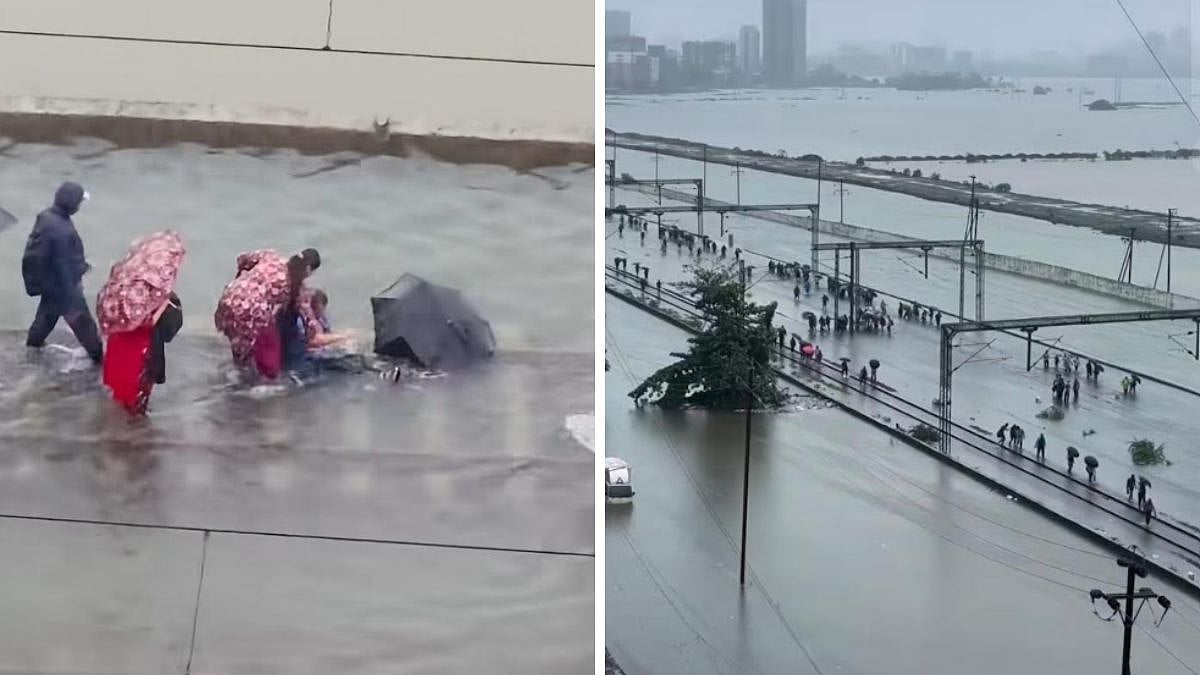
Mumbai: Three days of heavy rainfall brought life to a standstill in the Vasai-Virar region, leaving thousands of commuters stranded as repeated flooding near Nallasopara disrupted Western Railway's suburban services. While trains operated with delays during the morning, services between Vasai Road and Virar had to be suspended during the evening peak hours on Monday and Tuesday after water levels on the tracks crossed safe limits. The disruption once again highlighted the region's chronic drainage problems and the lack of reliable last-mile connectivity during emergencies.
For office-goers, the return journey became the biggest challenge. Many commuters managed to reach south Mumbai and other business districts in the morning, but were left with no clear way to return home after trains terminated at Vasai Road. Hundreds were forced to walk along railway tracks to nearby stations, while others depended on tractors and private vehicles charging steep fares to reach flooded residential areas.
"I have been completely cut off from my job, relatives and friends for the last two days," said Kanti Singh, a resident of Nallasopara. "There is three to four feet of water outside my house and no proper transport arranged by the Vasai Virar Municipal Corporation. Private tractor operators are charging ₹100 to ₹150 per person just to reach the station. Even if I somehow reach my office, I have no certainty that I will be able to return home because trains are getting terminated at Vasai. Like many others, I had to walk on the tracks and then take a tractor to reach my house."
Zafar Menon, a bank employee from Virar who works in Andheri, said his daily commute turned into an exhausting ordeal. "I left my office around 5 pm and it took me more than five hours to reach home. The train dropped me at Vasai around 8 pm, but from there I had to walk for hours through flooded roads. There was no proper coordination between the railway and the municipal corporation. Private transport operators charged heavily and not everyone could afford it."
The disruption also affected local businesses. Ajit Shah, a shopkeeper from Virar, said his business had almost come to a standstill. "My shop depends on supplies that come from Mumbai. For the last few days, transport has been badly affected and I cannot travel to Dadar to buy raw materials. Without fresh stock, running the business has become difficult."
Pramod Shukla, a resident of Nallasopara East, recalled walking for hours on Monday night after train services were suspended. "The tracks were flooded and there was no other option. I used my mobile phone flashlight to find my way while walking towards Nallasopara station," he said.
According to Western Railway, the flooding is not caused by rainfall alone but also by the geography of the region. Palghar is situated at a higher elevation, while Virar, Nallasopara and Vasai are low-lying areas. During heavy rain, water naturally flows towards these locations. However, rapid urbanisation, blocked natural drains and inadequate stormwater infrastructure prevent quick drainage, leading to water accumulation around the railway corridor. Since the railway tracks and surrounding city areas are almost at the same level near Nallasopara, train services have to be suspended whenever water rises beyond safe operating limits.
The disruption intensified on Tuesday, with 125 suburban train services cancelled by 8 pm, compared with 100 cancellations on Monday. While long-distance mail and express trains continued to operate on the through lines, suburban commuters bore the brunt of the disruption.
Recognising the recurring problem, Western Railway General Manager Ramashray Pandey inspected the affected section on Tuesday and directed officials to conduct a survey to examine the feasibility of raising the railway tracks between Vasai and Virar. The study will also assess the proposed MRVC fifth and sixth line project to ensure future railway infrastructure is built at a safer elevation.
A senior railway official said that permanent relief would not be possible without improvements to the city's drainage system. "From my experience, railway efforts alone will not be effective unless civic authorities improve drainage in these areas," the official said.
Vasai Virar Municipal Commissioner Prithviraj BP said the civic body's immediate priority over the past three days had been rescuing residents from flood-affected and coastal areas. "The rescue operation is still underway. We are identifying severely waterlogged locations and will prepare a comprehensive plan to prevent such situations in the future. Action will also be taken against illegal structures obstructing natural drainage," he said.
The commissioner added that due to severe waterlogging, buses could not operate on several routes. Dumpers and tractors were deployed to provide last-mile connectivity from railway stations, while police and RTO teams were stationed to prevent overcharging by private transport operators. As floodwaters receded on Wednesday, bus services resumed on several routes, while relief measures, including food distribution, continued in affected areas.
Railway officials maintained that Western Railway remained in constant coordination with the Vasai Virar Municipal Corporation at both senior and field levels throughout the crisis. However, for thousands of commuters who spent hours stranded, walking on flooded tracks or paying high transport charges to reach home, the three-day disruption exposed the urgent need for a permanent solution before the next spell of heavy rain.
To get details on exclusive and budget-friendly property deals in Mumbai & surrounding regions, do visit: https://budgetproperties.in/

