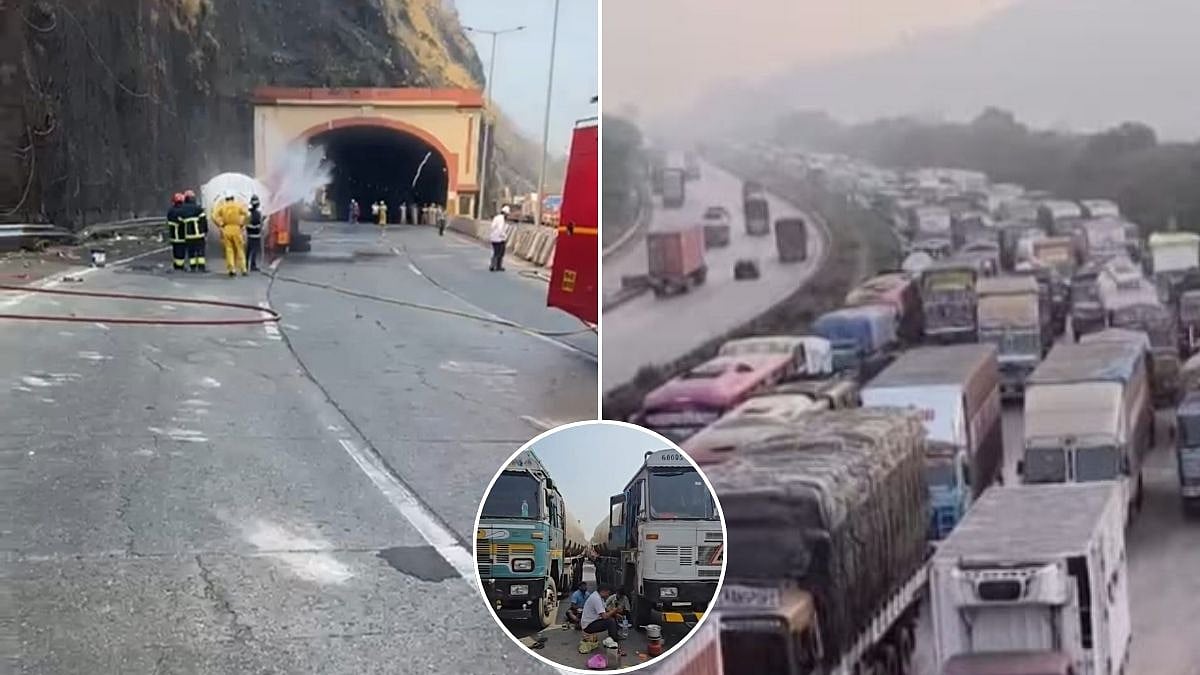
Mumbai, Feb 05: The Mumbai–Pune Expressway remained disrupted for nearly 30 hours following an accident involving a gas tanker. Due to the sudden closure of the highway, hundreds of vehicles were forced to remain stranded at the same spot for several hours.
Despite being one of the state’s most important highways, the government has been unable to take a decision on the expressway expansion proposal for the past four months.
Rs 16,000 crore expansion proposal pending
Considering the steadily increasing traffic on the 94.5-km-long expressway, the Maharashtra State Road Development Corporation (MSRDC) submitted a proposal to the government in November to expand the highway.
The plan involves converting the existing six-lane expressway into a 10-lane highway. The expansion of the country’s first concrete expressway is estimated to cost around Rs 16,000 crore.
According to a senior MSRDC official, a proposal worth about Rs 16,000 crore for the expressway expansion has already been sent to the government.
However, due to the Model Code of Conduct in force because of elections in different parts of the state, the proposal has not yet been approved. Approval for the expansion plan is expected soon.
Rising traffic and frequent jams
The Mumbai–Pune Expressway was opened in 2002 to enable faster travel between Mumbai and Pune. For a few years after its opening, commuters enjoyed relatively hassle-free journeys.
However, in recent years, due to population growth in Mumbai, Pune and surrounding areas, along with other factors, the number of vehicles using the expressway has increased rapidly. As a result, traffic jams have become a frequent occurrence, and on holidays, long queues of vehicles stretch for several kilometres.
Accident highlights need for wider highway
The accident involving a gas-laden tanker on Tuesday evening once again highlighted the need to expand the expressway. Had the highway been 10 lanes wide, it would not have been necessary to shut down the entire stretch for 13 hours.
Traffic movement could have been maintained by closing only a few lanes. It took the administration more than 35 hours to clear the traffic jam that built up from Tuesday evening. Given the seriousness of the situation, experts say there is an urgent need to take an early decision on the expressway expansion plan.
Missing Link Project progressing at speed
Meanwhile, the Missing Link Project, which will bypass the Khandala Ghat section and reduce the distance of the expressway by over six kilometres—cutting travel time by more than 25 minutes—is progressing at speed. The project is likely to be opened by May 1 this year.
The Missing Link Project is divided into two packages. Package I includes two eight-lane tunnels measuring 1.75 km and 8.92 km. Package II comprises two eight-lane viaducts measuring 850 metres and 650 metres, along with the widening of the expressway from six to eight lanes over 5.86 km, and the construction of over 10 km of approach and slip roads.
Also Watch:
Package II, which includes the 650-metre-long viaduct, will feature India’s tallest road cable-stayed bridge. It is being executed by Afcons Infrastructure Ltd. At the 650-metre viaduct, engineers are constructing 182-metre (597 feet) high pylons, taller than the 128-metre (413 feet) pylons of the Bandra–Worli Sea Link, making it the highest-ever bridge built for an Indian road project.
To get details on exclusive and budget-friendly property deals in Mumbai & surrounding regions, do visit: https://budgetproperties.in/

