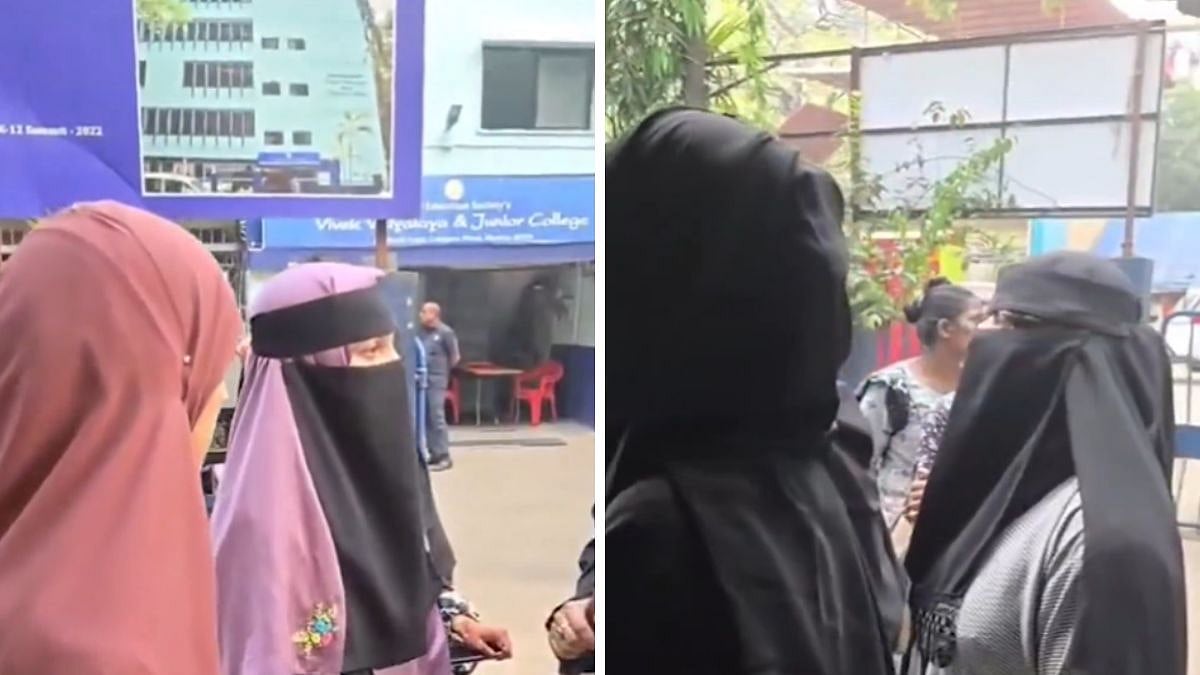
Mumbai, Dec 13: The debate over burqas, hijabs and niqabs in educational institutions resurfaced in early December 2025 at Vivek Vidyalaya Junior College in Goregaon West, where a temporary ban on burqas and niqabs triggered student protests and hunger strikes.
Following sustained demonstrations, the college withdrew the ban on burqas but continued to restrict face-covering niqabs, citing security and identification concerns.
Echoes of the Karnataka Hijab Controversy
The issue first drew national attention in February 2022, when a government college in Udupi, Karnataka, banned hijabs (head covering) in classrooms, triggering widespread protests and a legal battle that reached the Supreme Court. While the Karnataka High Court upheld the ban in state-run schools and colleges, the Supreme Court later delivered a split verdict in October 2022.
Divergent College Policies Amid Legal Uncertainty
In the absence of a final ruling, colleges have adopted differing approaches. In mid-2024, N.G. Acharya & D.K. Marathe College in Chembur introduced a dress code banning attire such as burqas, hijabs, niqabs and caps, leading to protests and criticism from particular groups.
Supreme Court Stay Offers Interim Relief
Meanwhile, the Supreme Court in August 2024 stayed the Mumbai college’s ban on hijabs and burqas, emphasising student choice and autonomy, particularly in private institutions. Many see this interim relief as a reaffirmation of individual rights, even though the larger legal debate is still unresolved.
Women’s Rights Activists Flag Impact on Education
Women’s rights activist Zakia Soman, founder of the Bharatiya Muslim Mahila Andolan, argues that the issue has been politicised at the cost of girls’ education. “Burqa and hijab are not related to religion. This is a patriarchal and political issue,” she said.
“Dress codes are applied only to girls and women, while men have complete freedom. Whether a girl comes to school with a hijab and books or without a hijab should not matter. But instead, girls are being pulled in opposite directions; some say don’t come without a hijab, others say don’t come with one. Eventually, girls suffer educationally.”
Political Voices Join Student Protests
AIMIM Women’s Wing Vice President Advocate Jahnara Sheikh joined the agitation at Vivek Vidyalaya, stating that the restrictions disproportionately affect Muslim girls. “Colleges do not have a specific uniform,” she said.
“We do not oppose the niqab ban; we oppose the ban on burqas and hijabs. Some colleges claim cheating cannot be traced due to burqas. But if a student wants to cheat, they will do so by any means.”
Allegations of Selective Enforcement
She further pointed out what she described as selective enforcement. “Sikh male students wear turbans, women from other communities wear sarees, and men wear kurta-pyjamas; no one bans their attire. In schools, dress codes are acceptable because uniforms exist. But in colleges, there is no such rule. Girls need a comfort zone. If a girl feels comfortable, she can focus better on her studies.”
Students Question Transparency During Admissions
A student pointed out that colleges did not inform students about the policy in advance. “Colleges do not tell us about the burqa and hijab ban during admissions,” said a female student. “If they had informed us earlier, many girls would have chosen another college. Colleges can make policies, but they must be transparent. We wear burqas and hijabs by choice. No one forces us.”
Identity, Not Just Attire, Say Students
For many, the issue goes beyond clothing. Law student Shanza Fakkih described the restrictions as an attack on identity. “We are not representing religion; this is our attire by default. If burqas create hatred, then sarees and suits should also be questioned,” she said. “This is political propaganda. These colleges have existed for years, and girls have always worn burqas. Why is it suddenly a problem now?”
She added that solutions already exist. “If cheating is a concern, female supervisors can examine female students. We have no objection. Not every student cheats, and that should also be considered.”
Administrators Cite Security and Accountability
A few college administrators, however, defend the restrictions, citing security and accountability. “Educational institutions have a responsibility to ensure that everyone on campus is identifiable,” said an administrator.
“Face-covering makes it difficult during examinations, admissions and movement in restricted areas.” Some also raise concerns about impersonation and misuse of facilities.
Supporters of the ban argue that institutions have the right to enforce uniform norms. “Once you enter an institution, certain rules apply equally to all students. It’s not about targeting any community,” the administrator added.
Fears of Exclusion From Education
Women’s rights activists caution that blanket restrictions on attire, especially face-covering, can unintentionally push young women from conservative backgrounds out of education altogether, undermining the very goal of empowerment.
Muslim Satyashodhak Mandal President On Hijab Controversy
Dr. Shamsuddin Tamboli, President, Muslim Satyashodhak Mandal, stated, “Burkha, hijab or niqab aren’t an essential part of Islam. It is a pre-Islamic culture and has continued due to a male-dominated socio-religious mentality. We consider that a burkha-free society would be healthier and a symbol of the modernisation of an age-old society. It is part of social reform, which we encourage. We have to understand that in our democratic society, we must respect individual choice and, at the same time, encourage a free social atmosphere.”
Further, Dr. Tamboli added, “Yes, if the dress code in educational institutions is mandatory, one has to accept it and follow the norms of the educational institutions. But if the motive of such educational institutions is ill-intentioned—to dominate the minority and discourage Muslim girls’ education—then it must be condemned. These days, right-wing organisations have become very active in raising such issues. Their intentions are not reform, but the creation of hatred and enmity in society. The Muslim community should also introspect on the issue and change its attitude. There is no need to exhibit a separate identity by using the burkha in educational institutions. However, social reform or change has to be brought through mass education and a free atmosphere, not through compulsion.”
Also Watch:

Scholars Come In Support Of Education Rules
A few scholars have come forward in support of the education rules, emphasising discipline and uniformity in educational institutions. Dr Zeenat Shaukat Ali, a prominent Indian Islamic scholar, former Professor of Islamic Studies, and Director-General of the Wisdom Foundation, stated, “Our country is secular and democratic, and everyone has the right to wear clothes of their own choice. In India, all kinds of attire, including religious symbols, are permitted. However, schools and educational institutions have uniforms, which promote equality, and students are required to follow these rules. Every religion has essential practices, while some forms of attire have evolved as cultural practices over centuries. If a student has an issue with institutional rules, they may choose to seek admission elsewhere. The matter is currently sub judice. Nowadays, every social issue tends to become political.”
As the debate continues, the burqa and hijab controversy has become more than a question of dress. It reflects deeper tensions around women’s autonomy, fundamental freedom, institutional authority and the future of inclusive education in India. One reality remains constant: it is the students, especially young women, who bear the highest cost in their education.
To get details on exclusive and budget-friendly property deals in Mumbai & surrounding regions, do visit: https://budgetproperties.in/

