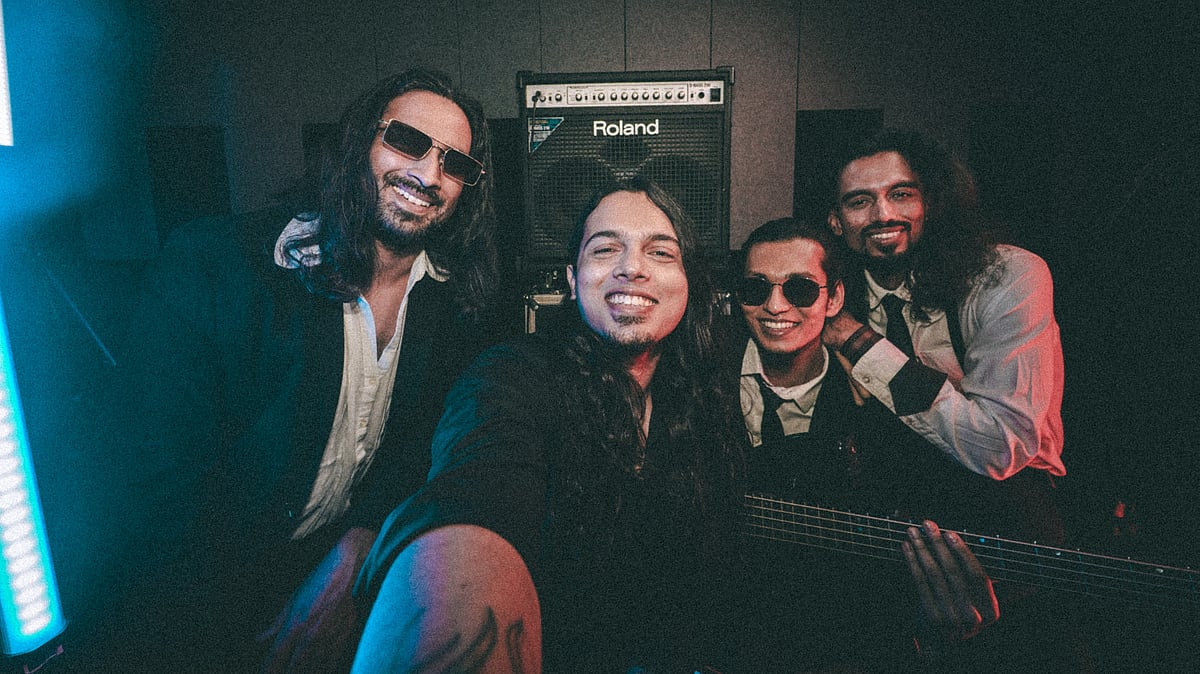
Pune-based Nemophilis is a three piece rock band emerging with electrifying as well as calming songs powered by enchanting harmonies, adept playing and seamless songwriting that narrates stories, perceptions and events that they witness in their lives.
The band were originally four members, until the band parted ways with session guitarist Mayank Katare and returned to the lineup they started off with. They now comprise of vocalist-guitarist Kshitij Kumar, bassist Saurabh Lodha and drummer Akarsh Singh. While the band members come from different parts of the country, since the last 10 years they have been living in Pune.
Nemophilis were winners at the Independence Rock Band Hunt 2023 competition. Their long hairdos and raging appearances reflect the stereotype of an archetypal grunge rock group.
The band accompanied by session guitarist Rohit Lalwani recently performed at the NCPA as part of Home Grown.
In an interaction with The Free Press Journal, the band members opened up about their musical journey and discussed their two albums.
Excerpts from the interview:
While you are three members in Nemophilis, for the show at the NCPA as part of Home Grown, you brought in guitarist Rohit Lalwani.
Adding a fourth member to the band is also part of that evolution. It allows us to bring a fuller, more immersive live sound on stage and explore more sonic layers in real time. Working with seasoned musicians naturally pushes us to be better.
So going back a few years, how did the name Nemophilis come about?
The original word is Nymophilist with a T in the end. But a lot of people already were called Nymophilist with a T. So I thought how about I drop the T and get a domain name. It's much more easier on the tongue and stuff. And now that has worked to our advantage because there's so many nymophilist like bands and artists, but there's only one Nemophilis. So if you go to the Google and type nymophilist all the things that you see is us.
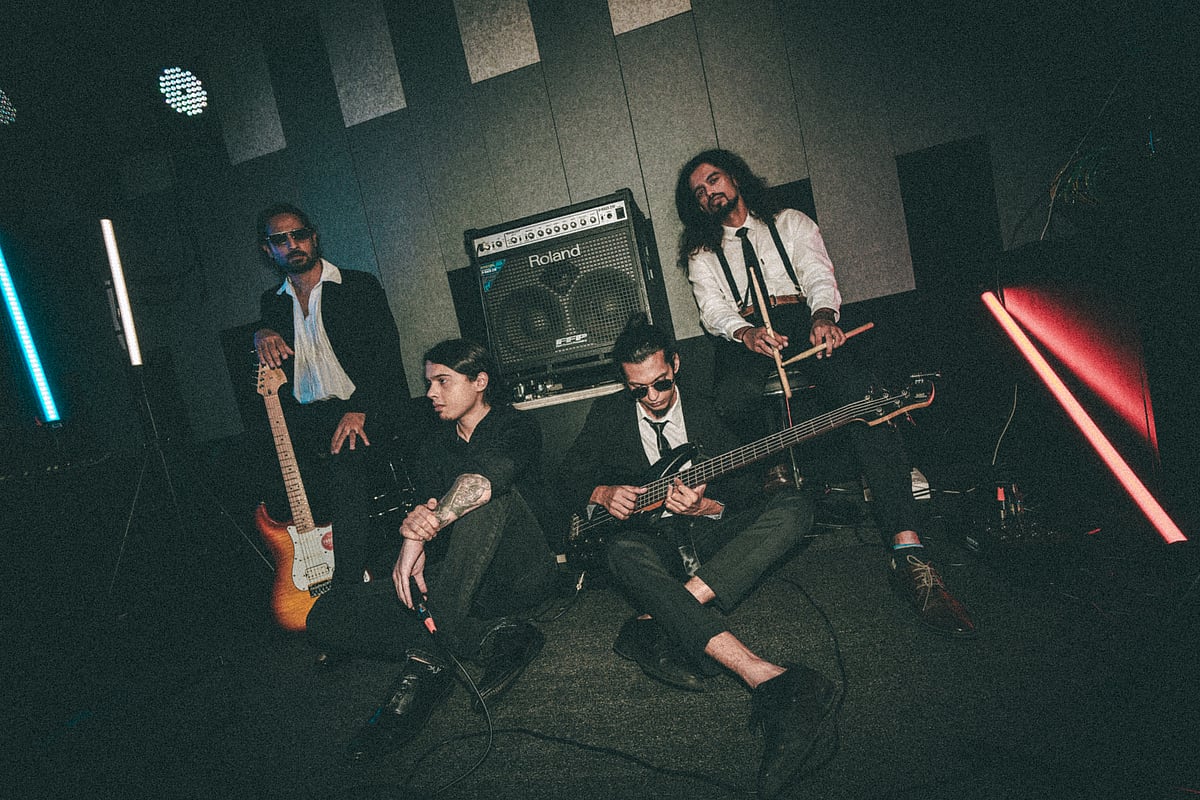
How did the three of you come together and form Nemophilis?
Nemophilis didn’t start with a big plan. It started quietly—just Kshitij and me, sitting with a newly bought audio interface, covering songs we loved and figuring things out as we went. There was no pressure, no vision of where it would lead. We were simply enjoying the process. In 2018, when Saurabh Lodha joined us, that’s when things truly shifted. What began as casual covers slowly turned into an original voice, and over the years that voice grew into 10 singles and two full-length albums released by 2025.
What is the story behind your second album name ‘Hyozan’.
After putting out our first album, we found ourselves reflecting deeply on what we were really trying to say. We realised that a lot of our melodies and lyrics like things we had written with a lot of honesty, were getting buried under layers of distortion and heavy drums. That’s when the idea of doing something quieter first surfaced. We wanted people to really hear the words, to sit with the vocals, to feel the emotion without being overwhelmed. That thought process eventually became Hyozan, an album built around restraint, clarity, and space.
You are known for high-energy rock/metal core. What prompted the shift to softer textures, acoustic guitars, and cajón for your acoustic 2025 album ‘Hyozan’? Are there any new songs on the album?
From the very beginning, Nemophilis was never meant to belong to just one corner of music. We always felt there was a massive gap between metal listeners and people who connect more with softer, emotional music. Our intention was never to choose sides, but to exist somewhere in between, to be a bridge. Hyozan naturally landed in that space, where heaviness isn’t about volume, but about feeling.
The album lyrically revolves around mental health. Why did you choose to touch on the concept of mental health in this acoustic set?
Growing up on bands like Linkin Park and Avenged Sevenfold, what stayed with us long after the music ended were the lyrics. They spoke openly about suffering, confusion, and inner battles, things we were all experiencing in our own ways. Those songs made it okay to feel broken. They made it okay to talk about it. That belief still sits at the core of Nemophilis. We write because we know someone out there might need to hear those words, just like we once did.

Does ‘Hyozan’ come to terms with your own lives?
We genuinely believe music can heal, not in a dramatic sense, but in small, meaningful ways. Every one of us has gone through phases where life felt heavy, and often the answers didn’t come from outside but from looking inward. Writing about that journey, about understanding pain and slowly learning how to deal with it, is something we hold very close.
How different is it from your debut album ‘The Iceberg’.
Interestingly, albums like ‘Iceberg’ and ‘Hyozan’ speak about similar emotions, but they do so in completely different languages. ‘Iceberg’ was loud, aggressive, almost confrontational. ‘Hyozan’ on the other hand, is soft, calm, and peaceful. The emotions are the same, but the expression has changed.
Having built a reputation with Linkin’ Park tributes, how does that legacy influence your original songwriting?
Tributes, especially to Linkin Park, continue to be important for us. We’re fans first, musicians second. While it’s true that our original music doesn’t always reach as wide an audience, we don’t regret doing tributes. If it helps carry a message forward or connects with people in any way, it feels meaningful.
After the ‘Hyozan’ acoustic set released in June 2025, what is next for Nemophilis? Are you working on new, heavier original music?
Yes, new music is already in the works, and we’ll start talking about it very soon. There’s a lot of excitement around what’s coming next.
When re-recording tracks like What I've Done or Breathe acoustically, what was the biggest challenge in keeping the emotional intensity without the heavy electric distortion?
Stripping the music down was actually far more challenging than making it heavy. With fewer instruments, there’s nowhere to hide. Every note has to matter. Every sound has to emotionally support the lyric without overpowering it. That process pushed us creatively and emotionally in ways we didn’t expect.
You have been described as a "raw and dynamic" trio. How has your sound evolved from your 2019 debut single Today to your recent work?
While the lyrics remain raw and honest, our sound has evolved with time. The musical landscape today is very different. It’s no longer just about guitars and drums, everything needs to be thoughtfully crafted with modern textures and sounds. In that sense, Nemophilis has grown more contemporary, while still holding onto its emotional core.
If you could collaborate with any international artist, who would it be?
Personally, I’m deeply inspired by artists who constantly experiment and push emotional boundaries. Bands like Bad Omens, Architects, and Sleep Token are some. That fearlessness in expression is something I admire and hope to explore more in the future.
So what makes Nemophilis different from other bands right now?
We don’t see ourselves as doing anything radically different from the rest of the scene. But we do believe consistency matters. If more bands keep showing up, playing shows, releasing music, creating content, the scene grows stronger. We’re just trying to do our part by staying present and committed.

