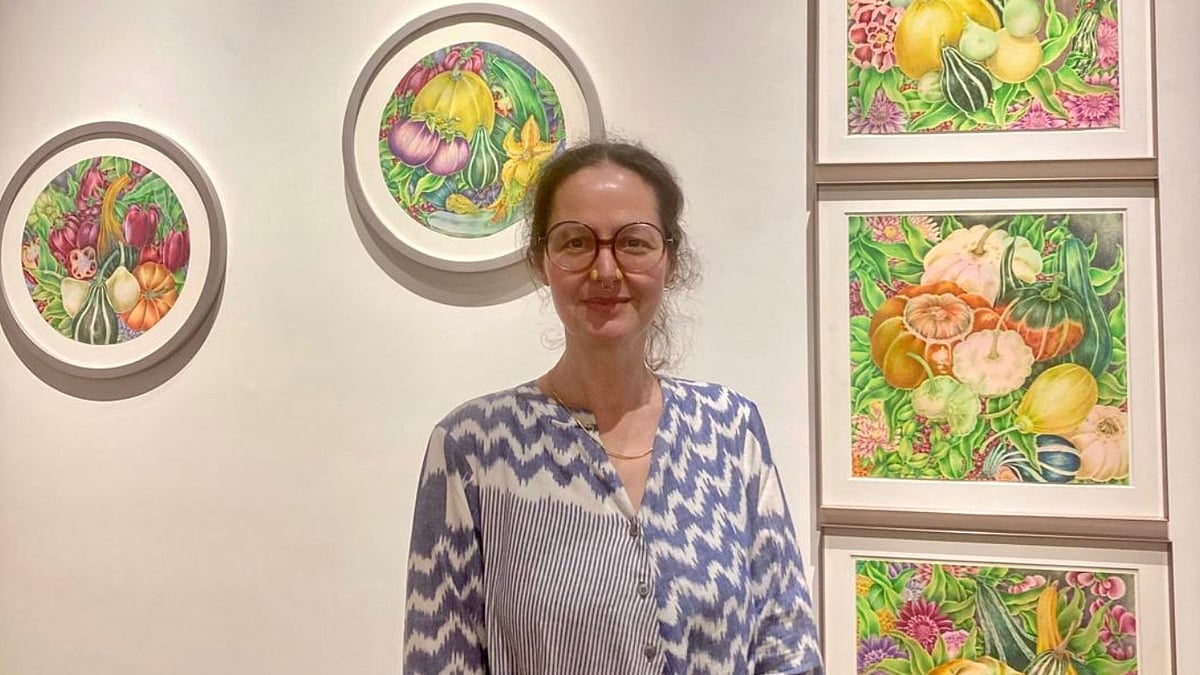
Gardens of Song, a solo exhibition by Maya Burman, was curated by Art Musings in conjunction with the Mumbai Gallery Weekend. Burman’s lineage, as the daughter of Indian artist Sakti Burman and French artist Maïté Delteil, serves as the bridge between European and Indic civilisations: “I feel it is expressed naturally in my work. I get inspired by everything that I see around me. That background is coming from both countries. This is what makes my work specific.” Fusing the detail of Indian miniature painting with the structures of European Medieval architecture, the artist offers a series that celebrates maximalism.
Rejecting Minimalist Void
The hallmark of a Burman piece is the seamlessness of its subjects. Rooted in the French Art Nouveau tradition, her protagonists are sewn into their surroundings. This 20th-century movement was about organic forms and flowing lines. Maya adopts this legacy by rejecting the minimalist void. Every element—from a blade of grass to the curve of a river—is subordinate to the overall tune of the painting. “Florals bloom across sleeves and shawls, geometric motifs ripple along hems, and floors unfold like woven rugs,” shares Shweta Shiware, Curator, Gardens of Song.
The artists’ approach reflects the Art Nouveau philosophy of Gesamtkunstwerk, or a “total work of art.” Saturating every millimetre of the paper, the visual mesh holds the composition in place. “Though there is a lot of detail and depth in Maya’s work, it all forms a composite whole. Nothing looks excessive or unnecessary to the composition. The painting keeps revealing itself to you and invites you to explore it again and again,” says Sangeeta Raghavan, Gallery Director, Art Musings. Ornamentation dictates the movement of the figures, forcing the elements to occupy the same swirling, organic logic. The figures and the foliage are cut from the same cloth, stitched with the same memory and mood.
Athleticism of Leisure
Despite the density of her patterns, the pieces possess a weightlessness. At the centre of the lattices are moments of heightened “play”. Not chaos but joie de vivre (literally translating to ‘joy of living’) expressed through a leisurely athleticism. The protagonists are in the act of being—preparing supper, bathing, or tending to vegetation. “There are subjects that I like to play with—the little drummer, the musicians, the angel, the little boat on paper, the circus, the acrobats. These subjects give me joy,” shares Burman.
A vivid, childlike imagination permeates Maya’s work. For her, the pleasure is in the noticing; the work celebrates the gravity of the domestic and the everyday: “I am very curious about character. I am always looking around me and trying to see how things can be added to my composition. I feel it is a blessing because I never feel bored in life. Any little thing makes me happy.”
Though her sensibilities sometimes align with the post-impressionist work of Édouard Vuillard or Pierre Bonnard, Burman’s vision is distinctly more porous, free of worldly logic. It creates a gentler, more expansive world.

Imagination to Inhabitation
The most striking shift in this body of work stems from Burman’s 2019 move to her family home in Anthé, a small town in southern France. For decades, Burman admitted to "painting the place I wished to be," An idyllic Eden. Living in the countryside inverted this relationship. She now paints the life she is actually inhabiting.
In the Mon Jardin series, this is most evident. Anthé’s abundance, its fruits, birds, and shifting seasons entered her art: “They have the same importance as the figures. A melon can anchor a scene the way a body would. A cabbage can hold light the way a face does.” They are, as Maya describes them, “love stories” or “encounters” with the living world. Talking about the Mon Jardin series, Sangeeta adds, “The artist has rendered the work using only colour pencil, and the effect is magical.”
“Pattern, in Burman’s hands, doesn’t decorate. It organises the picture, becoming both air and architecture,” states Shweta Shiware. Her architectural training at the École Nationale d’Architecture Paris – Villemin manifests in her precision, defining the depth and boundaries of the frame. “She never repeats a motif; her lines ripple, curl and diverge like living forms. Fabric becomes landscape, landscape becomes fabric. Clothing turns into topography,” adds the Curator.
Gardens of Song holds a relentless sense of discovery. The artist creates a world where colour, pattern, and feeling grow in tandem. On view till February 21, the song rings clear and uninterrupted, as part of a singular whole.

