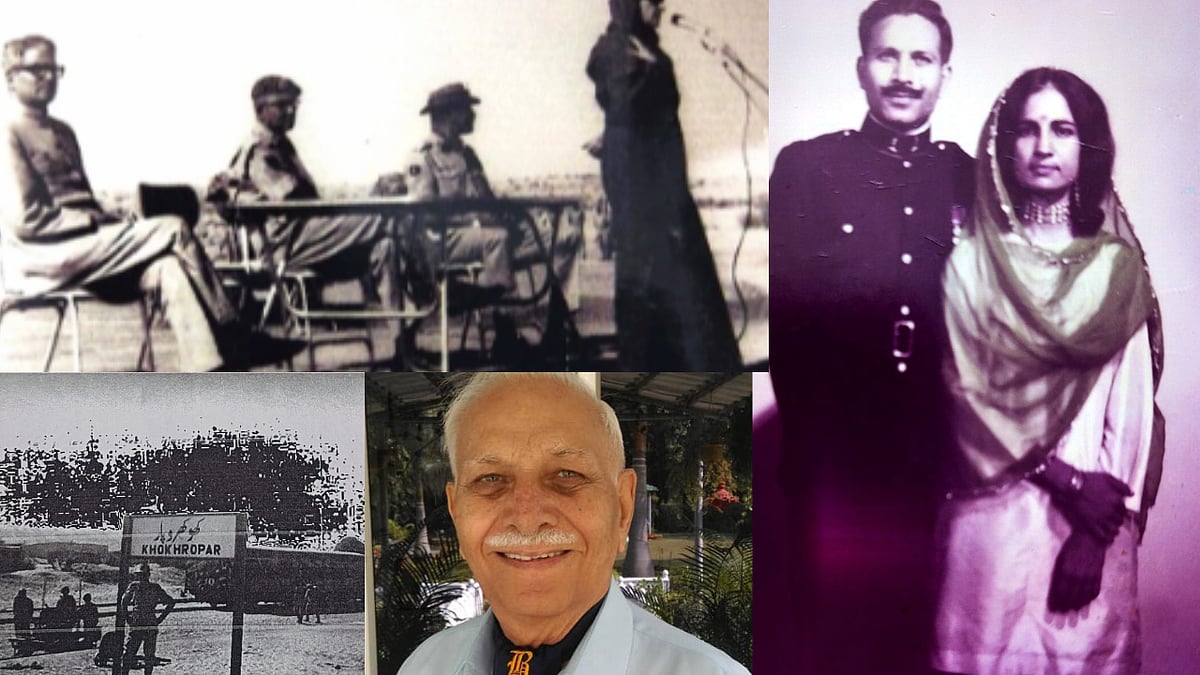
Mhow (Madhya Pradesh): We were fortunate to meet 90-year-Young veteran Brigadier Madan M Bhanot, whose eyes still sparkle with the fire of 1971—a war that carved Bangladesh's freedom and India's greatest military triumph. Commissioned in 1957, Brig Bhanot served 33 years in uniform, participating in every major conflict till his retirement in 1990.
He comes from a family of soldiers where his great-grandfather, grandpa and uncle all served in World War I. On the 54th Vijay Diwas, his recollections carry us back to the days of the Bangladesh Liberation War.

Wife's parting words that served as armour
December 3, 1971. Pakistan launched their attack and Bhanot, fresh from his Staff Course at Wellington, was heading to join the war in the Barmer sector, Rajasthan. His wife, Saroj, who came to see him off, whispered words that would echo through the battlefield: "Please do not worry about us. I am educated, and I will take care of myself and our children even if you did not return from war. Go and give your best on the battlefield and don't look back." Those words became his armor.
PM Indira Gandhi’s bold stand at the border
While being briefed on the battle situation, Bhanot learned of then Prime Minister Indira Gandhi's galvanizing visit to the troops at Barmer’s Munabao Railway Station, right next to the international border with Pakistan. Standing with her back to enemy territory, she rallied the soldiers in her olive green saree, declaring, "I have come to tell you that next time when I come, I shall meet you there inside Pak territory." Noticing everyone in khaki uniforms, she added with humility, "Sorry, I am improperly dressed. Next time, when I come, I will be wearing a khaki saree." That evening, after her address, the war ignited.
Navigating enemy territory with nothing but instinct
A few days into the war, Bhanot's first taste of war thrust him straight into the unknown. Tasked with delivering operation instructions to para commandos raiding deep inside Pakistan, he had no proper map—just an antique jeep and raw determination. Calculating roughly eight kilometres from his position, he ventured along the border toward Pakistan at night, using darkness as his shield. At 7.5 kilometres on his meter, he slowed down. Through the blackness came a shout: "THAM!" He dismounted. The voice rang again saying “PEHCHAN KE LIYE AAGE BADHO”. Then Bhanot gave him the password and responded with "DOST" (friend), flashed his light, and relief flooded both men—a Sikh commando had been waiting for those crucial instructions.
When railway tracks became lifelines in the desert
The next day brought a cruel reality—400 vehicles, half-swallowed by sand, their target, Nayachhor, sitting 67 kilometres inside Pakistan. After clearing obstructions and overwhelming a Pakistani company, they reached Khokhropar railway station and found water. With vehicles useless, donkeys and camels became their supply chain. Then came a stroke of genius: an officer noticed the gauge between railway tracks matched their jeep's wheelbase perfectly. Soon, jeeps rattled along the tracks, ferrying water and rations—a wartime improvisation that kept the advance alive.
Shift to Chittagong's chaos
On December 17, a ceasefire was established, and India had seized 10,000 square kilometres of the Barmer sector. Post-ceasefire on the same night, Bhanot flew from Jodhpur to Chittagong, Bangladesh, arriving on December 19. Battles raged in the Hill Tracts against holdouts, and his brigade of that time needed him to handle 26,000 prisoners. Bangladesh was born, and warriors like Brig Bhanot had midwifed a nation. His grandson now carries the uniform for the sixth generation.

