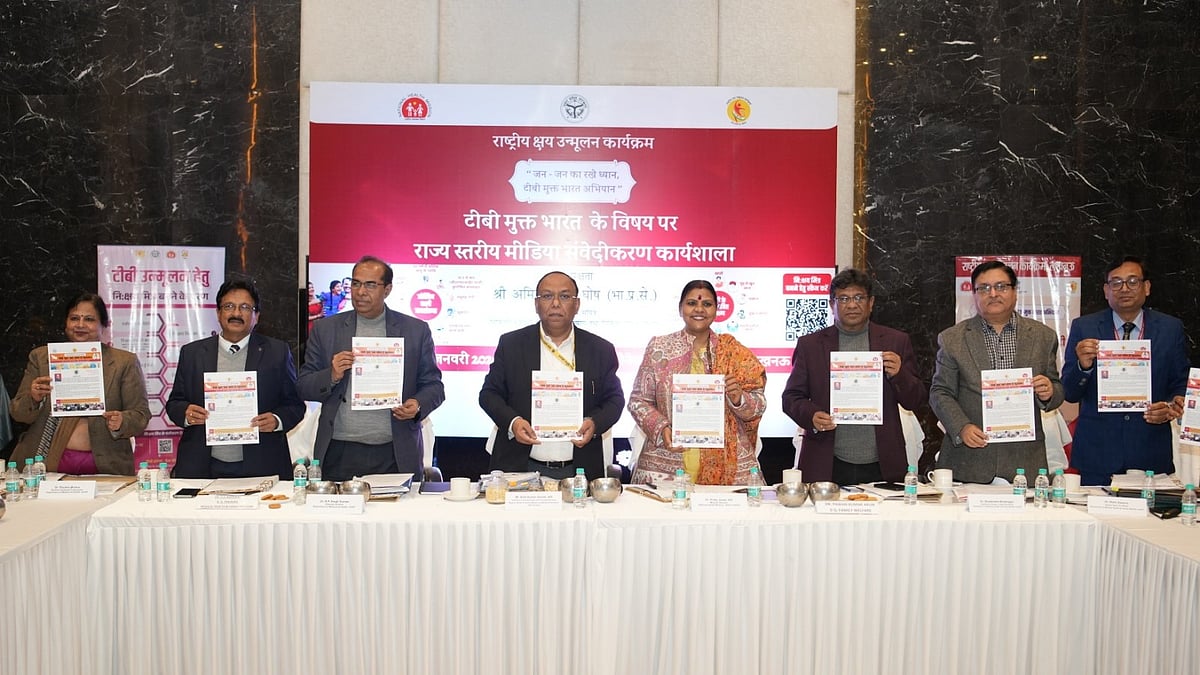
Lucknow: Uttar Pradesh will relaunch a 100-day intensive tuberculosis case-finding campaign from February as part of efforts to accelerate progress towards TB elimination, senior health officials said.
State workshop
The announcement was made at a state-level media sensitization workshop jointly organised by the Uttar Pradesh Health Department and Global Health Strategies. Additional Chief Secretary (Health) Amit Kumar Ghosh, who chaired the workshop, said TB elimination has now become a people’s movement and requires coordinated action by the government, media, development partners and communities.
Releasing the first edition of the e-newsletter titled “TB-Free Uttar Pradesh”, Ghosh said the state has expanded the use of portable, AI-enabled handheld X-ray machines to identify TB cases among people without visible symptoms. He added that molecular testing through NAAT has been strengthened at the community level, with 930 machines currently operational across the state to reduce the need for patients to travel long distances for diagnosis.
Ghosh said the first phase of the nationwide 100-day Intensive TB Case-Finding Campaign began on December 7, 2024, and Uttar Pradesh was recognised by the Union government for its performance. Between December 7, 2024 and January 17, 2026, around 30.2 million people from vulnerable groups were screened in the state. During this period, over 8.12 million X-rays and nearly 2.48 million NAAT tests were conducted, leading to the detection of about 733,000 TB patients. Of these, nearly 169,000 were asymptomatic, highlighting the impact of proactive screening.
PPP support
He also pointed to the role of public-private partnerships, noting that support through corporate social responsibility initiatives has helped strengthen diagnostic capacity. With assistance from IOCS, 74 True-Nat machines with four modules each are being provided to the state, while purchase orders have been issued for 75 additional AI-enabled handheld X-ray machines.
Mission Director of the National Health Mission in Uttar Pradesh, Dr Pinky Jowel, said the state has recorded a 17 percent reduction in TB incidence compared to 2015. She said the expansion of the laboratory network has been key to this progress. The number of NAAT machines increased from 141 in 2017 to 930 in 2025, while culture testing facilities rose from five to 14 during the same period.
Dr Jowel added that TB notification targets improved from 76 percent in 2021 to 104 percent in 2025. Treatment success rates for drug-sensitive TB patients increased from 85 percent to 92 percent, while treatment retention among drug-resistant TB patients rose from 72 percent to 87 percent. NAAT testing coverage also improved to 91 percent.
Social support
Highlighting social support measures, she said nearly 98,900 Ni-kshay Mitras have so far provided nutritional support to about 1.03 million TB patients under the Ni-kshay Mitra initiative, contributing to better treatment continuity and outcomes.
Director General of Medical and Health Services Dr Ratan Pal Singh Suman said the Differentiated TB Care system for severe and high-risk patients was strengthened during the campaign, with special assessments conducted for over 304,000 patients. He added that TB Preventive Treatment was initiated for about 581,000 eligible household contacts to prevent future cases.

State TB Officer Dr Shailendra Bhatnagar said the earlier 100-day campaign helped identify a large number of missed TB cases and link them to treatment. Building on this, the next campaign from February 2026 will involve participation from elected representatives, grassroots health workers, voluntary organisations and the media.
Next phase plan
He said awareness activities will be carried out from primary schools to higher education institutions, while intensive screening will focus on industrial areas, urban slums and other high-risk groups. Public outreach will also be expanded with the help of My Bharat Volunteers, whom he urged to register as Ni-kshay Mitras.
Summing up the workshop, Director of National Programmes Dr Shubha Mishra said Uttar Pradesh’s progress demonstrates the impact of strong leadership, data-driven planning and effective implementation at the grassroots level. She appealed to the media to help counter myths around TB, promote early diagnosis and spread awareness about government services.
Deputy State TB Officer Dr Rishi Saxena, delivering the vote of thanks, said the workshop reflected the state’s political commitment and collaborative approach, and would serve as an important step towards achieving the national goal of a TB-free India.

