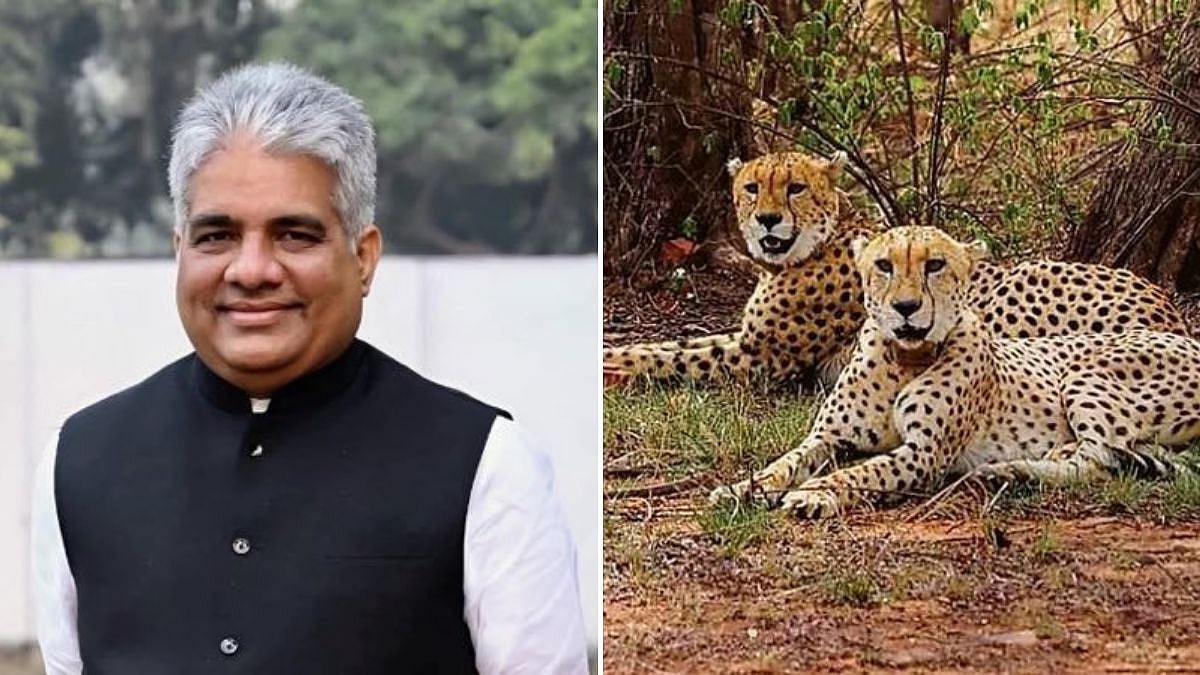
Jaipur: A new batch of Cheetah is arriving in the country from Botswana. Besides this, the central government would conduct a comprehensive review of policy for tiger conservation.
Cheetah Program Progress
This was indicated by the Union Minister for Environment, Forest, and Climate Change, Bhupender Yadav, while addressing the inaugural session of the ‘Conference of Chief Wildlife Wardens of Tiger Range States and Field Directors of Tiger Reserves’ in Alwar, Rajasthan, on Saturday.
Highlighting the Cheetah reintroduction program, the minister said India has successfully carried out an international translocation of a wild species that had become extinct in the country, with the project now reaching the third India-born generation of cheetahs. He said a new batch of cheetahs from Botswana is expected to arrive around the end of February.
Working Groups for Challenges
Calling for a review of all policy decisions taken in the 28 meetings of the National Tiger Conservation Authority (NTCA) held so far to identify decisions that have become outdated, those that could not be implemented, and those that have been fully executed, the minister said that this exercise would help tiger conservation policy to adapt to the challenges being encountered in present times and ensure efficient implementation of conservation measures on the ground. “India has completed 50 years of tiger conservation, and this is an appropriate time for a comprehensive policy review. Policy decisions taken over the last five decades should be consolidated into a formal policy statement placed as the first agenda item in the next NTCA meeting,” said Yadav.

Yadav also called for the formation of four working groups to review region-specific challenges, including changes in tiger population, and to assess the implementation of centrally sponsored schemes across the tiger reserves of the country. Further, the minister also emphasized discussing the ways to enhance coordination between NTCA and institutions such as the Wildlife Institute of India, the Botanical Survey of India, the Zoological Survey of India, and the Indian Council for Forestry Research and Education to incorporate research inputs from these apex organizations and derive practical benefits in tiger conservation.
Standardizing Rescue Care
On the issue of tigers and other wildlife animals moving out of core areas of forest, the minister said, "The need for strong response systems becomes critical as tigers and other wildlife move beyond core areas. Injured animals, conflict-related cases, orphaned cubs, and other animals in stress require timely and professional intervention, making it essential to develop a clear and standardized framework for rescue, rehabilitation, and transit treatment centers around tiger reserves.
The two-day conference would deliberate conservation priorities, implementation challenges, and emerging needs of wildlife conservation in an integrated manner.

