
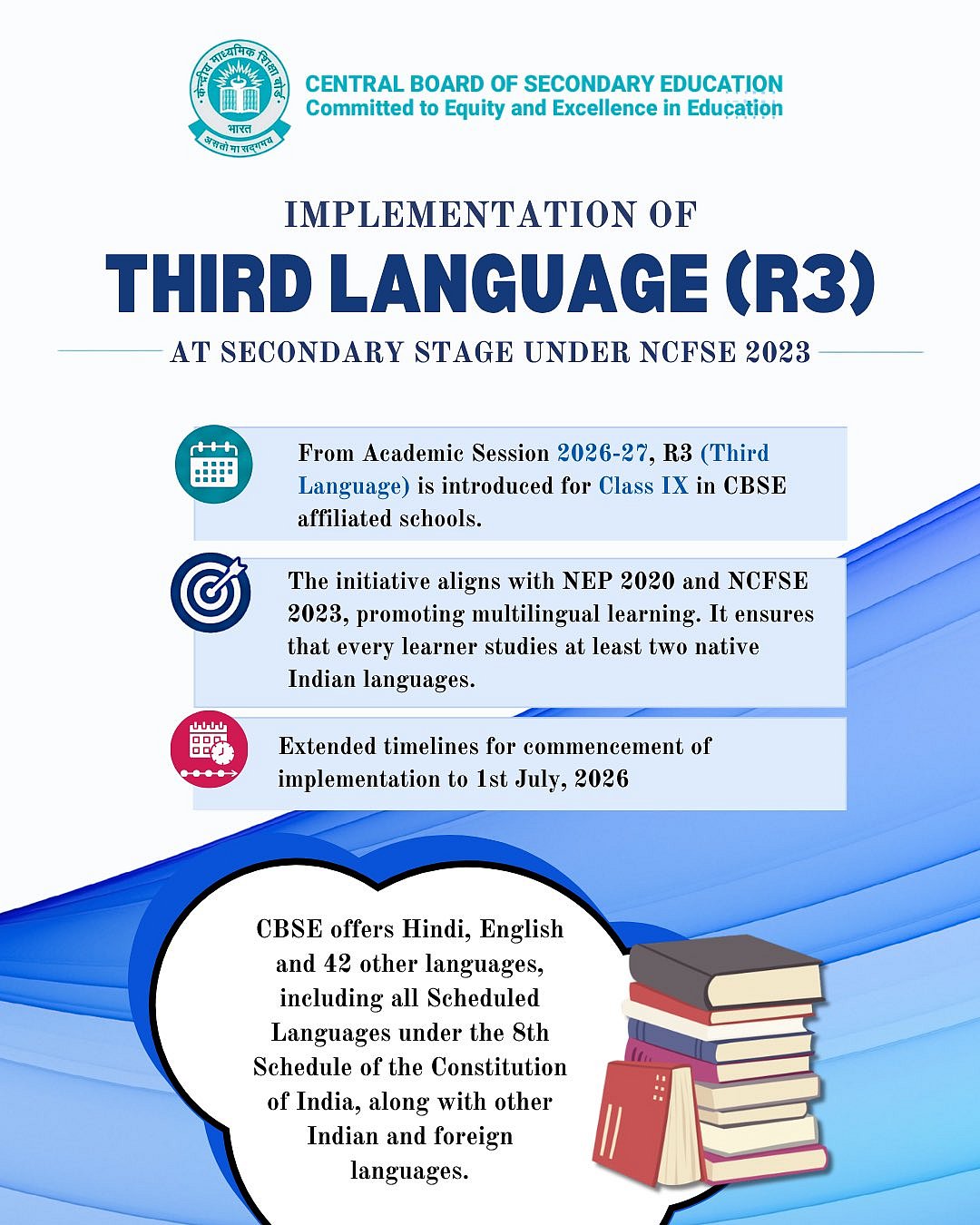
In a major step towards implementing the vision of the National Education Policy (NEP) 2020, the Central Board of Secondary Education (CBSE) on Friday announced that it will introduce R3 (Third Language) for students of Class IX from the 2026–27 academic session.
The move is part of the National Curriculum Framework for School Education (NCFSE) 2023, which seeks to strengthen multilingual education and promote India's linguistic diversity.
Under the new framework, students will study three languages from Class IX onwards, with an emphasis on ensuring that every learner acquires proficiency in at least two native Indian languages.
How the Three-Language Framework Will Work
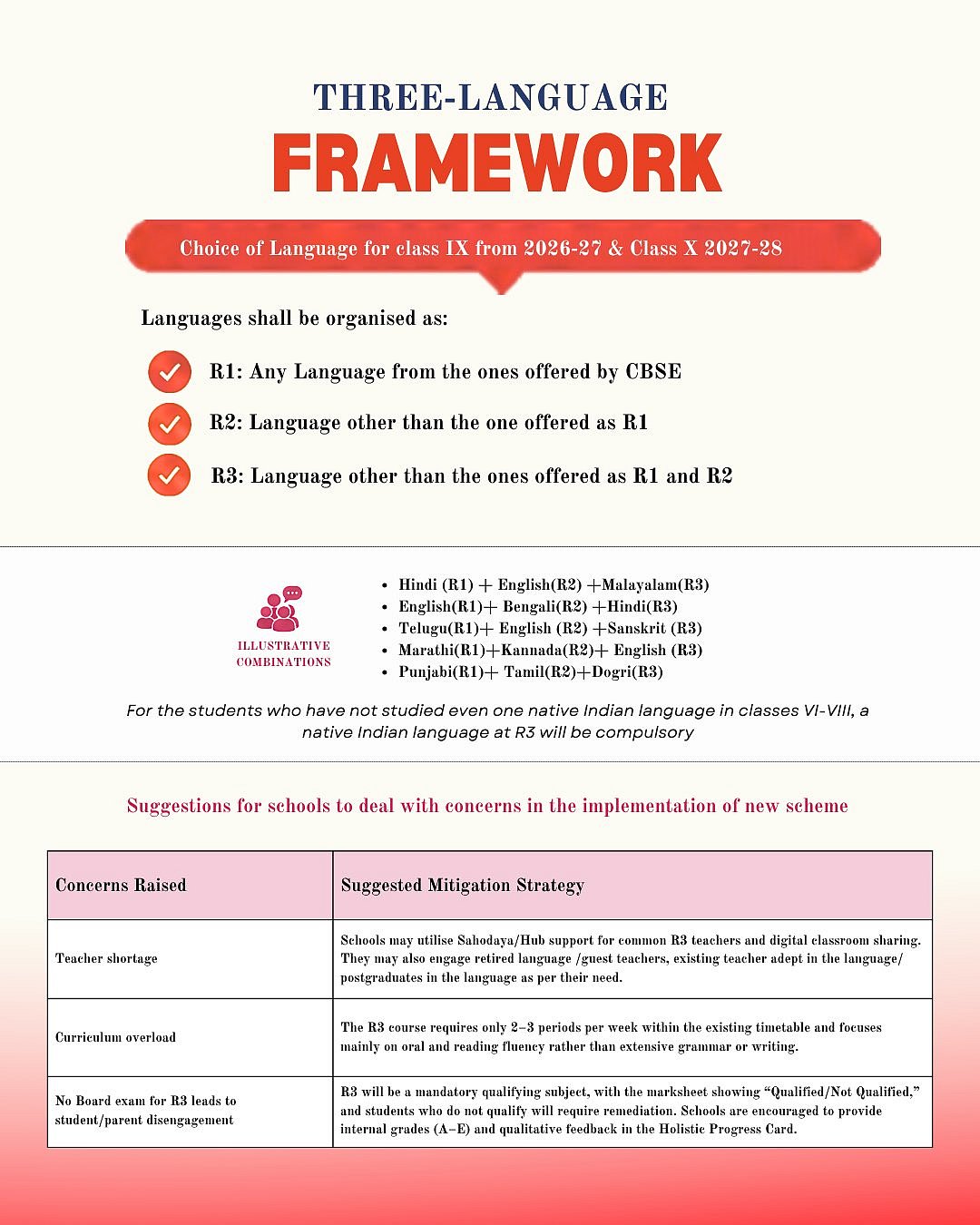
According to the guidelines, languages will be organised into three categories:
R1: Any language offered by CBSE
R2: A language different from the one chosen as R1
R3: A language different from both R1 and R2
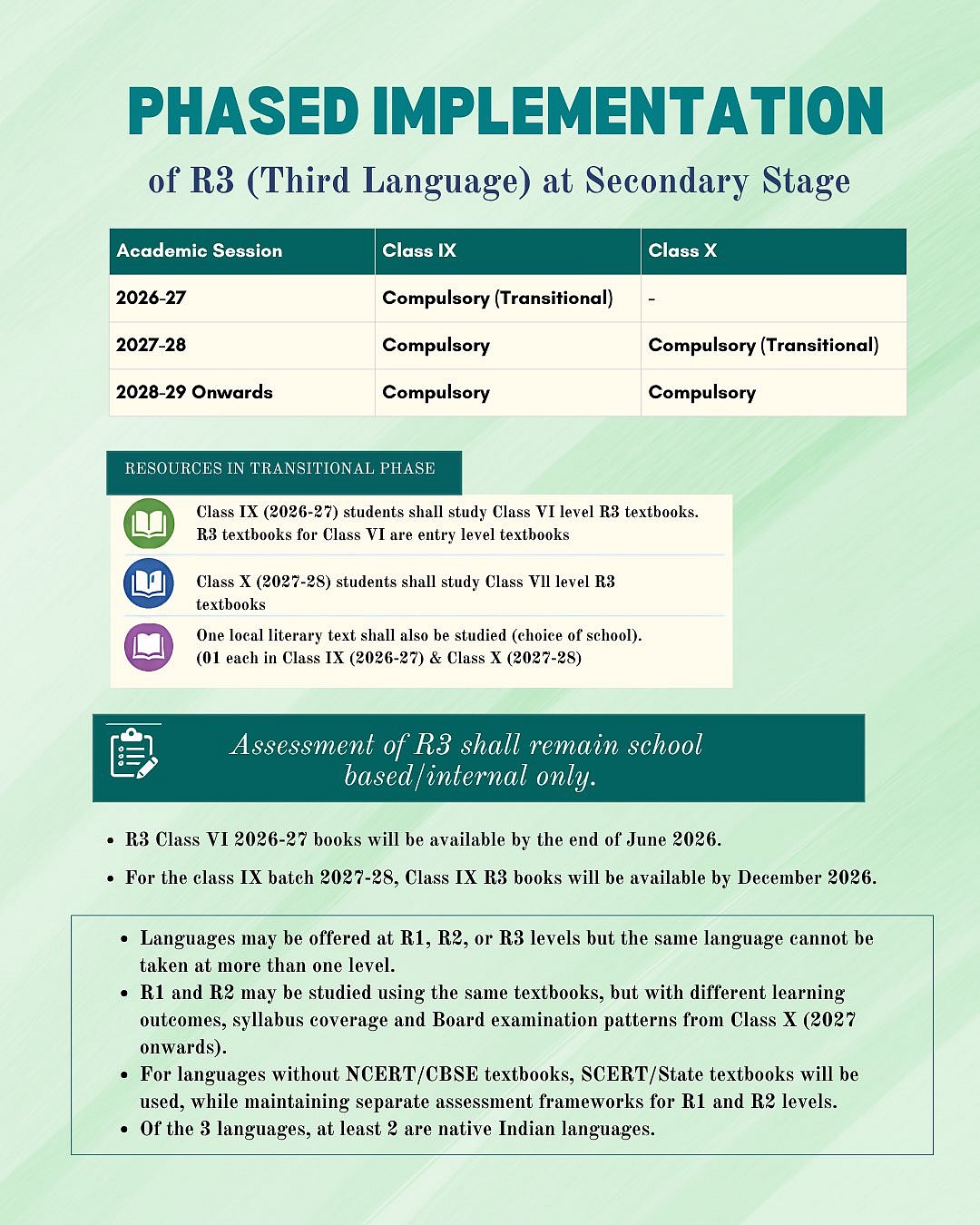
The scheme will apply to students entering Class IX in 2026–27 and Class X in 2027–28.
Illustrative language combinations include:
Hindi (R1) + English (R2) + Malayalam (R3)
English (R1) + Bengali (R2) + Hindi (R3)
Telugu (R1) + English (R2) + Sanskrit (R3)
Marathi (R1) + Kannada (R2) + English (R3)
Punjabi (R1) + Tamil (R2) + Dogri (R3)
CBSE has also clarified that students who have not studied even one native Indian language between Classes VI and VIII will be required to take a native Indian language as their R3 subject.
Key Academic Provisions
Languages may be offered at R1, R2 or R3 levels, but the same language cannot be selected at more than one level.
R1 and R2 may use the same textbooks, though they will have different learning outcomes, syllabus coverage and board examination patterns from Class X onwards.
For languages where NCERT or CBSE textbooks are unavailable, schools may use SCERT or State Board textbooks while maintaining separate assessment frameworks for R1 and R2. Of the three languages studied, at least two must be native Indian languages.
Assessment Pattern For R3
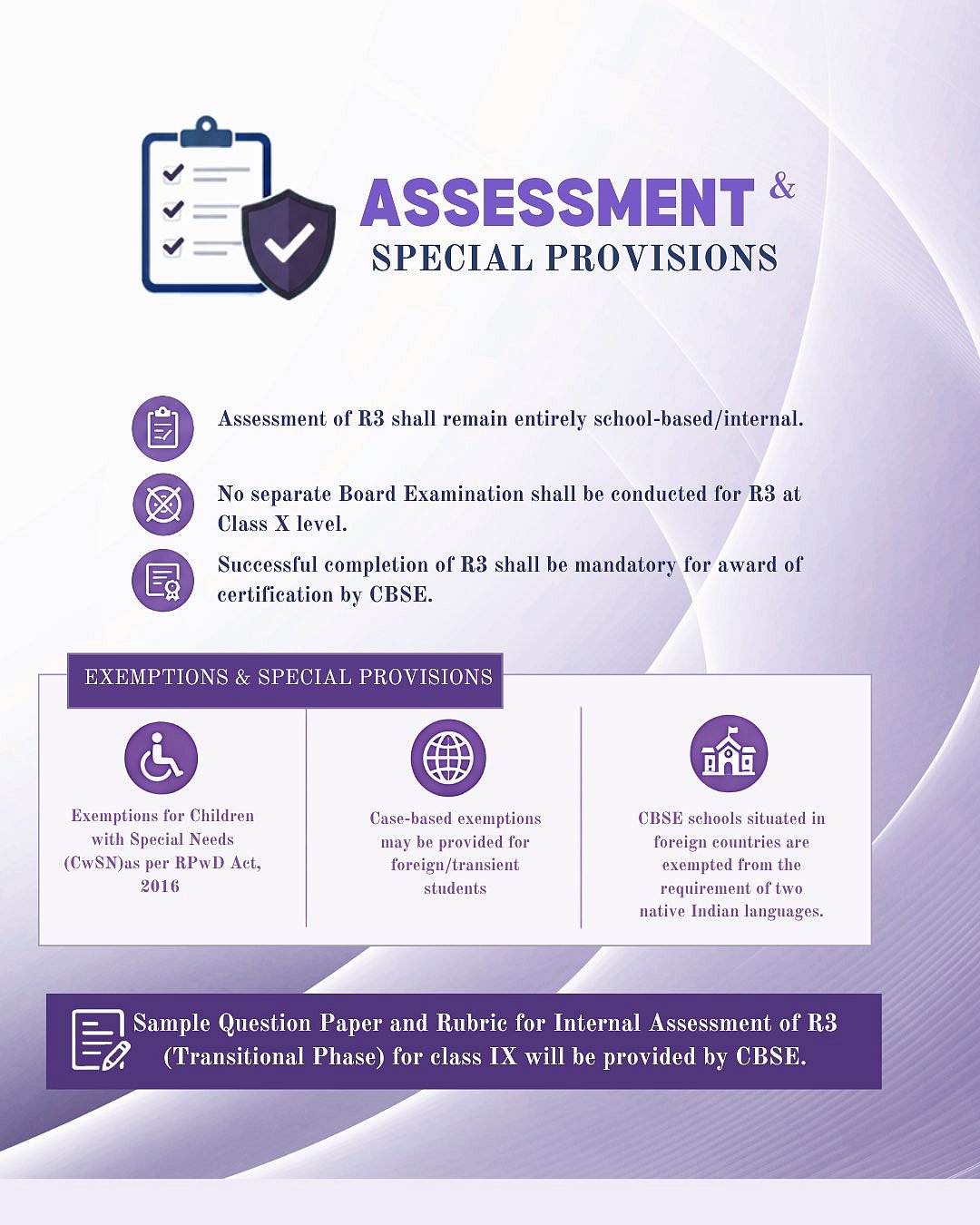
CBSE has specified that assessment of the third language will remain entirely school-based and internal.
The board has further clarified that no separate CBSE Board Examination will be conducted for R3 in Class X. Successful completion of R3 will be mandatory for obtaining CBSE certification.
CBSE Addresses Implementation Challenges
Recognising potential concerns regarding the rollout of the new language requirement, CBSE has suggested mitigation measures for schools.

Teacher Shortage
Schools may utilise Sahodaya or Hub support systems, digital classroom sharing, retired language teachers, guest faculty, or teachers already proficient in the concerned language.
Curriculum Load
CBSE has stated that the R3 course will require only two to three periods per week and will primarily focus on oral and reading fluency rather than extensive grammar instruction or writing exercises.
Student and Parent Engagement
The R3 subject will remain a mandatory qualifying component. Schools have been encouraged to provide internal grades and qualitative feedback through the Holistic Progress Card to ensure sustained participation.
Exemptions Under The Scheme
Certain categories of students will be eligible for exemptions or special provisions:
Children with Special Needs (CwSNs) under the Rights of Persons with Disabilities (RPwD) Act, 2016.
Foreign or transient students may be granted case-based exemptions.
CBSE-affiliated schools located in foreign countries will be exempt from the requirement of studying two native Indian languages.

