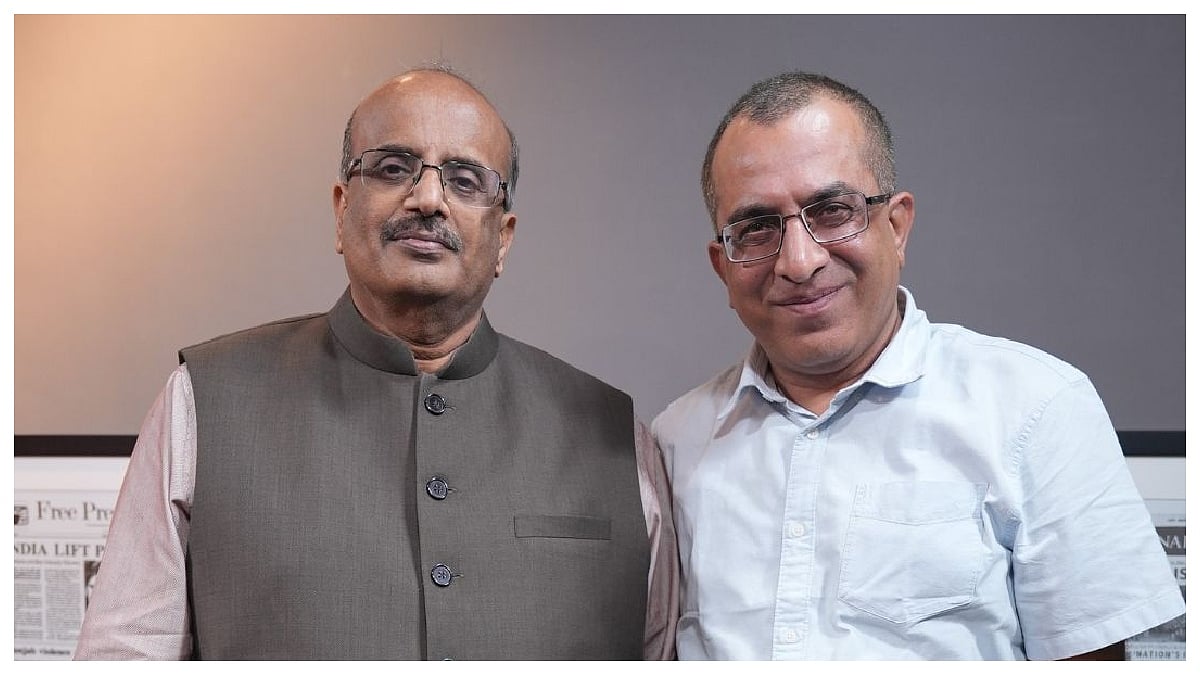
Law began by asking Chalasani to reflect on his long professional journey. Chalasani spoke about spending 37.5 years at SBI, working across 16 locations and handling diverse portfolios including retail banking, international operations, treasury, risk management, and compliance. Over the years, he oversaw more than 200 international offices, gaining a deep understanding of both domestic and global financial systems.
From Scarcity to Modern India
Law asked how India’s financial mindset has changed over the decades. In response, Chalasani took viewers back to the early 1980s, a period marked by scarcity. He recalled how even basic consumer goods such as scooters or cars involved waiting periods of six months to a year. In that environment, the dominant philosophy was protection of capital rather than growth.
Building on this, Law pointed out that today’s India feels fundamentally different. Chalasani agreed, explaining that the country has transitioned from a saver-centric mindset to one where people are increasingly willing to make their money work. Investing, rather than merely saving, is now becoming central to household financial decisions.
When asked about his most fulfilling assignment, he spoke about a rural posting in Chhattisgarh. Managing small IRDP loans of 5,000 for livestock, he focused not just on lending but on ensuring repayment and income generation. He noted that true financial inclusion lies in helping people earn sustainably and graduate to higher levels of economic participation.

The Growth Story of Mutual Funds
Turning to data, Law asked to explain how far the mutual fund industry has come. Chalasani highlighted that Assets Under Management grew from around 10 lakh crore in 2014 to over 75.6 lakh crore today. Despite this rapid growth, mutual fund AUM still accounts for only about 22 percent of India’s GDP.
Responding to a question on future potential, he said that mutual fund AUM could reach 50 percent of GDP over the next 10 to 20 years. This optimism, he explained, is rooted in the fact that mutual fund assets are growing at 15–20 percent annually, nearly double India’s expected GDP growth. He also placed India in a global context, noting that the worldwide average AUM-to-GDP ratio is 65 percent, while developed markets exceed 130 percent. For India to meet its Viksit Bharat 2047 development goals, he argued, reaching at least the global average is essential.
Banks vs Mutual Funds: Clearing the Misconceptions
Law raised a commonly debated question: Are mutual funds eating into bank deposits? Chalasani dismissed this as a misconception. He explained that liquidity never leaves the system. Money invested in mutual funds eventually flows back into banks through corporate bond issuances, equity transactions, and operational accounts. He further added that India’s banking sector remains healthy and profitable, with improving Net Interest Margins. Mutual funds and banks, he stressed, are complementary pillars of the financial system rather than competitors.
To illustrate this, Chalasani broke down household savings patterns. Of every 100% saved, 66% goes into non-financial assets such as gold and real estate. Only 34% enters financial assets, of which 40% percent goes to banks, while just 5–10% percent reaches mutual funds. This, he said, shows how much untapped potential still exists.
What the Household Survey Reveals
Law then brought up the extensive SEBI–AMFI household survey and asked what stood out most. Chalasani explained that while 63% of households are aware of at least one market instrument, only 9.5% actually invest. Urban penetration stands at about 15%, while rural participation remains far lower. He noted that complexity and fear of capital loss remain major barriers, particularly among younger investors. Despite this, 22% of households expressed an intent to invest within the next year, indicating a strong pipeline of potential new participants.

Expanding Reach Through Distribution and Education
When asked how AMFI plans to bridge this gap, Chalasani outlined a multi-pronged strategy. He spoke about the shortage of active distributors despite there being over three lakh registered ones. To address this, AMFI signed an MoU to train one lakh postmen as distributors, leveraging the trust they enjoy in Tier 2 and Tier 3 cities. In an initial pilot, 19 out of 35 trainees cleared the NISM 5A certification.
He also highlighted partnerships with institutions such as IIM Bodh Gaya, IIM Shillong, IIM Visakhapatnam and XIM Bhubaneswar to promote financial literacy and employment. AMFI has additionally adopted four states where final-year students are trained and supported to become certified distributors.
Incentives, Policy Advocacy and Behavioural Insights
Law asked about incentives designed to attract new investors. Chalasani explained that distributors receive incentives for bringing in small SIPs that stay invested for at least two years. Additional commissions are provided for investors from cities beyond the top 30, as well as for first-time women investors.
On the policy front, he shared details of AMFI’s pre-budget discussions with the government. These included requests to restore indexation benefits for fixed-income products and to consider waiving long-term capital gains tax for investments held beyond five years, to promote long-term investing behaviour. He also touched upon behavioural patterns, noting that women investors tend to stay invested for longer durations than men. Goal-based investing, he said, naturally extends holding periods and improves outcomes.

The Case for Long-Term Equity Investing
In closing, Law asked Chalasani what truly creates wealth over time. He responded that wealth is built by staying invested in equity, not by parking money solely in bank deposits. Over the past 30 years, equity has consistently outperformed gold, real estate, and fixed deposits. Quoting the principle often associated with Warren Buffett, he summed up the philosophy simply: save first, then spend what remains. For India to participate meaningfully in its own growth story, he concluded, investors must think long term and remain patient.
The episode presented a clear and conversational examination of India’s investment journey, combining personal experience, data-backed insights and policy perspectives. Through Law’s questions and Chalasani’s grounded responses, the discussion highlighted why mutual funds are becoming central to India’s financial future.

