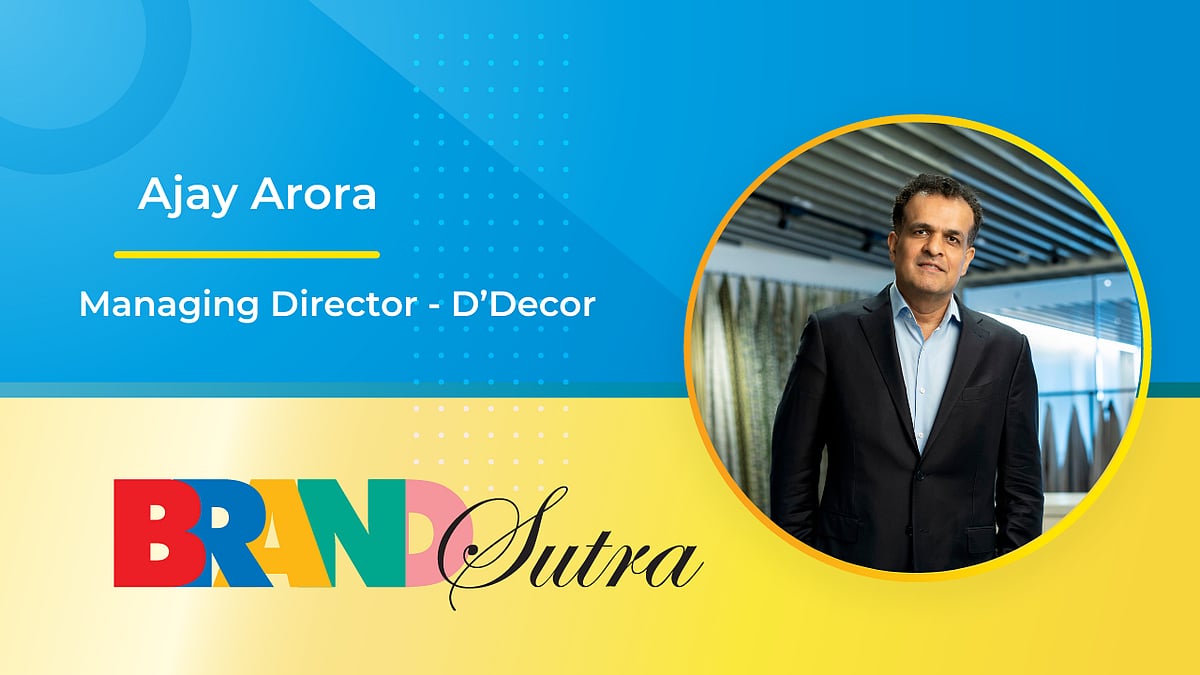
From pioneering luxury furnishings in India to redefining performance fabrics with its new-age brand FabriCare, D’Decor has consistently stayed a step ahead of the curve. For Managing Director Ajay Arora, innovation is not just about meeting consumer demand — it’s often about creating it. Yet, as Arora points out, building a brand today is far more complex than it once was. Fragmented media channels, fleeting attention spans, and the need for authenticity have transformed the marketing landscape.
In an interview with BrandSutra, Arora speaks on mastering the new age with equal parts creativity, technology, and consumer insight.
Edited excerpts…
What inspired D’Decor’s pivot into the B2C home fabrics space, and what factors helped the brand build the strong equity it enjoys today?
Our journey has been quite unique. We started as an export-driven business, long before the D’Decor consumer brand was launched. Between 1999 and 2010, our focus was entirely on international markets because we had the capability to make world-class products — but India, at that time, didn’t have a consumer base ready to appreciate or pay for them.
By 2009, the global financial crisis prompted us to rethink. We realised that real power rests with brands — the power to innovate, connect emotionally, and build customer loyalty. The Indian market, meanwhile, was maturing rapidly. With diverse home styles, regional aesthetics, and a growing desire for personalisation, India became an ideal market for custom-made home furnishings.
When we launched D’Decor, there was no established brand in the consumer’s mind. We entered that space with the right timing, capability, and vision. Our latest innovation, FabriCare, represents the next phase in that journey — a performance brand built on the idea of “beauty with brains.” It’s fabric you don’t have to worry about — stylish, functional and smart.
Do you believe supply creates its own demand, or does consumer need dictate innovation?
In a supply-constrained economy like India, I believe availability can trigger demand. When you make something available for the first time, supply can indeed create its own demand. But if it’s just an incremental improvement, then you must listen closely to consumers — understand what problems they face and what gaps existing products haven’t solved.
As innovators, we rely on consumer insights, international trends, and a bit of common-sense intuition. When you combine these intelligently, demand follows.
How has your media strategy evolved over the years? Is it more difficult to build a brand today than it was in the late 2000s?
When we first started advertising, our biggest advantage was that we were alone. There was no other consumer-facing brand in our category. But we still had to compete for attention against larger industries like automotive or mobile phones, which commanded massive ad spends.
The human mind needs repetition to register a message, and that takes time and investment. But because we had no direct competition, our messaging was more memorable.
Today, the challenge is far greater. Consumers are fragmented — some are on OTT platforms, others on social media, and some are barely reachable through traditional media. Getting attention has become exponentially harder.
Building a brand today is ten times more difficult. The upside is that targeted marketing allows precision — you can talk directly to the audience that matters without unnecessary spillover. However, digital marketing demands far better content — relevant, authentic, and dynamic. You can’t rely on a single campaign film for months.
Modern consumers want engagement that feels real and personal. The challenge now is to be consistent and present across all channels — while staying efficient and precise with your message and spend.
D’Decor’s associations with celebrity couples — from Gauri Khan to Alia and Ranbir — have been iconic. How do you choose brand ambassadors?
Authenticity has always guided our choices. Mrs Khan’s partnership with D’Decor reflected her genuine passion for interior design — something she later turned into a successful business of her own.
Similarly, with Ranbir and Alia, we wanted a couple that represented modern India. Now, as media has reported, they have moved into their new home, and that displays an authentic connection to the category.
How is D’Decor leveraging AI and technology today?
Technology has always been at the heart of our business — from manufacturing to managing complex supply chains. Today, AI is opening new frontiers across multiple aspects of our work.
The first area is content creation. Traditional ad shoots with massive crews are becoming outdated. AI allows us to produce digital content that’s highly flexible and cost-effective — changing colours, moods, or even settings post-production with precision.
Second, in product development, AI assists in design generation and visualisation. It helps consumers imagine how fabrics will look in their homes with remarkable realism. Given that we offer nearly 17,000 product options, AI-enhanced search and recommendation tools help our sales force suggest the right products faster and more accurately.
The third use case is customer service, where AI enables faster response times and more personalised interactions. Together, these innovations are making our brand more agile, efficient, and consumer-focused.
How do you envision laying out the brand’s retail strategy? Is expanding physical footprint still important?
Quick commerce is teaching us a lot. India is possibly the only market where consumers genuinely expect a bed sheet in 10 minutes — and it’s happening.
For us, it’s less about expanding physical stores and more about bringing the entire experience to the consumer. In home furnishings, the purchase involves three elements — design consultation, customisation (like stitching or upholstery), and the product itself. Our goal is to integrate these into a seamless, at-home experience.
We’re also strengthening our collaboration with interior designers, who have seen renewed demand post-COVID as consumers invest more in their homes. Growth is coming from premiumisation, performance fabrics, and hospitality segments. The luxury home market is booming — and we’re positioning ourselves to meet that demand head-on.
What’s next for D’Decor?
The next big step is taking the B2C brand internationally. We’ve built strong manufacturing and brand capabilities — now it’s time to extend that globally. Whether we build a brand abroad, acquire one, or pursue both routes — that’s something we’re evaluating closely.
The second focus area is FabriCare. We want it to become synonymous with performance home furnishing — for spaces that see real life, movement, and activity. Homes where families, kids, and pets coexist comfortably. We want consumers to experience and trust the difference FabriCare brings — not just in promise, but in proven capability.

