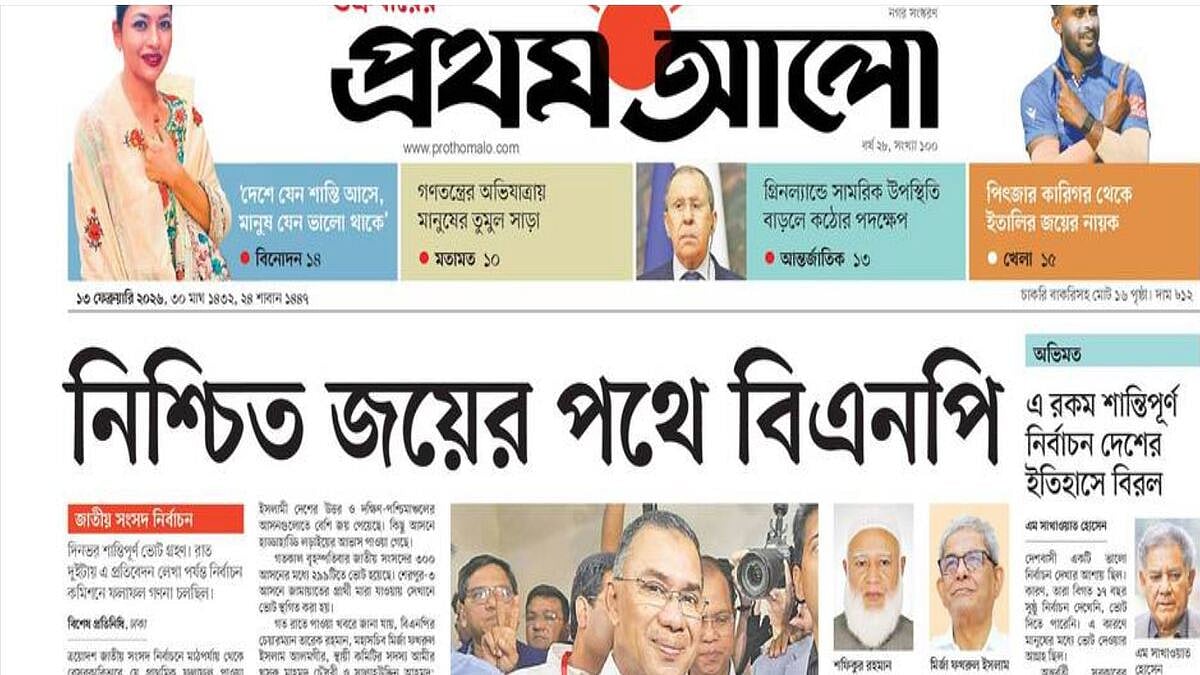
The Bangladesh Nationalist Party (BNP) has claimed victory in the country’s landmark parliamentary elections, with unofficial media tallies placing them firmly in the lead as of Friday. This election marks a key turning point for the nation following the collapse of the Awami League regime in August 2024, signalling the start of a fresh political era. In a rare show of unity, national newspapers published editorials celebrating this democratic revival—a hopeful milestone for a country still healing from the severe violence of the previous summer.
'Democracy cannot function on dominance alone'
The Dhaka Tribune in its editorial 'An election to determine our future' said, "It needs to be reiterated: Parliamentary democracy cannot function on dominance alone. It requires constant debate, public scrutiny, and critical dissent. A strong and credible opposition is not an obstacle to governance; it is an essential safeguard against exaggerated action and complacency. Likewise, this is an opportunity for those who fall short at the ballot box to demonstrate grace and maturity -- by accepting the people’s verdict sans the usual ruckus and retaliation we've historically witnessed. Our democratic culture can only deepen when all sides learn to respect the integrity and authenticity of theprocess. Credit must also be given where it is due: The government, the Election Commission (EC), and the political parties have so far contributed to maintaining a largely peaceful pre-poll environment."
"There is a collective hope that whoever is entrusted with power next will govern in a way that the people have hoped, asked, and fought for: With restraint, respect for institutions, and faithfulness to pure democratic values rather than partisan impulses," the editorial said
The editorial further added avery poignant point. It said, "Ultimately, elections are not only about power, but also about trust: Trust that votes will be counted honestly, that institutions will function impartially, and that leaders will remember the promises they have made in pursuit of the position."
The Daily Star in its editorial titled 'The people have given their verdict' celebrated the elections as the biggest festival of democracy.
"The overall atmosphere was celebratory, with people spontaneously coming out to cast their votes. Women and men of all ages were seen at the polling centres. The elderly, people with disabilities, and young voters—everyone—participated enthusiastically. This indicates a hard-earned, long-overdue public trust in the election process and demonstrates people's excitement in exercising their vote, something they were deprived of in the last three elections," The Daily Star editorial said.
The editorial also appreciated the electorate for not getting swayed by multiple posts on social media of malicious intent.
"In fact, hours before voting began, various political actors, seemingly aligned with the Awami League, Jamaat-e-Islami, and BNP, used social media platforms to cast doubt on the legitimacy of the election, falsely or unconvincingly accuse rival parties of foul play, and discourage people from voting. There were a few isolated incidents of attempts at creating panic and ballot snatching, but these were very few and promptly prevented. In the end, voters refused to be deterred by false propaganda and were determined to exercise their democratic right," it said.
In an op-ed called 'The election must restore democracy, not illiberal democracy' in Prothom Alo, analyst Zahed Ur Rahman wrote, "After a long time, Bangladesh is finally seeing a festive election. An election is supposed to mean a free, fair, participatory and credible vote."
Islamic fundamentalism in Bangladesh politics
Rahman also pointed out the rise of Islamic fundamentalism in Bangladesh politics.
"In this election, a truly unprecedented development has taken place in Bangladesh, one that deserves serious consideration. In fact, this trend could become a defining factor in the country’s future politics. Although Islamist parties have long existed in Bangladesh’s political landscape, they typically contested elections through limited seat-sharing arrangements with BNP or Awami League, or occasionally made their presence felt through political programmes," he said. "But for the first time, they have emerged as one of the two contenders for state power. Although the Jamaat-led alliance has included a few parties such as the National Citizen Party (NCP), AB Party, and LDP in an effort to move away from being labelled purely as an Islamist identity-based bloc, their number of seats is very small. Therefore, the 11-party alliance led by Jamaat remains, in essence, an Islamist identity-based political coalition."
His prediction, however, proved right. "Although Jamaat and a couple of other parties in the alliance, including the NCP, have released their own manifestos, these should be considered insignificant in the broader context," he wrote.
In fact, as the counting has concluded, Jamaat-e-Islami chief Shafiqur Rahman conceded defeat, stating that his party would not engage in obstructive “politics of opposition." He said, “We will do positive politics."
Scale of election
The election in Bangladesh was a massive undertaking defined by high stakes and immense logistical scale, involving 12.77 crore voters—nearly half of whom were women—and a competitive field of 2,028 candidates across 50 political parties. To manage the proceedings, approximately 8 lakh election officials oversaw 42,779 polling centres. A staggering 10 lakh security personnel were deployed nationwide. This force included over 1 lakh army personnel and 1.86 lakh police officers, bolstered by specialised branches such as the air force, navy, BGB and RAB.

