What are the basic differences in treatment of women that she finds in varied countries of APAC? Especially India.
I have noticed similarities all over the world in the treatment of women and girls and the barriers they face. For example, in all countries women and girls experience much higher levels of violence than do men and boys. Indeed, the prevalence of gender based violence globally is alarmingly high — the World Health Organization has said that one out of three women experience it their lifetime. I have also found that gender norms are remarkably similar in all the countries I have visited — as well as Australia- including stereotypes about what roles women and men play in society. Gender norms often mean that women are expected to care for children, family and community members, while men are expected to go to work and earn an income. This can place a heavy burden on women to take care of the home and garden increasing their dependence on men financially and decreasing their ability to be economical secure or contribute to decision making. In India there is an added challenge of issues such as dowry and early marriage which have a negative impact on women and girls and create many safety risks and barriers to them reaching their full potential.
How can sports help in elevation of gender equality, especially in India with football?
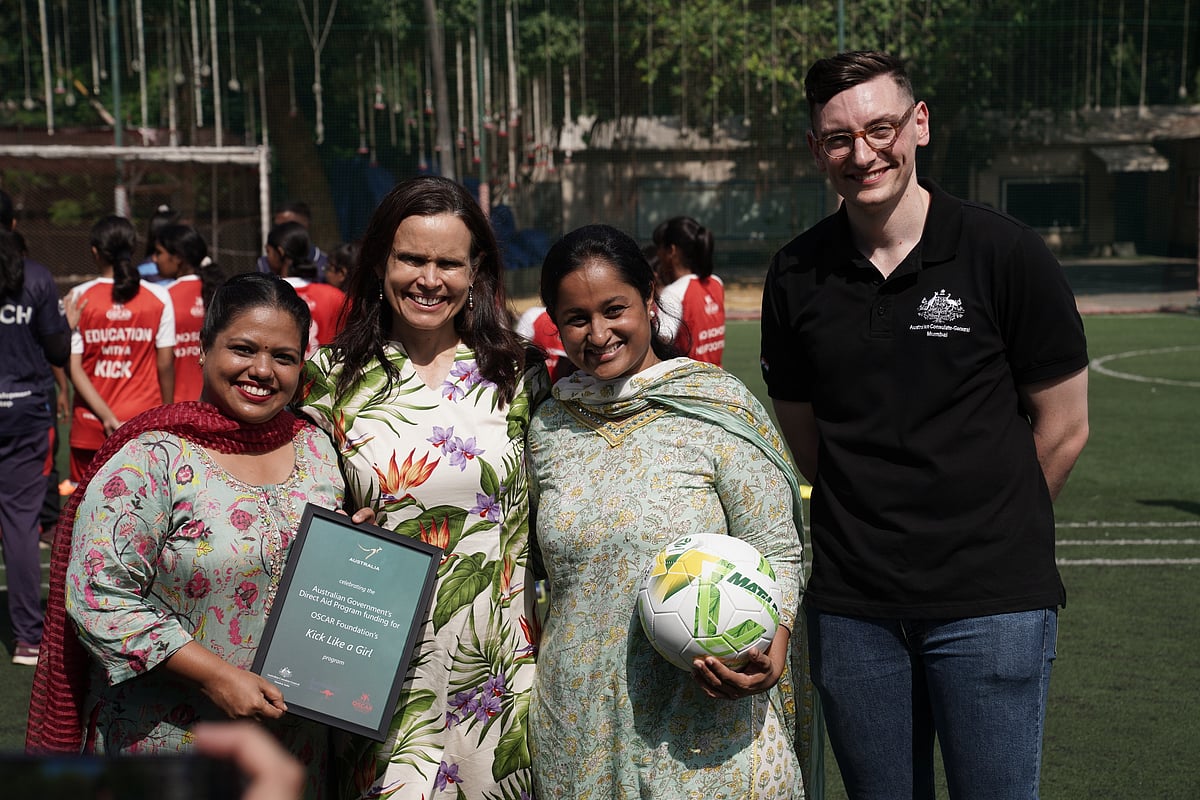
Girls’ and women’s participation in sport can contribute to challenging social norms and breaking down gender stereotypes. Participation in sports can empower women and girls at an individual level, at the same time as demonstrating to families, communities and societies what they are capable of achieving, and breaking down barriers. Involving girls in sport such as football has so many positive benefits. It can challenge norms around them being ‘fragile and weak’. This can be applied to other gender norms such as what they should study at school, what chores and jobs they undertake, or their capacity for decision-making. Not only does it contribute to improving physical and mental health and fostering social connections, participation in sport can also educate girls on a range of important issues such as safety or sexual and reproductive health, expand their horizons to new ideas and opportunities, and can increase self-esteem, resilience and confidence. For example, encouraging girls to continue to play sport during menstruation can demonstrate they can do other activities, such as going to school. It might also provide information, tools and confidence to be aware of the risks of violence and abuse, of trafficking or fight against early marriage.




In an attempt to create a strategy for gender equality, who have you met in India and what has been their response?
I had excellent engagements with women in politics, government, business and civil society during my visit to India and learnt a lot that I will take back with me to Australia to inform development of Australia’s new gender equality strategy. I heard about great examples of innovative solutions to gender inequality being progressed in India, for example through community-led women’s action groups, gender safety audits, closing the digital divide, and mobilising the private sector, that I will share with others. I also heard about specific challenges for poorer women and women living in rural areas that are common in many countries in our region and beyond, and about barriers to workforce participation. These are all challenges that need to be addressed to progress gender equality.

Have you read any of old Indian scriptures?
I practice Vipassana meditation and have read the Pali suttas as well as other text from the Paritta tradition, which goes back to the time of the Buddha. I love the reminder to be compassionate and grateful and to always be present and mindful. I deeply relate to values of not harming others, not taking what is not given, always being truthful.
What are the key points, keeping in mind the Indian circumstances and mindset, to help gender equality in India?
It is important to always find ways to challenge gender norms and ensure women and girls have the same opportunities as men and boys. Involving girls in sport is one way to do this. Other ways are through education, including educating boys, involving women in community decision making, creating opportunities for more women to enter the workforce and politics, and using media, art and other tools to challenge social norms and champion equality. Continuing to stop child marriage is essential as is challenging practices such as dowry that create massive risks and barriers for women and girls.
What is your takeaway from your interactions in Mumbai?
I was impressed with the number of people I met — men and women — who clearly recognise and articulate the importance of gender equality for the social and economic development of India. I also noted the energy and drive to tackle social norms, address sensitive issues such as period poverty, increase financial inclusion of women and get more women into the workforce and girls into education. I was impressed with how governments are working to improve safety for women including in urban planning and addressing violence against women and ending child marriage. I also saw some fantastic best practice approaches including those being undertaken by the private sector to get more women into the workforce and how India is using digital technology for financial inclusion. Others can learn from these approaches and I will certainly share them as part of my role as Australian Ambassador for Gender Equality!