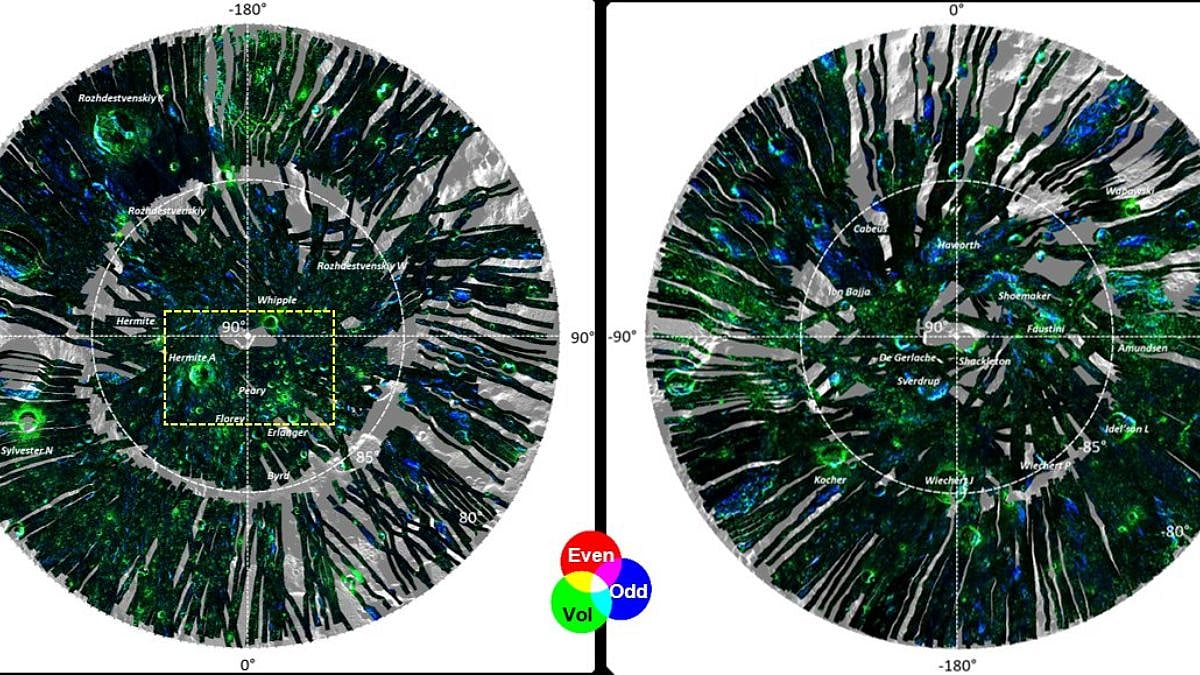
New Delhi: The Indian Space Research Organisation (ISRO) on Saturday announced that it has received advanced data products from the Chandrayaan-2 orbiter, including new parameters on the physical and dielectric properties of the Moon’s polar regions.
The agency described this development as a significant enhancement for future global exploration. ISRO said in an X post that these new parameters represent “India’s major value addition towards future global exploration of the Moon.”
The Chandrayaan-2 Orbiter, in lunar orbit since 2019, has provided approximately 1,400 radar datasets and high-quality data from its Dual Frequency Synthetic Aperture Radar (DFSAR).
This instrument is the first to map the Moon in L-band full-polarimetric mode at a resolution of 25 meters per pixel, according to an official statement.

This advanced radar mode sends and receives signals in both vertical and horizontal directions, making it ideal for studying surface properties, it added.
Using these data sets, scientists at the Space Applications Centre in Ahmedabad have developed advanced data products on potential presence of water-ice, surface roughness, and important electrical properties, namely dielectric constant which describes features like density and porosity of the Moon’s surface.
The algorithm for analysing the full-polarimetric data is developed and data products are generated indigenously by ISRO, it said.
These advanced data products can gain first-order information about Moon’s polar regions, which is expected to have preserved the early chemical conditions of the solar system, and clues to explain several facets of evolution of the planetary bodies.
These products complement hyperspectral data in studying the distribution of minerals on the Moon, the space agency noted.
ISRO recently successfully launched the heaviest GEO communication satellite CMS-03 satellite, with the LVM3-M5, also known as the ‘Bahubali’ rocket, and successfully placed it into its intended orbit.
(Except for the headline, this article has not been edited by FPJ's editorial team and auto-generated from an agency feed.)
