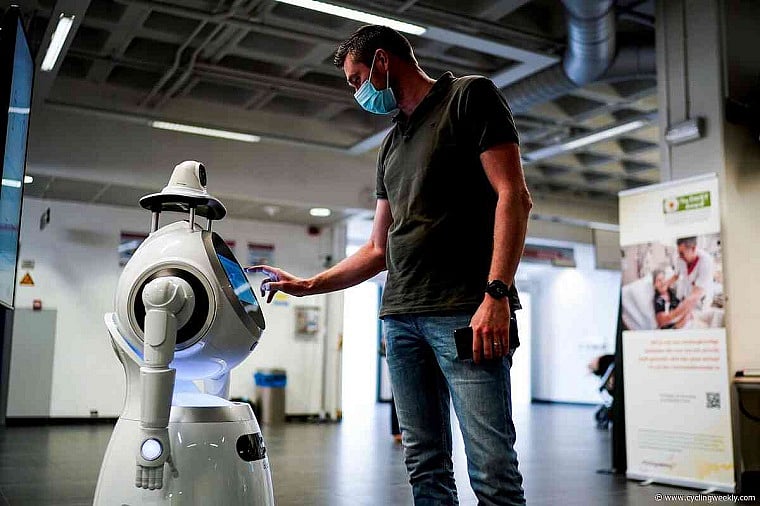
London: A new telepresence robot that enables people suffering from Covid-19 and in isolation to talk to their loved ones has been developed.
Researchers of the Integrated Systems Engineering Group of the University of Malaga (UMA) in Spain have designed the novel robot to adapt to the pandemic needs, with the aim of facilitating the work of professionals in nursing homes and hospitals.
"We have enabled people that are isolated in a room to have a video call with relatives and friends without risks and regardless of their ability to use new technologies," said Juan Pedro Bandera, Professor of the School of Telecommunications at the varsity.

The researcher explained that: a friend or relative books an hour for a video call by using a simple web interface; the robot boots up autonomously and goes to the counter to be disinfected, according to protocol; then, it goes to the room and starts the video call at the scheduled time; when finished, it is disinfected again and then goes to its resting place.
Just over a metre high, with a cylindrical or pedestal-shaped body, this "made in UMA" robot has simple expressive abilities, audiovisual communication capacity and, moreover, it is able to move around autonomously in daily life scenarios.

Other functions of this robot include announcing daily events in common areas of nursing homes like a "town crier" or offering the elderly the possibility of fulfilling themselves, sharing and viewing photos.
"A social robot that crosses continuously between two people talking, that gets too close to them when moving around, that moves too fast or abruptly or stops in a corridor blocking their way will not be accepted and, therefore, will not be useful," said Bandera, coordinator of the project.
Based on this approach, the team conducted two experiments. In the first one, they studied energy consumption in a real robot that moves around by following trajectories with different smoothness factors.
In the second experiment, they analysed opinions and impressions collected from different participants after presenting simulated situations where a robot moves around certain virtual scenarios, applying, again, trajectories with different smoothness factors.
The results show that while smoother paths decrease energy consumption and increase social acceptability, there is a need to keep adequate distance from people.

