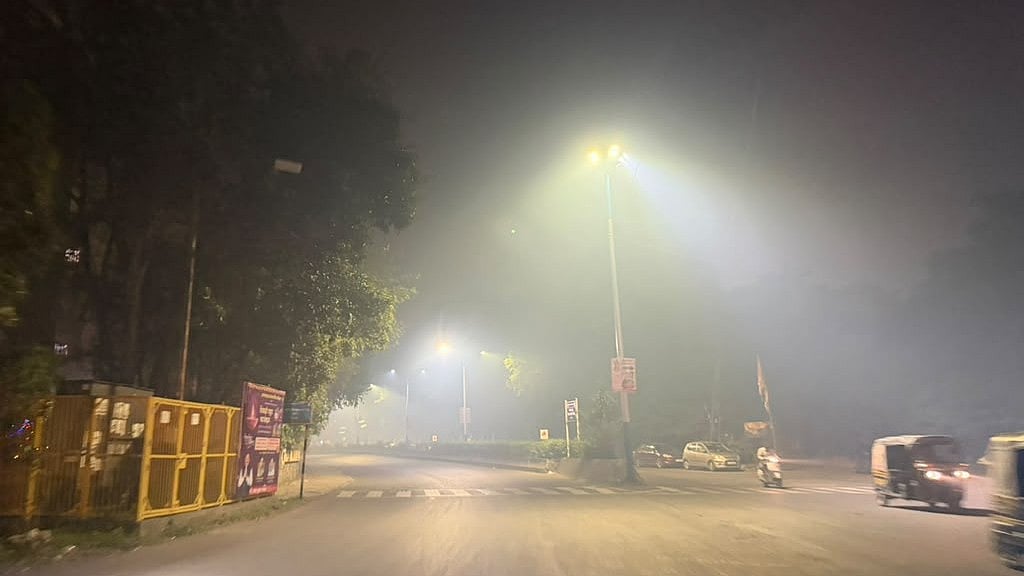
Pune: Two days after Diwali celebrations left Pune gasping for breath, the city’s alarming air quality levels continue to be a talking point among residents, with many questioning whether the price of festive celebrations is being paid through their health. While lights, festivities and firecrackers have become part of the annual celebrations, the severe pollution recorded this year has left Punekars concerned about the air they breathe. With the Air Quality Index (AQI) touching 432 in the early hours of November 9, residents say the celebrations have come at a considerable cost to public health.
For many Punekars, the pollution was not just a number on monitoring apps but something they could visibly experience. Smoke-filled surroundings, reduced visibility, throat irritation and difficulty breathing became major concerns as residents stepped outdoors after the celebrations. The situation has also brought renewed attention to the impact of firecracker emissions, construction dust, vehicular pollution and unfavourable weather conditions on the city’s air quality.

According to air quality monitoring data, the city’s average PM2.5 concentration surged to approximately 800 micrograms per cubic metre, while readings at select monitoring stations approached 1,000 micrograms per cubic metre. The PM2.5 levels were significantly higher than the peak of nearly 600 micrograms per cubic metre recorded during the corresponding Diwali period last year.
Residents expressed concern over the worsening situation. “The air quality is at its worst these days. Cannot breathe as firecrackers are being burst continuously from evening to late night. So much smoke that you cannot see even a foot ahead,” said Nupur Sharma, a resident of Shivajinagar.
Another resident, Ravindra Sinha from Kothrud, raised concerns over the continued use of loud firecrackers despite restrictions. He said, “Firecrackers were being burst near silent zones as early as 4am and beyond 10pm as well. Where are the rules now? Why aren't they taking action against the ones who are not following it? This raises questions and the bad AQI is not at all good for our health.”

The deteriorating air quality has particularly worried families with young children and elderly members. Health experts warn that exposure to high concentrations of fine particulate matter can aggravate respiratory conditions, trigger asthma attacks and increase cardiovascular stress.
Children, whose respiratory systems are still developing, and senior citizens are particularly vulnerable. People suffering from asthma, chronic obstructive pulmonary disease and other respiratory ailments may experience worsening symptoms. Even otherwise healthy individuals can experience coughing, throat irritation, wheezing and breathlessness during severe pollution episodes.
Dr Sachin Ghude, scientist and in-charge of IITM’s Air Quality Warning and Integrated Decision Support System for Emissions, warned that continued firecracker bursting could prolong the pollution episode. According to his assessment, PM2.5 concentrations could approach 400 micrograms per cubic metre, with AQI levels remaining between 300 and 320 on Tuesday morning.
Shreya Shetty, who is pursuing a master’s degree in environmental studies, said, “Clearly, as per all the data provided and AQI recorded, we cannot breathe the air that keeps us alive anymore. So what Diwali are we celebrating? What kind of celebration is this? Just hoping that this changes next year, and doesn't remain the same as this time.”

