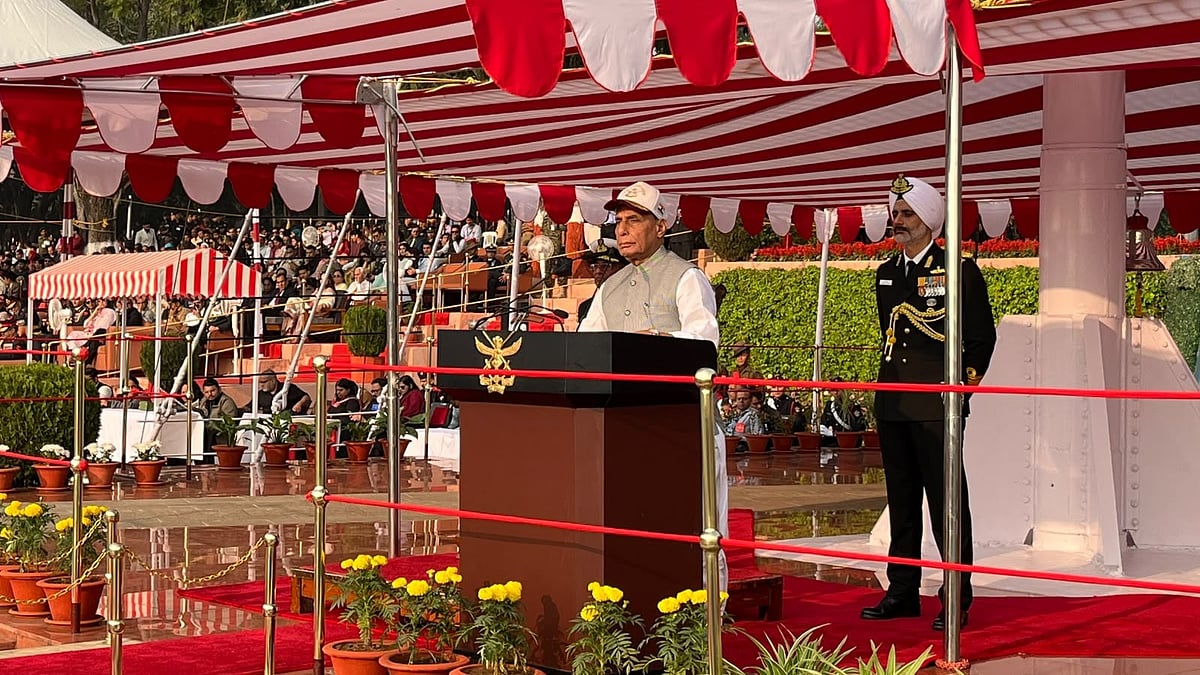
Pune: Emphasising that national security is the foundation of India's journey towards becoming a developed nation by 2047, Defence Minister Rajnath Singh said secure borders are essential for economic growth and overall development, while future warfare will increasingly extend beyond conventional battlefields to emerging domains such as cyber, space and artificial intelligence (AI).
“Only when a nation’s borders are secure can trade, education, industries and all other aspects of development flourish,” Singh said while addressing graduating cadets of the 151st Course of the National Defence Academy (NDA) and their parents at Khadakwasla, Pune, on Sunday.
He stressed that the armed forces play a crucial role in creating a secure environment for the country's economic and social progress. The graduating cadets, he said, would become an important part of India's security shield and contribute towards the vision of Viksit Bharat 2047.
Highlighting the changing nature of warfare, Singh said modern military conflicts would no longer remain confined to the traditional domains of land, sea and air. Cybersecurity, space and artificial intelligence are emerging as increasingly important areas that will shape future battles.
“Warfare is changing rapidly. The future battlefield will not be limited to land, sea and air. Cyber, space and artificial intelligence are emerging as important domains of warfare,” he said, underlining the need for the armed forces to continuously upgrade their capabilities and preparedness.

India must strengthen technological capabilities
Referring to India's changing demographic structure, the Defence Minister said the country must prepare for the future by strengthening its technological capabilities and gradually moving towards greater reliance on machines.
He pointed out that India's population growth rate is declining and its demographic structure will undergo changes in the coming decades. Therefore, the country must begin preparing for this transition rather than waiting for it to become a challenge.
Singh said, “India’s population growth rate is declining, and our demographic structure will gradually change in the coming years. We must prepare ourselves for this change. Developed countries are increasingly reducing their dependence on manpower and strengthening their reliance on machines and technology. India must also move in this direction.”
He emphasised that technologies relevant today could become outdated tomorrow, making innovation and indigenous technological development essential for India's future security. The armed forces must combine technological knowledge, intellectual capabilities and physical strength to meet emerging challenges.
Singh also said changing geopolitical developments across the world were transforming power equations and military strategies. India must develop its own technological solutions and strengthen self-reliance in defence capabilities.
Military uniform comes with enormous responsibility
Addressing the young cadets, Singh said wearing the military uniform was not merely a matter of pride or honour but also carried an enormous responsibility towards the nation.
He told the cadets, “Although you are young, your rigorous training has prepared you to shoulder significant responsibilities. Always remember that the security of the country and the lives of your fellow soldiers will depend on your decisions and leadership.”
He said their journey at the NDA marked the beginning of a new chapter in their military careers, with some of them potentially going on to occupy the highest leadership positions in the Army, Navy and Air Force.
Recalling the sacrifices of India's freedom fighters and military personnel, Singh said the graduating cadets were inheritors of a legacy built through the courage and sacrifice of countless individuals who laid down their lives for the country's independence and security.
He recalled the 63-day hunger strike undertaken by freedom fighter Jatindra Nath Das and paid tribute to military heroes, including Major Somnath Sharma, Company Quartermaster Havildar (CQMH) Abdul Hamid and Captain Vikram Batra.
He said, “The sacrifices of our freedom fighters and military heroes must continue to inspire future generations. You are not merely beginning your individual careers; you are carrying forward the legacy of those who sacrificed their lives for the country.”
Trust and teamwork essential for military leadership
Emphasising the importance of leadership qualities, Singh said a good military leader was one in whom subordinates could place complete trust. Leadership, he said, was not about exercising authority but earning the confidence and respect of those serving under an officer.
He said, “An officer must treat his subordinates with the same care and concern that he would show towards his own family members. During difficult situations, particularly in operational conditions, officers must stand alongside their teams.”
He urged the cadets to keep their egos aside and prioritise teamwork, mutual trust and collective responsibility. Military leadership, he said, required officers to understand the difficulties faced by their subordinates and work together to overcome challenges.
Singh also highlighted the importance of mental strength, saying physical fitness and military skills alone were not sufficient to meet the demands of service in the armed forces.
He said military life would involve difficult circumstances, challenging postings and prolonged separation from families. Officers must remain courageous, confident and mentally strong while working under pressure and taking crucial decisions.
“Perseverance and self-belief are essential qualities for future military leaders. You must be prepared to face difficult circumstances with confidence and determination,” he said.
Acknowledges sacrifices of parents and families
The Defence Minister also acknowledged the contribution of parents, teachers and elders in shaping the cadets' journeys. He said the achievement of graduating cadets was not theirs alone but was also the result of the sacrifices, support and encouragement of their families.
He pointed out that military families also make considerable sacrifices when personnel are posted in difficult and remote locations, often remaining separated from their loved ones for extended periods.
Describing the armed forces as an extended family, Singh said mutual trust, cooperation and shared responsibility were essential to maintaining the institution's strength.
He urged the graduating cadets to contribute towards making India strong, self-reliant and secure, while remaining technologically advanced and prepared for emerging security challenges.

