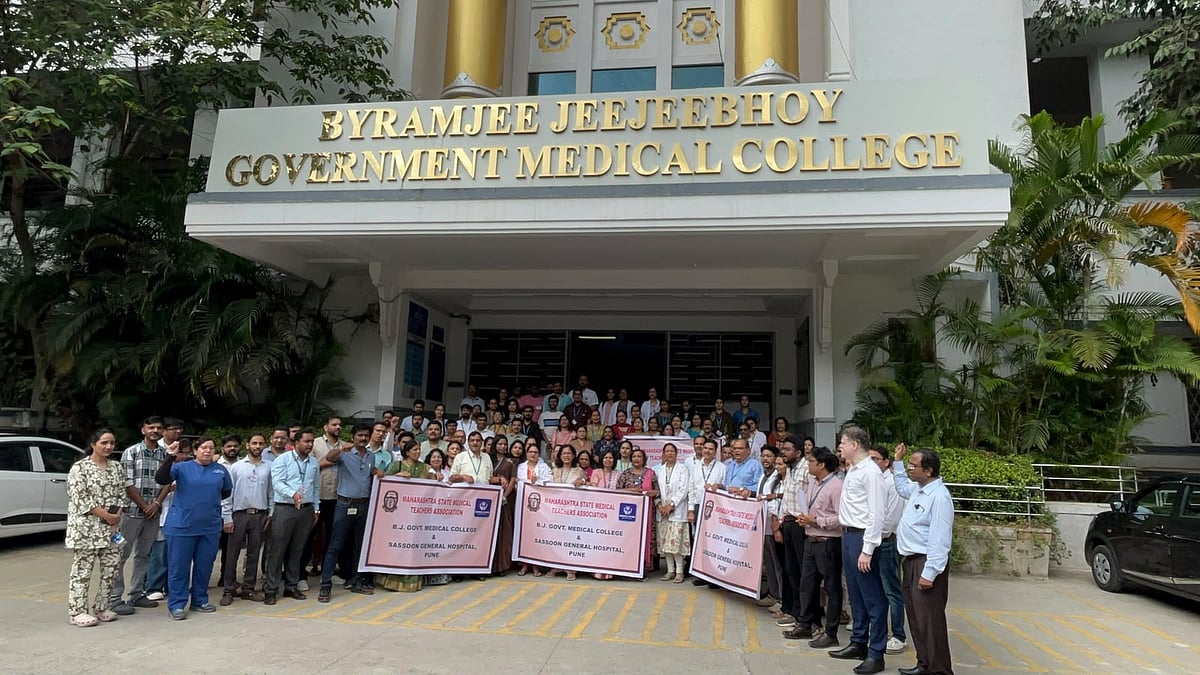
Pune: The Maharashtra State Medical Teachers Association (MSMTA), BJ Government Medical College and Sassoon General Hospital unit, staged a protest on Thursday against the revised staffing pattern introduced by the Medical Education and Drugs Department. The association said the reduction in sanctioned teaching posts would increase the workload of existing faculty and affect medical education and patient care.
According to the association, the revised staffing pattern has resulted in a reduction of 188 teaching posts across various cadres in Maharashtra, while 31 posts at BJ Government Medical College, Pune -- six professors, 12 associate professors and 13 assistant professors -- have been cut.

The association said the reduction would put additional teaching, postgraduate education, patient-care and administrative responsibilities on existing faculty.
MSMTA President Dr Sanjaykumar Tambe said, “The actual workload at BJ Government Medical College and Sassoon General Hospital is considerably higher. Faculty members are required to handle teaching, postgraduate education, clinical services and additional administrative responsibilities. At a time when the institution requires more specialist faculty, reducing sanctioned posts will further increase the burden on the existing teaching staff.”
The association also said faculty appointments at the institution are not limited to classroom teaching, as teachers are also involved in providing services to patients and handling various administrative responsibilities. It argued that the staffing pattern should therefore be prepared after considering the actual workload and patient services provided by individual institutions.

The association further claimed that while preparing the revised staffing pattern, the minimum standards prescribed by the National Medical Commission (NMC) were considered, but factors such as the actual teaching workload, additional responsibilities and patient-care requirements were not adequately considered.
MSMTA General Secretary Dr Nandkumar Salunke said, “The staffing pattern should be based on the actual work being carried out at each medical college and not merely on minimum standards meant for faculty appointments. The workload of teaching, additional administrative responsibilities and patient care needs to be assessed before deciding the number of posts.”
The association has demanded that the revised staffing pattern be withdrawn immediately for the affected departments and that the earlier staffing structure be restored. It has also sought a fresh assessment of workload before deciding on the number of teaching posts at each institution.

“If the revised staffing pattern is not withdrawn and the required posts are not restored, it will have a very bad impact on medical education, postgraduate training, patient services and the functioning of government medical colleges,” Salunke said.
The association has also called for staffing decisions to consider the actual workload of each institution rather than applying only the minimum faculty norms.

