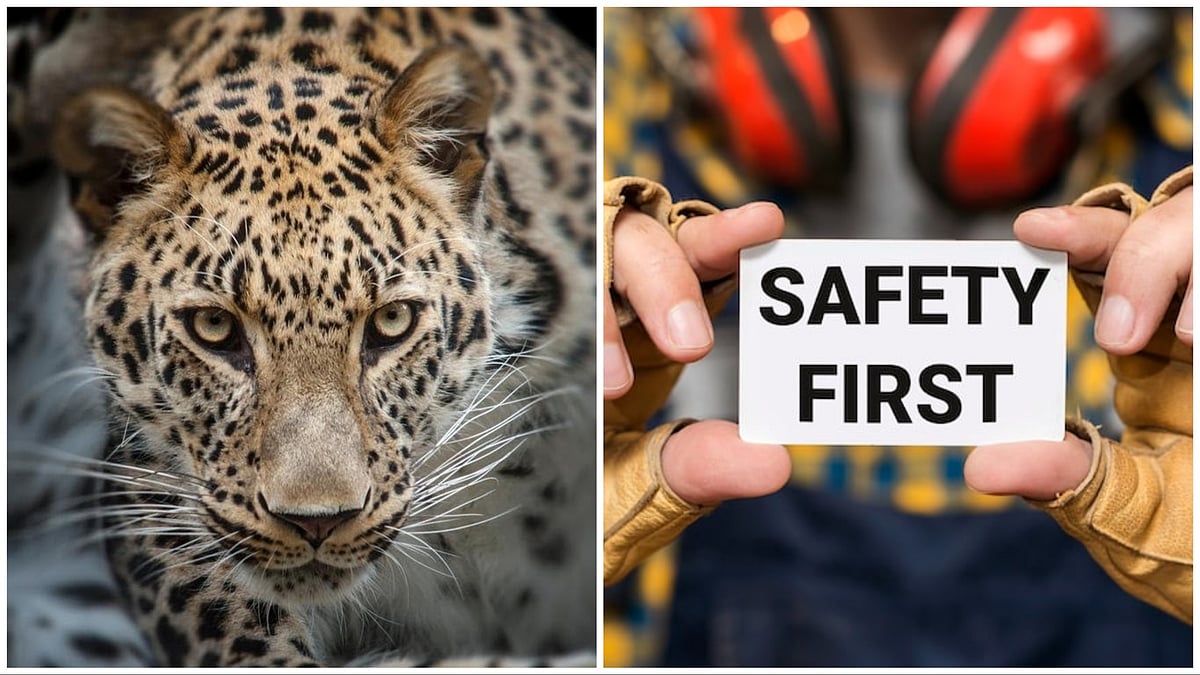
Pune: In the past few months, incidents of human-leopard conflict and sightings of the wild cats in both urban and rural areas of Pune district and other parts of Maharashtra have increased steadily. Amid this rise, fear has gripped residents, as a face-to-face encounter with a leopard is something most people neither expect nor wish to experience. This is the thing that has evoked widespread dread across the state.
While the Pune district administration has stepped up efforts to curb this growing menace, officials have also clarified that preventing such encounters entirely may not always be possible. Authorities have now advised residents to be prepared to protect themselves if necessary and have issued guidelines on how to respond during leopard encounters.
The issue of leopard attacks and human–wildlife conflict has always been common in Junnar, Ambegaon, Khed, Shirur, and Daund tehsils in Pune district. These tehsils have mostly hilly terrain and contain large-scale irrigation projects of the Water Resources Department of the Maharashtra Government. Due to the availability of irrigation, sugarcane is farmed in most areas. Because of sugarcane farming, the wild animal leopard gets abundant prey and water availability, as well as a safe habitat to hide. Prey becomes available through animal husbandry, poultry farming, etc., which are practised as a side business to agriculture.
However, this situation drew renewed attention in November after three deaths were reported within a span of 20 days in Pimparkhed village of Shirur tehsil. This was followed by sightings of leopards in urban areas of Pune, including Lohgaon, Bavdhan, and Aundh, as well as in other cities across Maharashtra, such as Kolhapur, Sangli, and Satara.

These incidents escalated concerns over the expanding presence of leopards beyond traditional forested zones. It prompted the issue to be raised aggressively in the Maharashtra Legislative Assembly during the Winter Session earlier this month, where wild demands, including shooting on sight and issuing a gun licence to affected people, were made.
Efforts Underway
To reduce human–leopard conflict, the Maharashtra Forest Department is undertaking wildlife rescue and reunion efforts on a war footing. This includes regular patrolling, surveillance, infrastructure development, compensation to the affected people, safety measures, training, and extensive public awareness. The Pune District Administration has started efforts to collect regional data for a scientific leopard census.
In leopard-prone areas, night patrolling, drone surveillance, AI-based monitoring, and village-level Leopard Problem Redressal Committees have been introduced. A whopping 233 villages have been declared ‘Potential Leopard Disaster Prone Areas’ by the Pune District Collector's Office.
The Junnar Forest Division, which includes the Junnar, Otur, Shirur, Ghodegaon, Manchar, Rajgurunagar, and Chakan ranges, has reunited 185 leopard cubs with their mothers in the last five years. Rescue operations were coordinated through the Manikdoh Leopard Shelter Centre and 400 Primary Rescue Team (PART) members.

A total of 400 cages are operational across the division, through which 75 leopards have been captured so far, while 10 leopards were relocated to Jamnagar, Gujarat, in July 2024 after Central Zoo Authority approval, and permission has been received to relocate another 50 to Vantara, Jamnagar.
Precautions & Preventive Efforts to Catch the Wild Cats
- ‘Leopard Action Force’ base camps set up in certain villages using local youth. This has been ongoing for the past couple of years, and administration reports reduced conflicts in parts of Shirur, Ambegaon and Junnar tehsils.
- A 24x7 control room with toll-free number 1800-303-3 operates from the Junnar Divisional Office for real-time reporting and patrolling coordination.
- Village patrolling has been increased since the problem has grown, and Rapid Rescue Teams have been formed with local participation. Along with that, 55 Kala Pathak programmes, expert-led sessions in 50 villages, along with workshops, posters and safety advisories, are being implemented to raise awareness.
- Safety measures also include the distribution of 410 solar lamps and 410 tents to shepherds and sugarcane labourers, as they are more prone to these conflicts. Solar fencing has been done for 150 isolated houses and cattle sheds, with coverage extended to 550 more. AI surveillance has been started at 55 locations, making Junnar the state’s first such forest division.
- Other measures include training of 400 Disaster Friends and PART members, distribution of 3,300 neck guards, operation of Anyders machines at 50 locations, and proposals for leopard sterilisation, daytime power for farm pumps, expansion of the Manikdoh centre, four new leopard shelters, relocation to protected areas, and a Special Leopard Protection Force.
- Also, training of 400 Disaster Friends and PART members (community-based first responders), distribution of 3,300 neck guards (to reduce fatal throat injuries during attacks), operation of Anyders machines at 50 locations (noise/light deterrent devices), and proposals for leopard sterilisation are being done.
.jpg)
- Administration has made sure that daytime power is available for farm pumps (to limit night-time human activity), while plans are in place for expansion of the Manikdoh centre, four new leopard shelters, relocation of leopards to protected areas, and formation of a Special Leopard Protection Force (on the lines of the Special Tiger Protection Force).
What Care Should You Take?:
Forest officials said, “Do not chase a leopard, and do not try to hurt it. A scared leopard will attack and is very dangerous. Children in leopard-prone areas should always move in groups. No one should walk alone in the dark or go to backyards at night. If you must go out, sing, talk loudly, or carry a torch or mobile with sound on so the leopard knows someone is coming.
“Do not sleep in the open at night. Shepherds should sleep only inside a closed and safe space. Avoid going out alone in the evening or at night. Always move with another person or in a group. Never leave children alone, and parents must take extra care of small children. Keep stray dogs, goats and pigs away from the village area. At night, keep cattle inside sheds that are closed from all sides. Do not believe or spread rumours,” added forest officials.
When asked about what to do if a leopard suddenly appears in front of you, the forest officials said that you should not be afraid at all, stand still and try to be calm. It's recommended you do not run away because no matter how fast you run, you cannot run faster than a leopard. Chasing running prey is the leopard's natural instinct, so it may attack. Raise both your hands and scream loudly. By doing this, the leopard gets the impression that you are a larger animal than it.
If the leopard is close, slowly back away while screaming. If it is far away, quietly raise your hands and move back. Do not hide in trees or bushes. If you try to hide, there is an increased chance the leopard will mistake you for a small animal and attack. Do not bend down because if you bend, you look small, which can trigger an attack, noted forest officials.
Deputy Conservator of Forests Prashant Khade of Junnar Forest Division said, “On behalf of the Junnar Deputy Conservator of Forests office, measures and public awareness are being carried out to reduce the conflict between humans and leopards and to avoid loss of life. Citizens should use toilets regularly. Avoid going to the fields in the morning and at night. Cooperate with the Forest Department by following the instructions given by the administration. If the presence of a leopard is sensed, contact the office's control room on the toll-free number 1800-303-3.”

