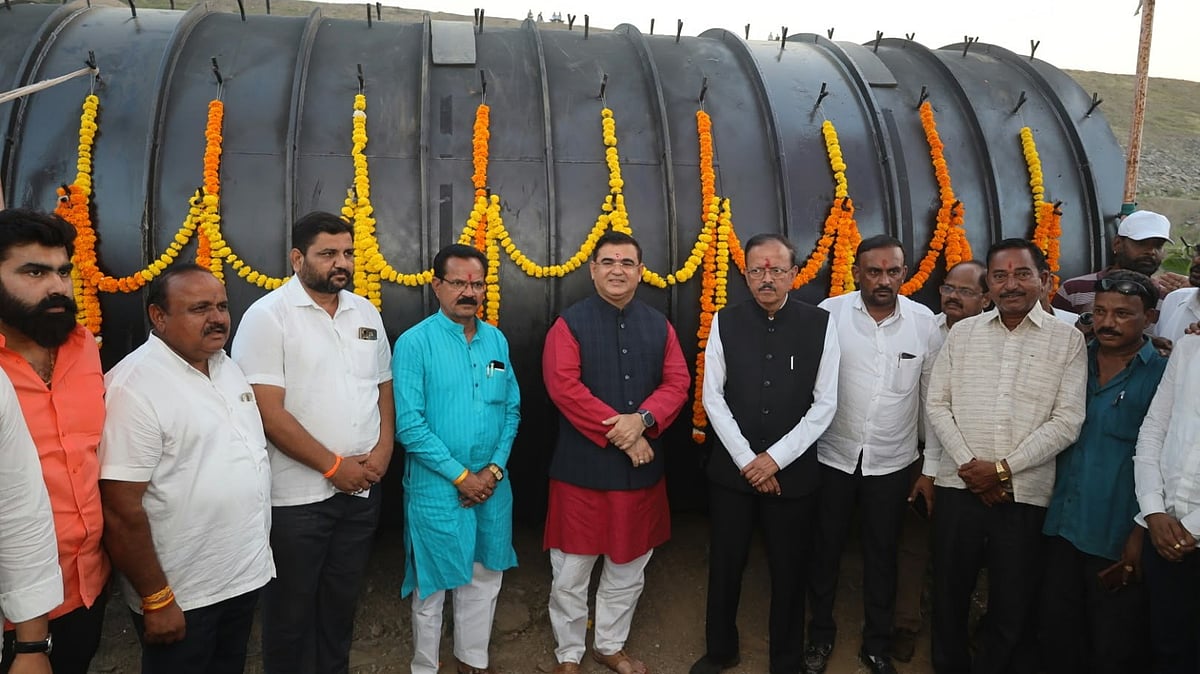
Dhule: Work on the main pipeline connection of the ₹1,058 crore Jamphal Dam Pipeline Distribution Network (PDN) has begun, marking a significant step towards providing irrigation facilities to agricultural land across 54 villages in Shindkheda taluka.
The project, part of the Sulwade-Jamphal-Kanoli Lift Irrigation Scheme, aims to bring water from the Tapi River to drought-prone areas of the taluka. Efforts are underway to provide irrigation benefits to farmers in phases from June 2027.
Dhule Guardian Minister Jaykumar Rawal, who also holds the Marketing and Protocol portfolios, inaugurated the main pipeline connection work at the Jamphal Dam site.
Speaking on the occasion, Rawal said the project would help improve the economic condition of farmers who have faced water scarcity for generations.
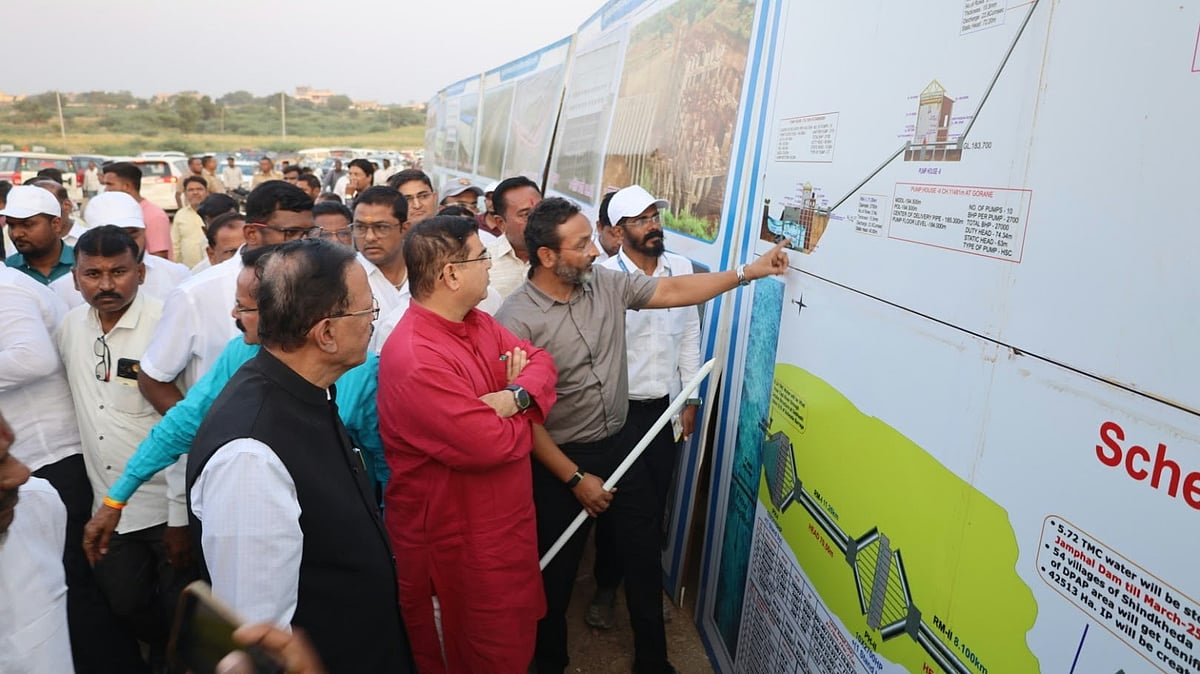

He said that despite the perennial Tapi River flowing along one side of Shindkheda taluka, villages located just a few kilometres away had experienced drought conditions for years.
Rawal said efforts to secure approval for the Sulwade-Jamphal project gained momentum after 2014 under the leadership of then Chief Minister Devendra Fadnavis. Prime Minister Narendra Modi performed the groundbreaking ceremony in February 2019, following which the pace of implementation increased.
Pipeline Work Reaches 42.41%
Rawal said works worth ₹1,058 crore had been undertaken for the closed-conduit pipeline distribution system of Jamphal Dam.
The network is designed to provide irrigation to a command area of 26,907 hectares across 54 villages.
Of the total planned pipeline length of 766.16 km, pipes covering 548.81 km have been supplied, while 324.93 km of pipeline laying has been completed, accounting for 42.41% of the total.
The project involves five railway crossings and three national highway crossings. Work on railway crossings at Dabli, Melane and Malich has been completed, while work at Hol is in the final stage.

Irrigation Benefits Planned From June 2027
Rawal said approximately 80% of the work on the main Sulwade-Jamphal project had been completed.
To provide irrigation benefits to farmers without waiting for the entire project to be completed, work on the main pipeline connection has been initiated.
The initiative aims to make approximately one thousand million cubic feet (TMC), equivalent to 28.32 million cubic metres, of water available.
Rawal said efforts were being made to begin providing irrigation benefits in phases from June 2027.
Plans are in place to develop water distribution infrastructure covering approximately 6,000 hectares over the next three to four months. Irrigation facilities are expected to be extended to another 13,000 to 14,000 hectares in the subsequent phase.
Closed Pipeline System to Reduce Water Loss
Rawal said the closed pipeline distribution system would help reduce water leakage and wastage compared with traditional open canals.
The resulting water savings are expected to make it possible to extend irrigation benefits to an additional 2,700 hectares, covering another five to six villages.
He said emphasis would be placed on micro-irrigation systems to ensure that water reaches the fields of eligible farmers.
89 Water Users' Associations Planned
For effective water distribution, the command area of 26,907 hectares has been divided into two parts and six zones.
The first part covers 13,500 hectares, while the second covers 13,407 hectares.
Arrangements are being made to establish 89 Water Users' Associations to manage water distribution. Construction of offices for 23 of these associations is currently underway.
Rawal urged farmers to participate actively in the associations and use water judiciously.
He also directed officials to minimise damage to standing crops during pipeline laying.

