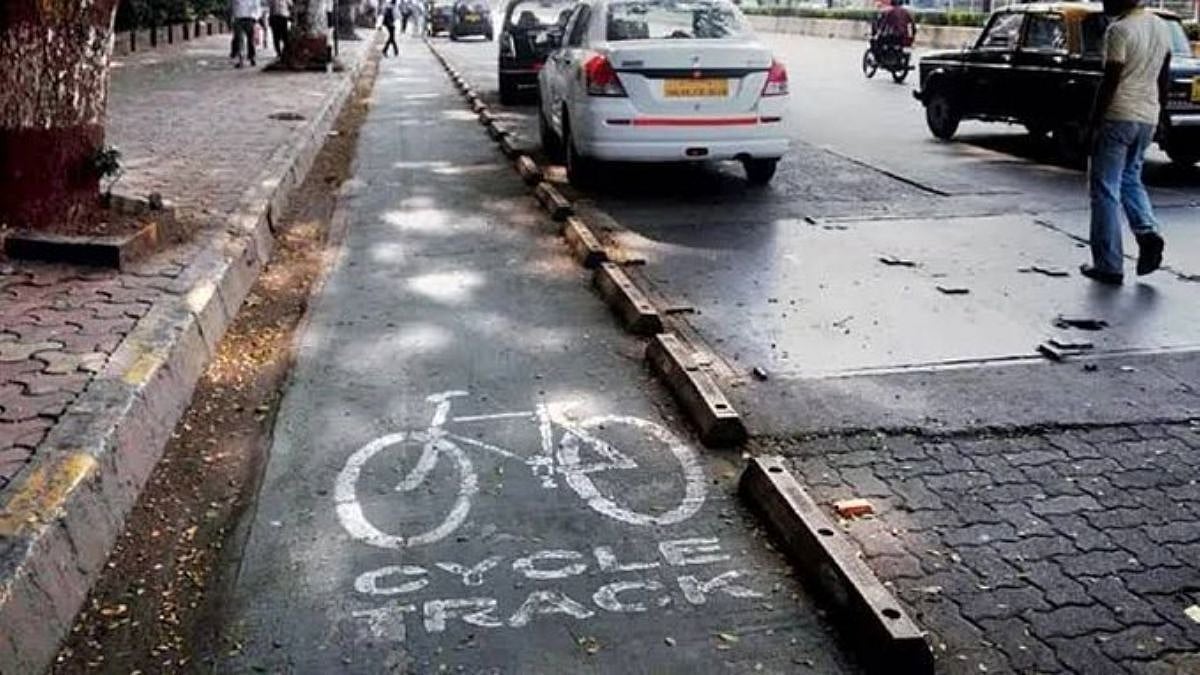
A detailed audit of Pune’s cycling infrastructure conducted by NGO Parisar has revealed that the city’s cycle tracks fall far short of the standards promised under the Comprehensive Bicycle Plan of 2017.
The cycle track audit report 2024–25 highlights that nearly 35 kilometres of cycle tracks across 19 major roads, divided into 77 segments, are having issues of discontinuity, poor maintenance and serious safety lapses.
The report gains significance at a time when the city has stepped onto the global stage through the Pune Cycle Grand Challenge, an annual international cycling event. With the city expected to host the challenge every year, the need for a safe, continuous, and world-class cycling network has become more urgent than ever. The findings underline the gap between Pune’s aspirations and the present ground reality.

The audit was conducted by trained volunteers who cycled across each 500-metre segment, documenting the lived experience of everyday cyclists. Their assessment focused on continuity, safety, and comfort, three essential parameters that determine whether a cycle track is usable in practice, not just on paper. While continuity received relatively better scores, comfort and safety performed poorly across most locations.
Many tracks, the report notes, suffer from broken interlock tiles, uneven or damaged surfaces, inadequate drainage, and encroachments that force cyclists to repeatedly dismount. Safety was compromised by the absence of segregation from traffic, poorly designed junctions, inadequate lighting, missing signage, and frequent obstructions from parked vehicles and roadside vendors. In several places, even where tracks physically exist, their everyday usability remains severely limited.

The audit also points out that Pune’s cycle tracks do not consistently follow the design standards laid down under IRC:11-2015, issued by the Indian Roads Congress and made statutory under the Motor Vehicles Act. The binding nature of these guidelines has been reaffirmed by the Supreme Court, making compliance by local authorities mandatory.
Parisar’s report stresses the need for Pune to build a continuous, citywide cycling network rather than disconnected fragments that serve little practical purpose. It calls for stronger markings, better signage, and design improvements that can encourage behavioural change among motorists and cyclists. The organisation suggests using painted cycle lanes as a quick, low-cost intervention in the short term, followed by the phased development of fully segregated tracks.
Governance and enforcement emerge as critical gaps. The report recommends reinstating the Non-Motorised Transport Committee and the Bicycle Department within the Pune Municipal Corporation (PMC), along with a public dashboard to track maintenance issues and obstructions. It also calls for strict action against parking and vending on cycle tracks.
To strengthen community participation, Parisar proposes digital reporting tools that allow cyclists to flag problems in real time and encourage local groups to adopt stretches of cycle tracks for monitoring and upkeep. The report also highlights the need to create safe school zones with dedicated cycling access to reduce peak-hour traffic and improve safety for children.

The audit emphasises better integration between cycling and the Pune Metro, particularly through the creation of secure cycle-parking spaces at stations, instead of relying on the limited option of carrying bicycles inside trains. It also recommends the formation of a Pune Cycle Partnership a citywide platform to drive awareness, support new riders, and implement soft interventions that promote cycling as a daily mode of transport.
Lastly, the report identifies several high-growth localities such as Kharadi, Kondhwa, Mohammedwadi, Yewalewadi, Mhalunge, Dhanori and Lohgaon as priority zones where cycle-track development can have an immediate impact. It suggests using credit notes and public-private partnerships to accelerate infrastructure creation in these areas, especially where new layouts and short-distance travel patterns offer natural opportunities for cycling.
With the city preparing for more global attention through the Cycle Grand Challenge, Parisar’s audit serves as a strong reminder that Pune must urgently upgrade its cycling infrastructure if it hopes to position itself as a true leader in sustainable mobility.

