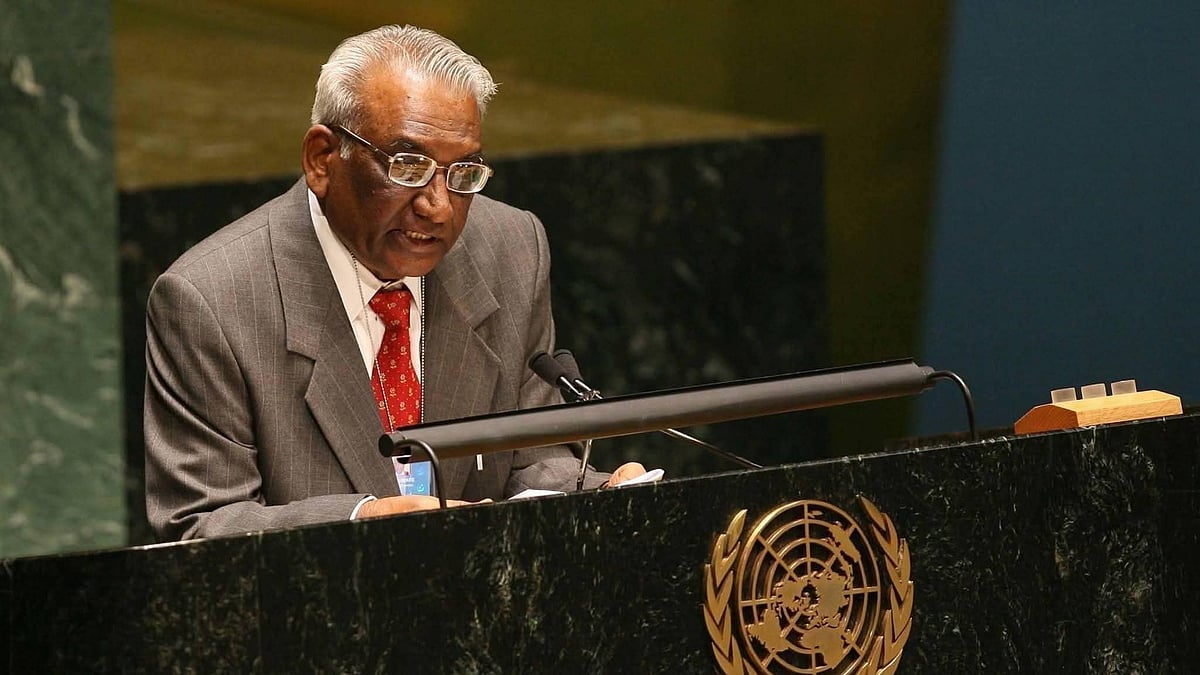
Latur: Maharashtra has lost one of its brightest intellectual luminaries. An eminent thinker, educationist, author, critic, principal, architect of the nationally acclaimed ‘Latur Pattern', founder vice-chancellor of Swami Ramanand Teerth Marathwada University, Nanded, the only directly elected president of the Latur Municipal Council, former member of Parliament, lifelong member of Yashwantrao Chavan Pratishthan and founding president of its Latur district branch, and member of the Nanded Education Society (established by Swami Ramanand Teerth), the respected Dr Janardan Waghmare passed away on Monday (March 2) at the age of 91 after a brief illness.
With his passing, a radiant beacon in Marathi intellectual and literary life has been extinguished. What follows is a humble attempt to briefly trace his extraordinary journey. It is often said that education lends fulfilment to life and nobility to character. Dr Waghmare’s life stood as a living testament to this truth. His was a life enriched by relentless reading, reflection, scholarship, teaching, authorship, philosophical inquiry, and critical thought -- a rare and remarkable intellectual odyssey.
Born on November 11, 1934, in Janwal village (his maternal home) in Chakur tehsil, Dr Janardan Waghmare was nurtured in modest surroundings. His father, Madhavrao Waghmare, was a farmer who ensured that young Janardan received an education at home by appointing a private tutor. He later joined the Government School in Latur, where he studied alongside future Union Home Minister Shivraj Patil -- a friendship that endured for decades.
He completed his matriculation at Marwadi Rajasthan Vidyalaya at a time when Urdu was the medium of instruction. His collegiate education took him to Hyderabad, where he consistently excelled. In 1955, while studying at Nizam College, he won first prize in the All India Hindi Elocution Competition, an achievement personally acknowledged by then President Rajendra Prasad, Prime Minister Jawaharlal Nehru, and Defence Minister V.K. Krishna Menon. Such recognition at a young age proved deeply inspiring. In 1957, he earned his BA degree from Osmania University.
He completed his MA in English Language and Literature in 1959 from Pune University (now Savitribai Phule Pune University) and soon began his teaching career. After serving at Shivchhatrapati College in Omerga and Dr Babasaheb Ambedkar College in Aurangabad (Chhatrapati Sambhajinagar), he also pursued an LLB degree.
Raised with Arya Samaj values, Dr Waghmare entered into an inter-caste marriage on May 22, 1962, marrying Sulochana, daughter of Manikrao Arya (Jadhav) of Hallikhed in Bidar district, Karnataka -- a progressive step reflecting his convictions. They were blessed with three children: Sucheta, Jitendra, and Asmita.
After teaching English at Deogiri College, Aurangabad, he assumed a transformative role in 1970 as the first principal of Rajarshi Shahu College, founded to serve the educational aspirations of marginalised communities. Under his visionary leadership, the college rose to prominence as a centre of academic excellence and social transformation. It was during his tenure that the famed ‘Latur Pattern’, a rigorous, disciplined, results-orientated approach to education, took shape and gained nationwide recognition. Today, the Latur Pattern is often referred to as a “factory of doctors and engineers".
He served as principal for 25 years (1970–1994), shaping thousands of students who went on to distinguished careers in India and abroad.
Dr Waghmare was equally distinguished in literature. His first book, American Negro: Literature and Culture (1978), was widely acclaimed and drew praise from celebrated writer P.L. Deshpande in Maharashtra Times. Over his lifetime, he authored 75 books in English and Hindi, covering politics, society, philosophy, autobiography (A Handful of Soil), and biographies such as Sharad Pawar: Personality, Leadership and Achievement. Many of his works received prestigious awards. His writing and activism reflected deep engagement with India’s Dalit movement, and he also expressed his sensitive inner world through Hindi poetry.
In 1994, amid challenging circumstances, he became the founder vice-chancellor of Swami Ramanand Teerth Marathwada University, Nanded. Over five years, he laid a strong institutional foundation and initiated several significant reforms, including efforts toward establishing a “caste-free village” model through National Sevagram initiatives. Several scholars have completed doctoral research on his literary contributions.
After retiring in 1999, he was directly elected President of the Latur Municipal Council in 2001 with a decisive mandate. His tenure was marked by a firm anti-corruption stance and transparent governance. In 2006, under his leadership, the Latur Municipal Council won first prize in the Maharashtra Sant Gadge Baba Urban Cleanliness Campaign.
Recognising his stature and intellect, Sharad Pawar nominated him to the Rajya Sabha (2008–2014). As a Member of Parliament, he served on key committees, including Human Resource Development and Defence. Despite initial hardships, including the lack of official accommodation in Delhi for nearly ten months, he carried out his responsibilities with dignity.
In 2009, he was part of the Indian parliamentary delegation to the United Nations, where he addressed representatives from 150 nations on global peace, earning admiration for his eloquence. He also introduced an important bill in Parliament advocating mandatory premarital HIV/AIDS testing.
Dr Waghmare received numerous state and national honours, including the Dr Babasaheb Ambedkar Dalit Mitra Award (1994) from the Government of Maharashtra. He presided over several major Marathi literary meets, including the 38th Marathwada Literary Meet in 2016, and chaired the International Hindi Literary Seminar organised by Sant Kabir Pratishthan in 2017.
His last rites will be performed at his native village, Kavtha, in Ausa tehsil on Tuesday at 11 am.

