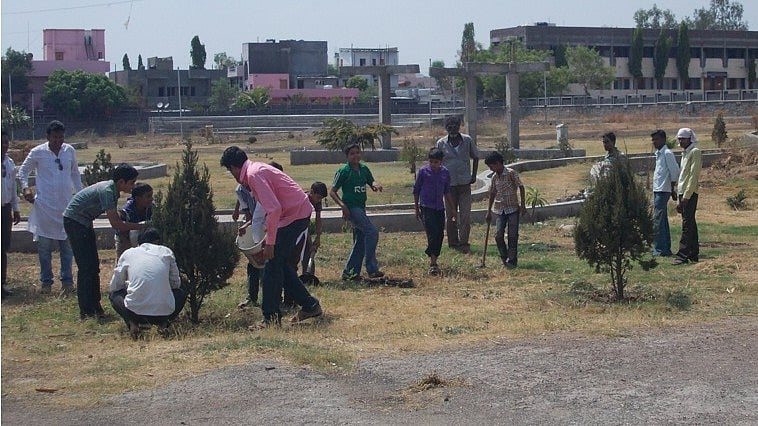
Chhatrapati Sambhajinagar: For Dr Priyanand Agale, environmental conservation is not the responsibility of a handful of environmentalists. He believes it must become a people’s movement -- one that brings together communities, scientists, researchers, academicians, social organisations, policymakers and spiritual leaders.
An environmentalist from Chhatrapati Sambhajinagar, Dr Agale has spent years working in water conservation, environmental protection, education, rural development and social transformation. Through the Eco Needs Foundation, which he founded, he has sought to turn this belief into action through the Eco-Revolution Movement.
The movement aims to create a common platform where science, society, governance, spirituality and community action come together to address environmental challenges. Its approach goes beyond tree plantation and conventional conservation. It connects environmental protection with water security, natural resource conservation, education, rural development, technology, health, peace and human well-being.

“Development and environmental conservation must progress together for the happiness and well-being of all living beings,” says Dr Agale.
Over the years, the Eco Needs Foundation has worked to take this approach beyond Maharashtra and build a wider network in India and abroad. Its Eco-Revolution national and international conferences have brought together researchers, experts, institutions and other stakeholders to discuss environmental challenges and possible solutions. Conferences have been organised in India, Sri Lanka and Nepal.
One such conference, Eco-Revolution 2013 in Pokhara, Nepal, focused on the vulnerability of high-altitude regions to climate change. At a time when much of the climate conversation centred on low-lying and coastal regions, the foundation sought to draw attention to mountain ecosystems and the impact of changing temperatures, snowfall and glaciers on springs, rivers and drinking-water availability.
The foundation has also worked on rural development models. In Dhanora, Rajasthan, it developed what it describes as India’s first Smart Village. The Smart Village concept, developed with Dr Satyapal Singh Meena (IRS), follows a five-fold approach -- Retrofitting, Redevelopment, Greenfield, e-Pan and Livelihood.
Closer home, Dr Agale’s work has focused strongly on water conservation in drought-prone Marathwada.
“Water conservation has been one of the major focus areas of my work,” he says.
To create awareness and demonstrate practical solutions, the foundation established the Centre for Water Literacy in Chhatrapati Sambhajinagar. The centre showcases different water conservation structures and serves as a platform for educating citizens, students and institutions about sustainable water management.

The foundation also worked extensively under the Aurangabad Water Conservation Campaign to protect and rejuvenate local water bodies. Rejuvenation efforts along the Kham and Sukna rivers and at three major lakes have since shown positive results.
For Dr Agale, however, the real measure of water conservation is its impact on people’s lives.
In Parsoda village in Vaijapur taluka, water scarcity had severely affected agriculture and development. The foundation initiated the Bore River rejuvenation project and worked towards holistic village development under the Adarsh Village approach. The village has since emerged as one of the leading examples in the region, according to the foundation.
Such initiatives, Dr Agale believes, demonstrate how water conservation can become the foundation for rural transformation and sustainable development.

His work has also taken him to national and international forums, including the UN Water Conference in 2013. He holds an M.E. in Water Resources and has conducted Ph.D. research in wastewater treatment. He has also developed a patented nature-based wastewater treatment technology.
His contribution to water conservation was recognised during Azadi Ka Amrit Mahotsav, when the Government of India featured him as a “Water Hero of India” on the Ministry’s platform.
Education is another important part of his work. January 3, the birth anniversary of Savitribai Phule, has a special significance for the Eco Needs Foundation. In her honour, the foundation has been observing the day as National Free Education Day and campaigning for free education from KG to PhD for every learner.
For Dr Agale, environmental conservation, education and social transformation are closely connected. His work has therefore evolved beyond individual projects into a larger attempt to build awareness and community participation.

Film director R Gunaseelan from Tamil Nadu, who has followed Dr Agale’s work, describes his journey as one shaped by “compassion, equality, knowledge and service to society”.
“His work brings together water conservation, water literacy, community and digital libraries, rural transformation and the Eco-Revolution movement,” Gunaseelan said.
He believes Dr Agale’s work has also evolved into the Peace Army initiative, which carries the message of compassion and seeks to promote peace, harmony and friendship among people and all living beings.
“Dr Agale’s story combines social transformation, environmental action, education, water literacy and peace,” Gunaseelan said.
For a drought-prone region like Marathwada, where water scarcity continues to shape the lives of communities, Dr Agale’s work reflects an attempt to make conservation more than a campaign -- and turn it into a way of life.

