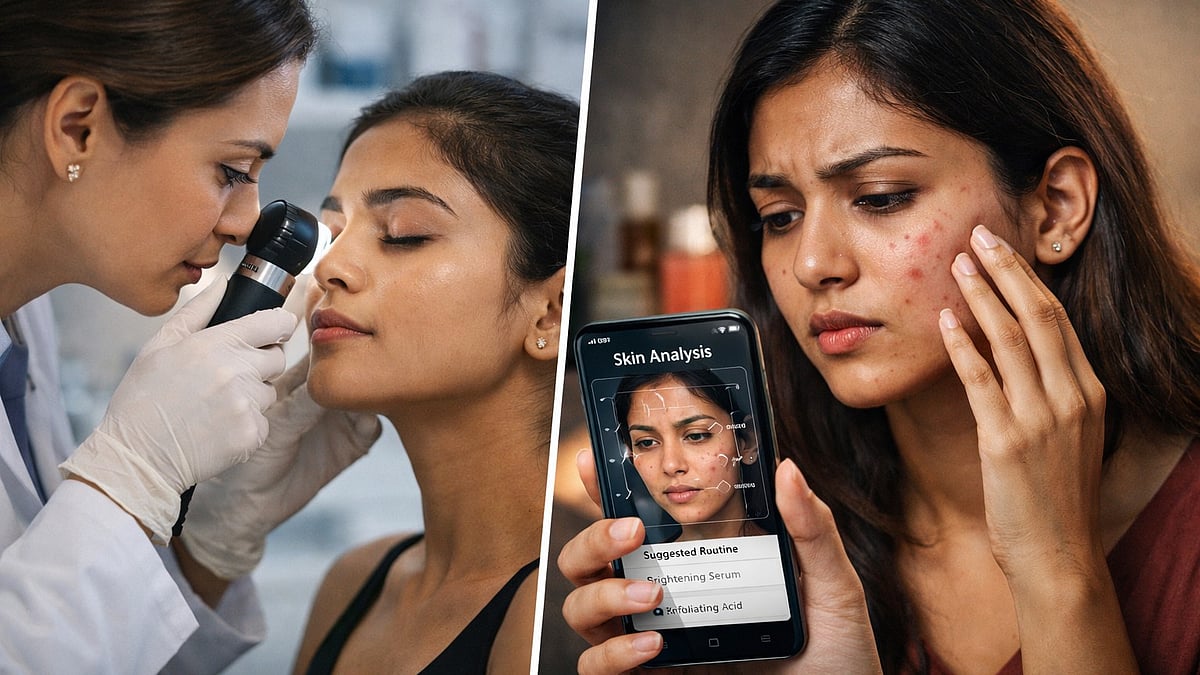
Over the past two years, India has witnessed the rise of a new kind of skincare authority, one that doesn’t sit in clinics, doesn’t examine skin under proper lighting, and doesn’t ask about your hormonal cycle, allergies, or medical history. Instead, it lives on screens. AI-driven skincare apps and influencer-led routines are now being trusted as much as, and sometimes more than, trained dermatologists.
But beneath the glossy claims of “instant skin analysis” and “dermat-approved routines,” dermatology clinics across urban India are reporting a quiet epidemic: damaged skin barriers, flare-ups worsened by misdiagnosis, aggressive layering of actives, and young adults who no longer know what their real skin type is.
A 2024 Kantar Beauty Study found that 71% of Indian Gen Z consumers try skincare products recommended by influencers, while 58% have used AI tools for routine suggestions, a sharp jump from just 22% in 2022. Yet, the same report notes that over 52% of these users experienced new or worsened skin problems soon after following these routines.
AI can scan a face, but cannot read skin
AI-powered apps promise quick answers: upload a selfie, get a diagnosis. Except what they provide is not a diagnosis at all — it’s an algorithmic assumption.
Dr. Aparajita Lamba, dermatologist and aesthetic medicine specialist at Iksana Wellness, sees the consequences daily. “Social media and AI have made skincare advice more accessible than ever, but also more generalised. In my practice, I’ve seen that most people who come to me don’t actually know their true skin type… Someone who believes they have oily skin might follow a dry-combination skin routine they saw online or try an AI-generated regimen that doesn’t suit them. This mismatch often leads to breakouts, irritation, or even long-term barrier damage.”
Her concern goes deeper. “AI can read the image, but it can’t read the skin. It can’t assess deeper concerns like hormonal imbalance, PCOD, or lifestyle triggers… Even small factors like lighting, filters, or camera quality can completely distort what the algorithm sees.”
A 2025 Stanford dermatology audit supports her point — AI skin-analysis tools showed up to 34% error rates for Indian and deeper skin tones, primarily because datasets remain Western-skewed. In other words, AI may “see” your skin. But it doesn’t understand it.
Influencers become ‘skin experts’
Parallel to AI’s rise is the booming influencer skincare economy. India’s creator industry is projected to reach ₹3,500 crore by 2025, with beauty creators forming one of its largest verticals. But visibility is often mistaken for credibility.
Dr. Shifa Yadav, Consultant–Dermatology, Artemis Hospitals, explains: “There is a lot of skincare advice out there these days from AI-powered apps to Instagram influencers… This trend has made skincare easier to get but it has also made it harder to tell the difference between professional advice and general advice.”
She stresses that the problem often starts with misidentification. “Different people's skin is different, so what works for one person might not work for another and might even cause breakouts, irritation and allergies.”
Her biggest worry is the reckless use of actives. “Putting too many active ingredients on your skin at once like retinol, vitamin C and exfoliating acids without the right advice can hurt your skin over time… Dangerous DIY hacks, including home remedies using lemon juice, baking soda or toothpaste, can cause chemical burns, permanent pigmentation issues and severe irritation.”
According to a 2024 Aesthetic Medicine India survey, 42% of dermatologists reported an increase in chemical burns caused by at-home “viral skincare hacks.”
Young users pay the price
For many young Indians entering adulthood, skincare didn’t begin in a clinic — it began on Instagram and AI apps. Their experiences mirror a generation trying to self-diagnose in an era of instant advice.
Kajol Awon, 26, Public Relations Consultant, recalls how she got pulled into the culture of influencer-led routines during the pandemic: “While many creators were genuinely mindful about what they endorsed, we forget that skincare is personal… A simple routine, supported by good sleep, nutrition, and hydration, can do more than ten products ever could.”
She adds, “In reality, good skin comes down to basics… Maybe a serum here and there for specific concerns, but not every product on the shelf needs to be part of your routine.”
Her turning point came after a reaction: “I remember using a serum by a known brand which was new, i didn't learn much about the concentration, and that caused breakout… Personally, I’ve come to rely on dermatologists more than influencers.”
Urvashi Rathore, 24, a social media executive, echoes the sentiment, but her reliance was on AI.
“I used AI apps because they felt quick and smart… But following those regimens without knowing my skin type ruined my barrier — I had inflammation for weeks.”
She adds, “When I finally visited a real dermatologist, she explained things I never even thought about… AI can guide you, but it cannot diagnose you.”
Together, their experiences reflect what a 2025 NCBI review highlighted: self-guided skincare increases the risk of prolonged inflammatory issues and delayed clinical intervention.
AI leaders warn against over-reliance
Even technologists acknowledge that AI should complement, not replace humans. Ankush Sabharwal, Founder & CEO, CoRover.ai, warns: “Lately, we see AI and influencer-driven skincare regimens all over social media… The Result? Most users end-up breakouts, get a rash, or even get their condition exacerbated.”
He adds, “AI's no magic bullet, only a very capable assistant… Let's use AI with a definite purpose, due diligence, and human oversight to deliver real leverage and avoid costly failures.” His perspective reflects a growing global consensus: AI’s role should be informational, not diagnostic.
Real fix is consultation, not automation
Dr Aarzoo Pahwa, Consultant Dermatology, Kailash Deepak Hospital, emphasises simple caution: “It is advised that people should consult a dermatologist before experimenting with products or routines seen online… Professional consultation ensures that skincare advice is personalized to one’s skin condition, keeping treatments safe and effective.”
With dermatology OPDs reporting a 30–38% rise in barrier-damage cases among Indians aged 18–30 (AIIMS Dermatology, 2025), the message is clear: prevention begins with guidance, not guesswork.
The rise of AI and influencers has democratized skincare, making conversations about skin health more accessible. But accessibility without accuracy creates confusion — and chaos.
Skincare was never meant to be trend-based. It was meant to be tailored. Perhaps the real skincare revolution young India needs today is not another serum, scanner, or trend. It’s a return to basics: listen to your skin, understand your type, don’t self-diagnose, and when in doubt, consult a professional. Because AI can give you possibilities. Influencers can inspire you. But only a dermatologist can give you the truth.

