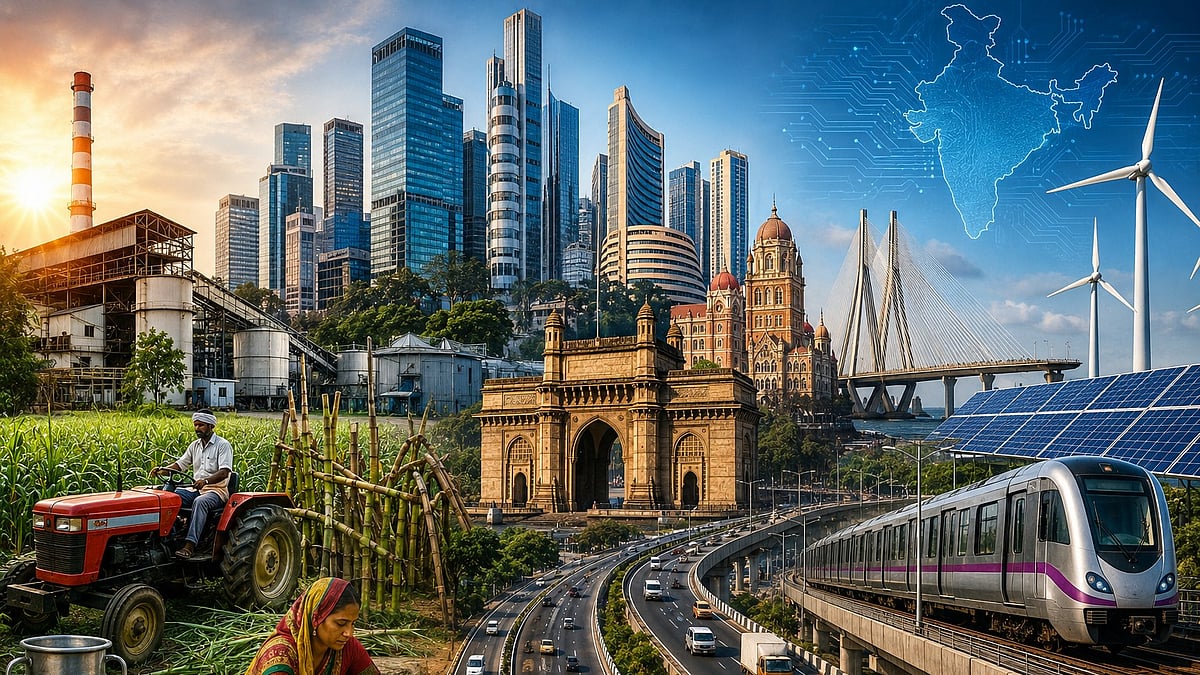
For more than six decades, Maharashtra has remained the driving force of India’s economy. While Mumbai, the capital of Maharashtra, established itself as the country’s financial and commercial capital, the state’s economic success has been shaped by the collective contribution of every region. From the cooperative movement that transformed rural Maharashtra through sugar factories, dairy cooperatives and cooperative banks to the industrial, agricultural and technological growth of cities such as Pune, Nashik, Nagpur and Chhatrapati Sambhaji Nagar, Maharashtra has continuously diversified and strengthened its economy. With leadership in manufacturing, finance, information technology, services, innovation and infrastructure, the state has consistently remained India’s foremost economic powerhouse.
As per the Economic Survey for FY2025–26, tabled in the Maharashtra Assembly, the state contributes 14.3% to the country’s nominal GDP and remains the nation’s largest state economy. As per the Ministry of Industry, Maharashtra accounts for around 31% of India’s total Foreign Direct Investment (FDI) and has consistently remained the country’s leading FDI destination over the years.

Vision that shaped a state
When Maharashtra was formed on May 1, 1960, its first Chief Minister, Yashwantrao Chavan, laid the foundation for a development model that balanced agriculture with industrialisation. His vision was simple yet transformative: prosperity should not be confined to cities but should reach villages as well.
During the 1960s and early 1970s, the cooperative movement became the backbone of rural Maharashtra. Sugar factories, dairy cooperatives, cooperative banks and credit societies empowered farmers, created rural employment and connected agricultural producers directly with markets. The movement not only strengthened the rural economy but also nurtured entrepreneurship across the state.
The state’s commitment to grassroots governance was further strengthened through the enactment of the Maharashtra Zilla Parishads and Panchayat Samitis Act, 1961, which institutionalised rural local self-government. Decades later, many of its principles were reflected nationally through the 73rd Constitutional Amendment that made the Panchayati Raj system mandatory across India.
Industrialisation beyond Mumbai
Experts say that, recognising the need for balanced regional development, Maharashtra shifted its focus towards decentralised industrial growth during the 1970s. The establishment of the Maharashtra Industrial Development Corporation (MIDC) transformed the industrial landscape by creating industrial estates across almost every district. The objective was clear: generate employment outside Mumbai and Pune while attracting investment across the state.
This policy laid the foundation for thriving industrial centres in Pune, Nashik, Nagpur and Chhatrapati Sambhajinagar, each developing its own industrial identity.
Over the following decades, Maharashtra emerged as a national leader in automobile manufacturing, engineering, electrical and electronic equipment, pharmaceuticals, textiles, food processing, real estate, printing and numerous service industries. Simultaneously, Mumbai strengthened its position as India’s financial capital, housing the country’s leading banks, insurance companies, financial institutions and stock exchanges.
The state’s strong educational institutions also ensured a steady supply of skilled professionals, creating an ideal ecosystem for industrial expansion.
Liberalisation accelerated Maharashtra’s growth
Economic liberalisation in the early 1990s provided Maharashtra with another decisive advantage. Since the state already possessed strong industrial infrastructure, financial institutions and skilled manpower, it was among the first to benefit from the opening of India’s economy.
Sectors such as banking, financial services, trade, information technology, IT-enabled services, biotechnology, chemicals, construction and global commerce expanded rapidly. Mumbai strengthened its reputation as India’s financial nerve centre, while Pune evolved into one of the country’s leading IT and automobile hubs.
Today, Maharashtra remains India’s largest industrial employment provider and continues to lead in urbanisation, manufacturing output and foreign investment.
From manufacturing to a knowledge economy
Economic analyst and Honorary Director of the Indian School of Political Economy, Pune, Abhay Tilak believes Maharashtra is entering a new phase of economic evolution. "Now the state will become the country’s largest service centre, particularly for human intellect and knowledge-intensive industries. Trade, finance, banking, insurance, information technology, biotechnology and education are becoming the major drivers of Maharashtra’s economy. The state has built a comprehensive education network that provides the skilled workforce these sectors need. Maharashtra is now entering the mature phase of its economic development," he says.
According to Tilak, Maharashtra’s success is not accidental but the result of consistent and responsive policymaking by successive governments. "Governments across party lines largely maintained economic continuity while adapting policies to changing national and global conditions. That continuity has been one of Maharashtra’s greatest strengths," he adds.


Infrastructure driving the next phase
The state’s next growth cycle is being powered by massive investments in infrastructure and logistics. Projects such as the Mumbai–Delhi Industrial Corridor, the Mumbai–Nagpur Samruddhi Expressway and new industrial clusters in regions such as Gadchiroli and Khandesh aim to spread industrialisation beyond traditional urban centres.
Defence manufacturing, logistics, renewable energy and advanced manufacturing are emerging as new pillars of growth. Jalna has become one of India’s largest centres for construction steel manufacturing, while improved road connectivity is reducing logistics costs and making the state more attractive to investors.
Rural transformation continues
The post-liberalisation emphasis on horticulture and floriculture has further diversified agricultural income. Maharashtra’s grapes, pomegranates and mangoes are exported across Europe and several international markets. Women’s self-help groups and microfinance initiatives have also played a significant role in promoting financial inclusion and rural entrepreneurship.
Dr Santosh Dastane, an economics professor and author of several books on economics, says the cooperative model created long-term social and economic benefits. "The cooperative movement uplifted the middle class and lower middle class in rural Maharashtra. Sugar factories, dairy industries, cooperative banks, agro-processing and rural credit institutions generated employment and sustained economic growth for decades. Today, the expanding service sector, supported by Mumbai’s strengths in finance, information technology, banking and insurance, continues to drive the state’s economy," he says.
Social stability behind economic success
According to Tilak, Maharashtra’s economic achievements are deeply rooted in its social fabric. "Economic stability depends on social stability. Maharashtra has benefited from social harmony, a strong sense of security, industrialisation, urbanisation, a rich cultural legacy, the contributions of social reformers and activists, the Sant tradition, the cooperative movement, widespread education, and the presence of Mumbai as a global financial city. Together, these factors have created an environment in which economic growth could flourish."

Looking towards a $5-trillion economy
The state’s ambitions continue to grow. At the 11th meeting of the NITI Aayog Governing Council, Chief Minister Devendra Fadnavis outlined Maharashtra’s roadmap to become a $5-trillion economy by 2047. The government has set intermediate milestones to become a $1-trillion economy by 2030 and a $2-trillion economy by 2035, supported by investments in artificial intelligence, innovation, startups, manufacturing, logistics, and digital infrastructure.
Fadnavis has also expressed confidence that Maharashtra is poised to surpass the economies of Singapore and the United Arab Emirates within the next few years, further strengthening its position among the world’s largest sub-national economies.
The journey continues
From cooperative sugar mills to artificial intelligence, from village credit societies to global financial markets, Maharashtra’s economic journey reflects a remarkable story of vision, resilience and continuous reinvention. Its ability to combine agricultural strength with industrial expansion, financial leadership, skilled human capital and infrastructure development has enabled the state to remain India’s economic engine for over six decades.
As India moves towards becoming a developed nation, Maharashtra is expected to remain at the forefront, driving growth, attracting investment and shaping the country’s economic future.

