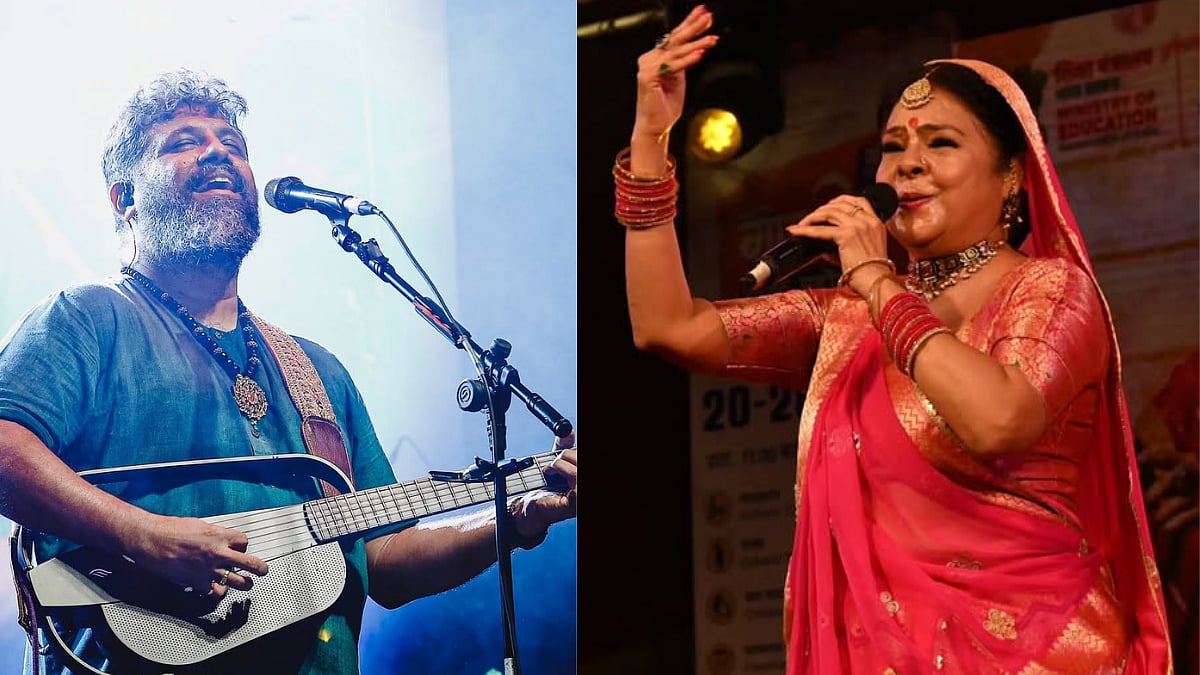
One always talks of the richness and diversity of Indian folk music forms, right from the variety of styles and range of instruments to the sheer excess of talent in each language and state. And though festivals like Jodhpur RIFF, Ruhaniyat, Roots at Mahindra and the earlier Paddy Fields have showcased artistes from different sub-genres, one always feels a lot more needs to be done to familiarise styles from across India.
In some ways, the seminar on folk music organised recently at the Experimental Theatre by the National Centre for.the Performing Arts (NCPA) and the International Foundation for Fine Arts was quite beneficial to folk lovers.
After Shekhar Sen talked about the role of folk music – lok geet - in today’s culture, there were sessions by Malini Awasthi on Uttar Pradesh styles, Ashit Desai and Hema Desai on Gujarat, Chandan Tiwari on Bihar, Nandesh Vitthal Umap on Maharashtra, Ratnaboli Bose, Rangoli Biswas and group on Bengal and Rakesh Tiwari on Chhattisgarh. Unlike most seminars, which are filled with speeches and PowerPoint presentations, this one was more like a set of live demonstrations with brief lectures thrown in.
Some people felt a seminar on folk music was incomplete without Rajasthan and Punjab, but then, there has been an overdose of shows depicting these states. Chhattisgarh and Bihar folk is heard less in Mumbai, and the presentations acted as eye-openers. One also got to know about the specialities of different states – like Bhavaiya, Bhatiyali and Jhumur from Bengal, or Garba, Lagangeet or Bhavai from Gujarat or Sohar, Chaiti and Bidaai from Uttar Pradesh.
Whatever region they belong to, folk songs come under specific categories. They can involves tales of gods and goddesses, kings and clowns, heroes and villains, real and fictional. They could be associated with different stages, from birth to marriage and bidaai to death. They could be about different festivals or seasons. The scope is endless. Each district in India has its own special flavour, and with spoken dialects changing from town to town, one notices a change in the style of music too.
One welcomes the broader intent of the seminar and also the sheer variety of songs sung by the participants. But there are a couple of things one needs to look at. For a field as vast and diverse as Indian folk, a single day’s programme seemed inadequate. Only one hour was slotted to each participant, and that duration was cut to 40 minutes after the first few sessions. Thus, many of them were only able to skim the surface. A two-day seminar, with representation from more states, would be better.
Secondly, considering that entry was open to all without any ticket fee, it was surprising to see so many empty seats. The attendees included musicians, researchers, connoisseurs and students, but there were obviously many who missed something enriching.
While one hopes such a seminar becomes a regular feature, one also looks forward to Living Traditions at the Experimental Theatre on March 6 and 7, which will focus on the folk forms of Arunachal Pradesh. Considering that not much is known about the state’s culture within Mumbai circles, there will be plenty to learn here.
Over the past seven or eight years, barring the Pandemic period, there have been regular activities to promote different folk styles. Showcase Events organised the Sounds From The Desert shows to highlight the music of Rajasthan and later Fankar-e-Kashmir to identify talent from the northern states. The Amarrass nights in Delhi feature folk artistes.
Apart from the purer forms, there has been an increase in folk-fusion acts, where the aim is to attract the younger generation by blending traditional styles with jazz, rock or electronica. Besides acts like Indian Ocean, Advaita, Swarathma, Raghu Dixit, Himali Mou and Tapi Project, the Coke Studio series has showcased some talented artistes.
Yes, there have been sincere efforts. But they all seem to be travelling in different directions. This is where seminars, workshops and guided listening sessions can play a role in creating more awareness.

