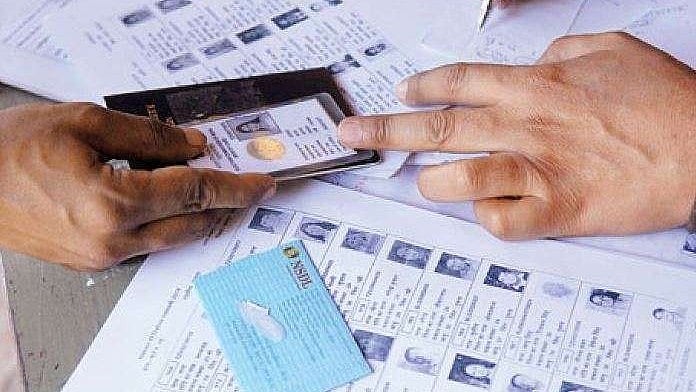
Ayodhya: The Special Intensive Revision of electoral rolls has thrown up an unexpected challenge in Ayodhya, where hundreds of sadhus and saints have filled voter forms in keeping with monastic traditions, raising fears of possible deletions from the voter list and causing unease within the BJP.
Ayodhya is home to more than 15,000 sadhus and saints residing largely in the Nirvani Ani, Digambar and Nirmohi akharas. During the SIR process, many of them entered the names of their gurus or Hindu deities in the column meant for the father’s name. In the mother’s name column, entries such as Kaushalya, Sita, Janaki, Durga and Saraswati were frequently written.
Sadhus are widely seen as a core support base of the BJP in the temple town, and party leaders privately concede that large scale rejection of such forms could have electoral implications. The concern has been amplified as the SIR exercise in Uttar Pradesh concluded on Friday with the deletion of nearly 2.89 crore names from the voter list, though the exact number of sadhus affected remains unclear.

Nirvani Ani Akhara mahant Sitaram Das, who filled his SIR form on December 10, said he consciously chose not to mention his biological parents. “I have renounced family life and follow the virakt tradition. Virakt means severing all blood relations. For us, there is no mother, no father and no gotra. God is everything. I wrote Janaki Mata’s name in the mother’s column because she nurtures the entire universe,” he said.
The practice of mentioning names linked to the Ramayana period is not new in Ayodhya. It was first adopted by former BJP MP and late Hindu Dharm Peethadheeshwar Dr Ram Vilas Das Vedanti, who had written Janaki Mata’s name in the mother’s column. Over time, saints from Digambar Akhara and Hanuman Garhi followed the same practice.
According to the Ayodhya Development Authority, the city has 60 wards and a population of around 24.7 lakh, comprising 12.6 lakh men and 12.1 lakh women. More than 15,000 residents are sadhus and saints living in temples, monasteries and akharas across the city.

A senior BJP leader from the Awadh region termed the situation a serious concern for the party. Speaking on condition of anonymity, he said many saints were unaware that incorrect entries could lead to rejection of their forms. “If their forms are rejected, their names will be removed from the voter list. I have personally appealed to the saint community in Ayodhya to fill in the names of their real parents. Some have done so, but their number is very small,” he said.
Ayodhya mayor Girish Pati Tripathi said the matter has been taken up with the Uttar Pradesh Chief Electoral Officer. “We have spoken to the CEO, who has taken the issue seriously and issued specific instructions for Ayodhya. At present, there is no major problem,” he said.
Deputy District Election Officer Aniruddh Pratap Singh said that while mentioning parents’ names in the SIR form is mandatory, flexibility is being exercised in the case of sadhus residing in monasteries and temples. “The signature of the form applicant is being treated as sufficient proof. Saints who are unable to give their mother’s name do not need to submit documentary proof related to the name entered in that column,” he said.
He added that the filled SIR forms are sent to the sub divisional magistrate for scrutiny, where mapping with the 2003 voter list is carried out. “If discrepancies are found, notices are issued to the voters concerned for correction,” Singh said.
The episode has highlighted the friction between administrative procedures and long standing religious traditions in Ayodhya, even as political parties closely monitor the impact of the SIR exercise on their core voter base.
