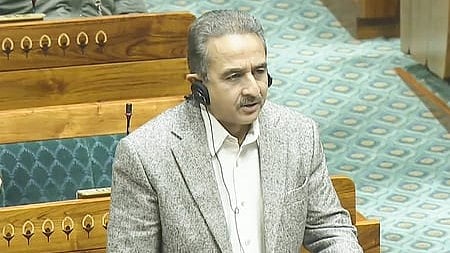
New Delhi: The Ministry of External Affairs (MEA) informed Parliament on Thursday that nearly 9 lakh Indians renounced their citizenship in the past five years, continuing a trend of high numbers of expatriates opting for foreign nationalities.
Responding to a question in the Rajya Sabha, Minister of State for External Affairs Kirti Vardhan Singh said the government maintains year-wise records of individuals who surrender Indian citizenship.
According to official data presented in the written response, citizenship renunciations have risen sharply over the past five years—from 85,256 in 2020, 1,63,370 (in 2021), 2,25,620 (in 2022), 2,16,219 (in 2023) and 2,06,378 (in 2024).
Notably, from 2011 to 2019, 11,89,194 Indians renounced their citizenship.
As per the data, 1,22,819 (in 2011); 1,20,923 (in 2012); 1,31,405 (in 2013); 1,29,328 (in 2014); 1,31,489 (in 2015); 1,41,603 (in 2016); 1,33,049 (in 2017); 1,34,561 (in 2018) and 1,44,017 (in 2019).
Notably, in another response to a question on the number of complaints received from Indians living abroad during 2024–25, the MoS said that the MEA received 16,127 complaints.
The complaints were registered through the government’s online grievance platforms, including MADAD, which accounted for 11,195 cases, and CPGRAMS, which received 4,932 cases.
Saudi Arabia topped the list of countries reporting the highest number of distress cases, with 3,049 complaints, followed by the UAE (1,587), Malaysia (662), the US (620), Oman (613), Kuwait (549), Canada (345), Australia (318), the UK (299) and Qatar (289) amongst others.
The Minister said India has a “robust and multi-channel mechanism” for grievance redressal, using emergency helplines, walk-ins, social media and 24×7 multilingual support. Most cases, he said, are resolved promptly through direct communication, mediation with employers, and coordination with foreign authorities.
Delays in a limited number of cases were attributed to incomplete information, non-cooperation by employers, and restrictions on the role of Indian missions in ongoing court matters.

Singh highlighted that Indian embassies provide legal assistance through empanelled lawyers, supported by the Indian Community Welfare Fund.
He said migrant worker protection remains a priority, with Pravasi Bharatiya Sahayata Kendras and consular camps offering guidance and outreach in key regions.
(Except for the headline, this article has not been edited by FPJ's editorial team and is auto-generated from an agency feed.)
