
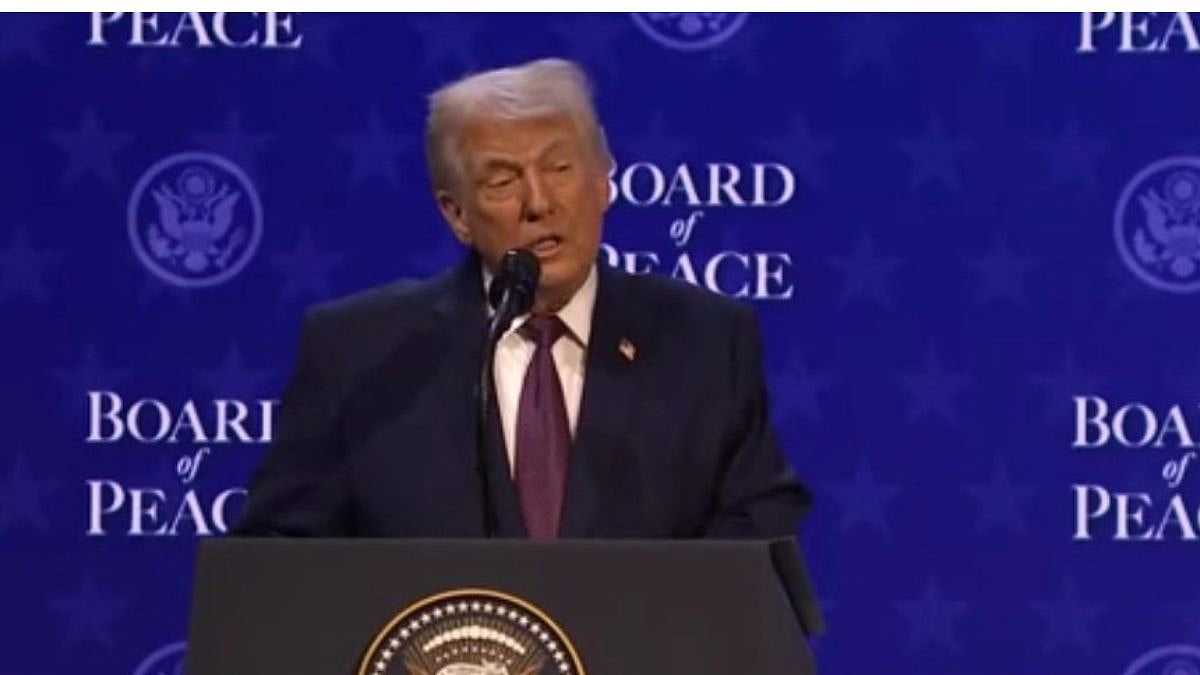
New Delhi: As New Delhi mulls President Trump’s invitation to the Board of Peace (BoP), it has come under criticism among India's strategic community, with one senior diplomat calling it a “significant assault on the international order.”
Designed to create a “New Gaza”, BoP has, according to a White House official, seen 35 confirmations from various nations so far. Member nations will work under US stewardship with Trump serving as the chair, with US Secretary of State Marco Rubio, US envoy Steve Witkoff, and Trump’s son-in-law Jared Kushner serving as executive members. Given their presence, it is unclear what the member nations’ role will be and whether their presence will make a difference to the Gazan people or Palestine.

Former Ambassador & West Asia Expert Talmiz Ahmad's Message
Former Ambassador and West Asia expert Talmiz Ahmad believes that the BoP is something all nations need to worry about. “This is an indicator that the focus of attention for resolving world affairs will shift to Donald Trump and Washington. Trump is saying he will be the chairman of a board that will look at global issues and solve problems in every troubled spot in the world. That means he is claiming the right to intervene everywhere.”
Former Ambassador K.C. Singh's Statement
Former Ambassador K.C. Singh agrees with this assessment and points out that a further complication for India could be the presence of Pakistan at the Davos launch ceremony. “Trump did slip in “working with the UN,” but the absence of four out of five permanent members of the UNSC, most NATO allies, and middle powers like Brazil and India reflected its hollowness. However, Pakistan Prime Minister Shehbaz Sharif was also there next to Trump.”
Pakistan's presence at the launch and at most international events with Trump is proving to be another headache for New Delhi, which is already struggling to tone down a US relationship that has become significantly testy under Trump. Former foreign secretary Kanwal Sibal counsels that India should take a “passive” stance by neither accepting nor rejecting the Trump proposal. “Keep saying the proposal has to be examined in all its aspects,” he counselled on X.
However, others did not agree with this assessment. Ambassador Ahmad argued that this was a time India needed to recall its history of strategic autonomy and stand up to the US. “The US has frequently interfered in our internal affairs and even attempted to change our government whenever possible. Their appeasement of Pakistan is not something new, so this is not a new situation for us. We have coped with this and taken an independent position even when our economic status was very relatively weak compared to what it is now,” he said.

He added. “India must make a clear statement that it will not succumb to outside pressure and that all its foreign policy decisions will be taken in its national interest. It should also make clear that it will not support any plan that does not uphold the aspirations of the Palestinian people. India has a long-standing policy of support to the Palestinian people, and the government - even if it should want to - will not find it easy to support the BoP without facing accusations of a policy shift. Some diplomats suggest that quiet talks with new Ambassador Sergio Gor may be one option, but others dismiss this option given the Trump administration’s “are you with or against us” stance.
Trump’s propensity to leak backchannel talks is another reason for not engaging in such dialogue on this issue. Diplomats feel that however India approaches this situation, it should be aware it cannot appease the US president forever and must start charting out scenarios accordingly. “It is not as if we are without friends; we have built up substantial technological capabilities. We partner with many other countries that welcome our association,” said Ambassador Ahmad.
He added. “Even the European Union is uncomfortable with the BoP. France is not there, Canada is not there. There is an opportunity for an outreach here on this. The road ahead will not be easy, but I believe it is one that India might have to consider soon.”

