
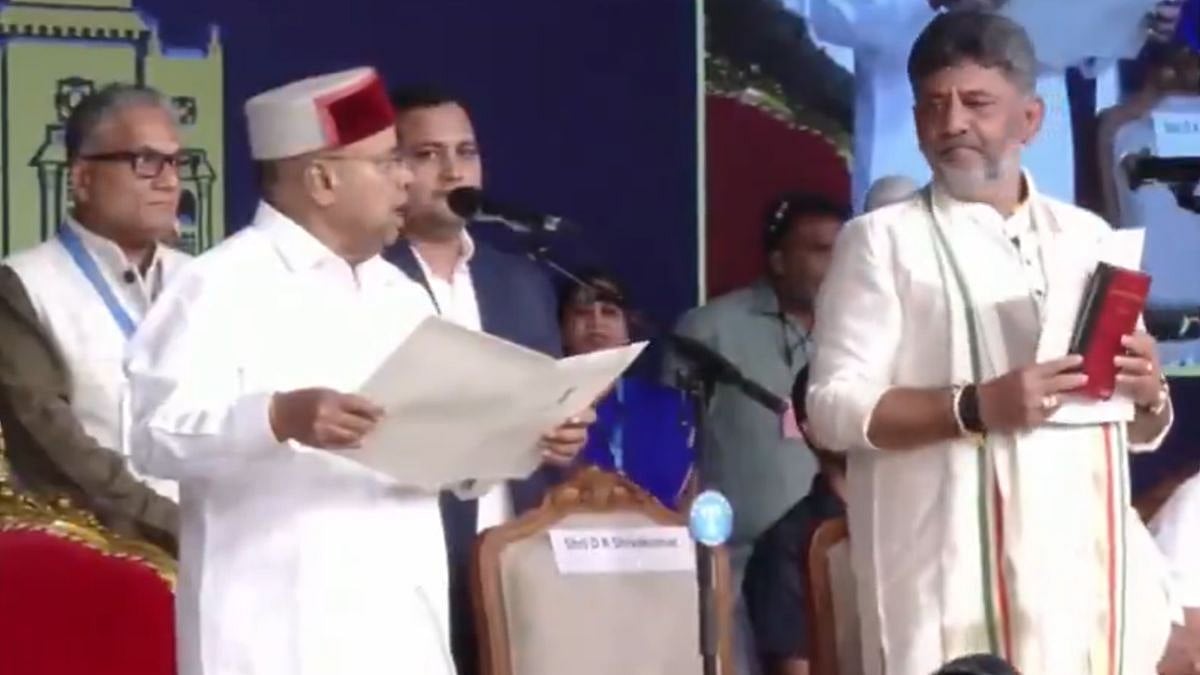
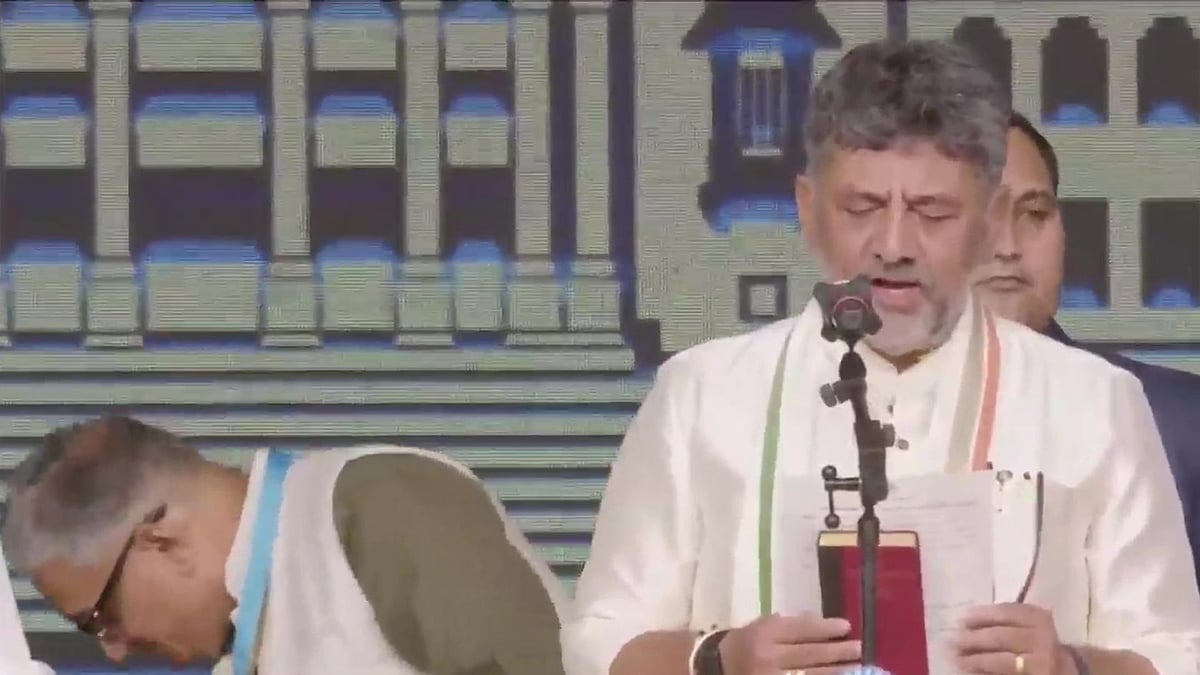
Bengaluru: If one thinks that the Karnataka Chief Minister D K Shivakumar, who took over on Wednesday evening, has fulfilled his life's goal, he has dropped enough hints that it could be the beginning of a new era.
While allowing the media to speculate around power transition and the future of Karnataka Congress through Siddaramaiah camp, DK has silently ensured that the Congress party and administration set up was silently structured to suit his needs.
Congress Working President Sathish Jarkiholi wanted to hold both the posts of KPCC President and Ministerial berth like D K Shivakumar held while he was Deputy Chief Minister. For the last few years, Siddaramaiah camp, which joined Congress after 2008 were calling shots and took all the credit for the work others did too. Sathish Jarkiholi, belonging to Valmiki community, also joined Congress with Siddaramaiah and wanted to take over as KPCC President. However, Shivakumar ensured that B K Hariprasad, who belongs to the Idiga community, which is parallel to Valmiki community was given that responsibility.

Hariprasad and Shivakumar were together in Congress since their student lives, while NSUI was active. While Shivakumar started contesting elections early, Hariprasad started leading the Seva Dal, which was very active in those days.Though Hariprasad could not win direct elections, he developed good contacts in Delhi circle and went to Rajya Sabha and has been Gandhi family loyalist since then.
After taking over as the Chief Minister, in his first cabinet meeting, D K Shivakumar took six decisions. Onset, they all look like populist measures,which would be a further burden on the already strained treasury. But on closer look, the `Bharat Jodo youth organisations' in Panchayat levels are aimed at consolidating youths towards Congress.
This is not a new initiative from D K Shivakumar himself. During S M Krishna regime in Karnataka, the government had launched `Sthree Shakti', a women cooperative movement,which was a huge success. Seeing the success, the then Cooperative Minister D K Shivakumar had launched Yuva Shakti, which did not receive good response. It is a different issue that Sthree Shakti did not translate into votes for Congress during the next elections, but it is still a very popular government initiated program in Karnataka.
The Bharat Jodo Youth Organisation is aimed at having 150-200 members at each Panchayat level and the government will be extending financial assistance of ₹ 10 lakh for each organisation. Throughout the State, there will be 10,000 such organisations and the government will be spending over ₹ 1,000 crore on this project, said to be promoting cultural and sports activities among the youths.
In Karnataka, BJP has a strong network of RSS and Bajarang Dal working at grass root level. However, the BJP leaders are complacent and constantly engaged in faction politics. Besides, every senior leader is promoting their own family and these grass root workers are getting disillusioned. Many of them got killed in communal feuds, but the State BJP leadership has not gone for their help.But still, they work. Despite such a network, BJP has never crossed the halfway mark in the Assembly. It always was forced to poach from other parties to get a simple majority.
Contrarily, Congress has no such organisational structure. NSUI and Seva Dal were the two strong grass root level organisations Congress had till late 70's. In the 80's, Seva Dal started slowing down. Later, when the then Janata Government banned student union elections on campus, the NSUI also died down. Now, Congress depends only on the KPCC youth wing to work at the grassroot level.
The formation of Bharat Jodo organisations will link at least 15 lakh youth with the government, who will be either inclined towards Congress or politically neutral, which is a formidable number. With RSS and Bajarang Dal youths slowly getting detached with BJP, the Congress can make use of this youth group in the grass root level works.
Besides, for the last six months, the government has been talking about re-introducing student union elections on campus. The earlier ban was the result of violence in the University campuses across the state. This had weakened the Congress organisational structure to a large extent. Though re-introducing elections has the risk of campus violences, it will help Congress organisational structuring to a large extent. This is where the Hariprasad experience will come into focus.
At the moment, the BJP-JD(S) combination in Karnataka is solely banking on the failures of the Congress government to bring them to power in 2028. The coalition calculation is simple arithmetics of Lingayat-Vokkaliga combination. For this, the party leaders heavily depend on various mutts and other religious institutions to win elections.Most of the senior BJP leaders are known to be into 'adjustment politics' and are in touch with both Congress and JD(S) to have a weak opponent in the elections in their respective constituencies. Between the coalition partners, the Chief Ministerial post is already becoming a contentious issue now itself.In whole, the organisational workers' morale is low, so the confidence of the party leaders.
Under such circumstances, the moves made by Shivakumar and Hariprasad combinations looks like they have already started working towards 2028 general elections.

