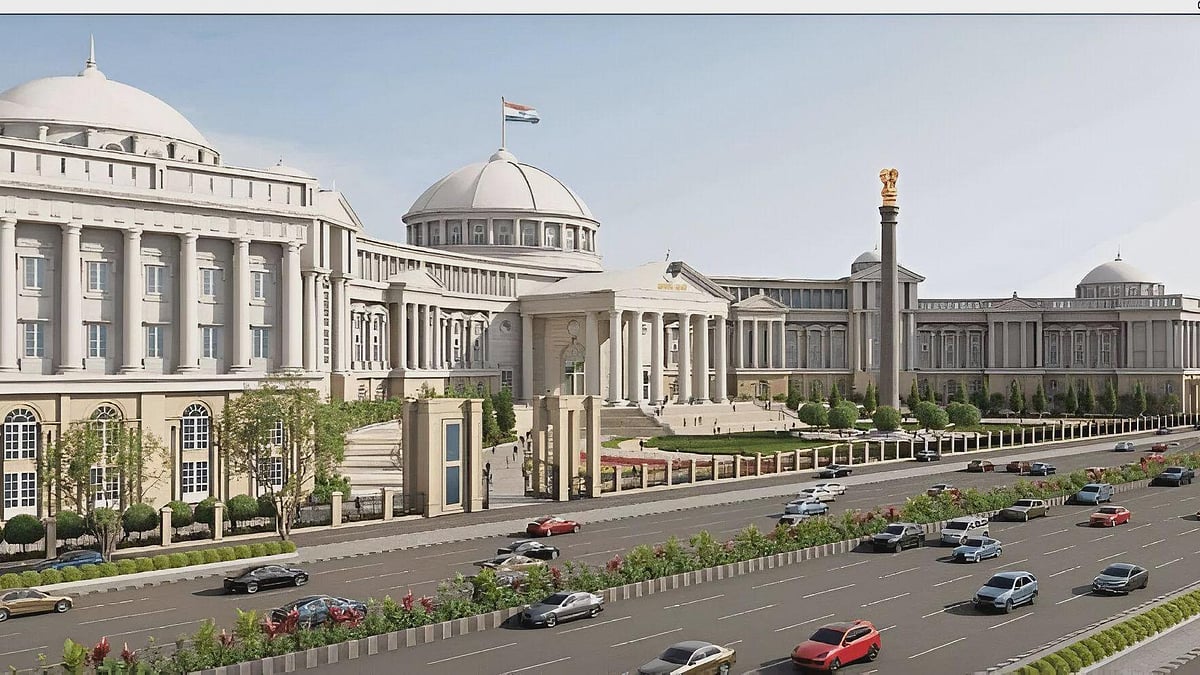
The Bombay High Court is about to get a new address. From its Gothic Revival building in the early English style in South Mumbai to a classical and neoclassical structure in Bandra East, it will not be quite the journey from colonial to post-colonial, from the historical to the modern, as it should have been. The new one, spanning across 30 acres, is expected to cost around Rs 3,750 crore, and the design has already generated controversy or, at least, a debate.
Why should a public building, designed in 2025 and constructed in the New India, carry the imprint of the colonial era? On what basis was this design chosen over the others that were invited? What were the parameters in the judging process? And why were all designs not opened up for public discussions before the decision was made, considering that this will be a significant public building designed and constructed in Mumbai in the post-independence decades?
These, and similar questions, do not have easy answers, perhaps none at all, given how transparent and accessible the work of the honourable judiciary is. But this does not mean that there cannot be public viewing of the designs and discussions. This is, after all, the home of the Bombay HC that we are talking about. In a laudable move, the Mumbai Architects Collective did just that earlier in the week. The public exhibition of the chosen design by Hafeez Contractor, along with the designs submitted by four other architects and planners, was on display across nearly two dozen panels, each design exhibited in great depth and detail and made available in ways that they could be compared and debated.
At the discussion, Justice (retd) Gautam Patel, of the Bombay HC, held nothing back in taking apart Contractor’s design as distinctly unsuitable for the HC and fundamentally undemocratic in its ethos. To summarise, Justice Patel pointed out that the design was not litigant-friendly at all, did not provide spaces for litigant-lawyer meetings, did not invert but blindly followed the old trope of placing judges on a pedestal looking down upon litigants, did not take into account lighting and sound requirements in courtrooms, and was not climate resilient.
In a scathing takedown, he said, “The new building was an opportunity to relook at the vocabulary of the justice delivery mechanism itself, but it’s an opportunity lost. This design, like courts do, makes the litigant into a supplicant ‘praying’ for justice and is reflective of the colonial mindset. This should not be built; we need something more nuanced.”
Architecture professor and poet Mustansir Dalvi, too, critiqued the design in terms of the approach and style. “This is not even classical, but colonial,” he explained. “In the classical style, in Greece and Rome for example, litigants were central to the judicial space, and the levels between the petitioners and judges were the same. These were public places… This design is more like the Government House in Calcutta, built by the East India Company to stamp its authority for political effect.” Prof Dalvi then cited the Chandigarh HC building, designed by world-renowned architect and Chandigarh planner Le Corbusier, in the immediate post-independence decade as an example.
A section of public responses to the design on social media varied. Some called it an impressive one, befitting the stature of the highest judiciary in the state and so on. Stateliness and grandeur are not limited to colonial styles. Indeed, laypeople with minimal or no knowledge of architecture are not best equipped to evaluate architectural designs and perhaps respond from their impressions or beliefs of what a high court ought to be without questioning how it reflects democracy, accessibility, and today’s imperatives.
This, unfortunately, seems to have been the case with the decision-makers too in the Bombay HC. Did they have design and architectural inputs, if not the domain expertise, to evaluate the designs they sought? Or was the colonial hangover—reflected even in the language used in the courts to this day—so heavy that the decision-makers were not able to imagine, or reimagine, the 21st-century high court? These were the questions, as I took in the panels, some of them by friends and others I have worked with.
It is also significant that the new high court building—an important public structure in the city—could be imagined, planned, designed, and approved with no public involvement or discussion around it, without placing it in the context of the neoliberal glass-fronted high-rises of the Bandra Kurla Complex, and without a process of consultations and ideation that went beyond the chosen architectural firms. Some attendees at the exhibition-discussion questioned this, but it’s a fact that closed competitions in specialised domains, by themselves, are not flawed.

Even if this was not an open competition, the chosen designs should have been opened to the people of Mumbai for discussions and suggestions. International cities like London, for example, have a due process for planning and constructing new public buildings—the design must be submitted to the Local Planning Authority, which, in consultation with the Mayor’s London Plan, decides based on the vision, land use framework and design principles for the area. Other cities have their own design principles and approval processes.

In the case of the Bombay HC new building, the process appears to have been helmed by the Maharashtra Public Works Department; no one is sure what design principles were followed or consultations with architects done before it put out a generic brief that asked for “creativity”. In any case, a qualified jury and a set of well-deliberated parameters should have been a part of the process from the scratch. The debate that has been sparked now should have been generated before the decision was made in favour of one design.
Public buildings matter—greatly so. If there’s scope to revisit the chosen design, review it in terms of functionality and style; the honourable court must do so. As Jan Gehl, a reputed Danish architect and writer, has said, “We shape cities, then cities shape us.”
Smruti Koppikar, an award-winning senior journalist and urban chronicler, writes extensively on cities, development, gender, and the media. She is the Founder Editor of the award-winning online journal ‘Question of Cities’ and can be reached at smruti@questionofcities.org

